
Cactus & Succulent, Family & Kids' Gardening, Flower Seeds, Herb Seeds, Sensory & Wellness Gardening, Sustainable & Regenerative Living, The Horticulturist’s Lab, Urban & Small-Space Gardening, Vegetables
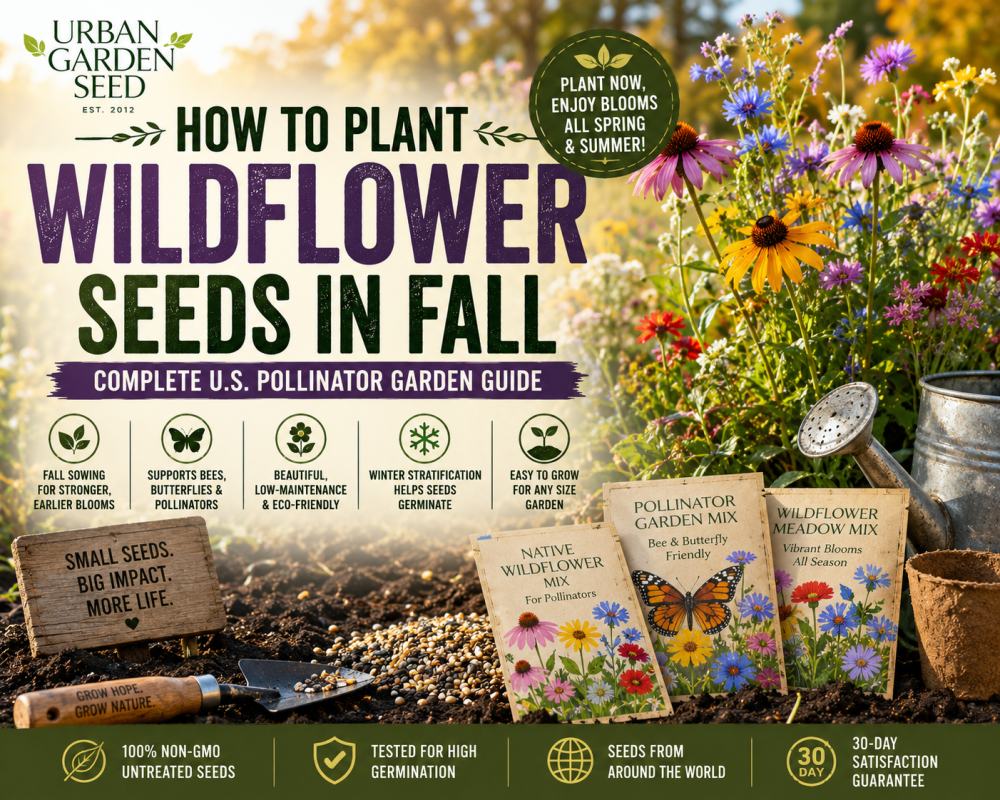
How to Plant Wildflower Seeds in Fall: A Complete U.S. Pollinator Garden Guide
Jul
A colorful spring wildflower garden often begins months before the first flowers appear.
For many gardeners across the United States, fall can be an excellent time to sow selected annual and perennial wildflower seeds. Cooler weather, seasonal moisture, and natural winter conditions may help suitable species establish or prepare for spring germination.
However, successful fall planting requires more than scattering an unidentified seed mixture over an existing lawn.
You need to choose flowers suited to your region, prepare the planting area, create good seed-to-soil contact, and sow at the correct time for your local climate.
This guide explains how to plant wildflower seeds in fall for:
- Backyard flower gardens
- Pollinator gardens
- Small wildflower meadows
- Farms and larger properties
- Raised beds
- Patio containers
- Small urban gardens
Can You Plant Wildflower Seeds in Fall?
Yes, many wildflower species can be planted in fall.
Some perennial flower seeds benefit from exposure to naturally cold and moist winter conditions. Other species may germinate during mild fall weather and begin developing before winter.
The correct planting method depends on:
- Your state and region
- The individual flower species
- Local fall and winter temperatures
- Rainfall and soil moisture
- Whether you are early-fall sowing or dormant sowing
Not every wildflower should be planted at the same time.
Always review the growing requirements of each variety before sowing.
Why Plant Wildflower Seeds in Fall?
Natural winter conditioning
Certain perennial seeds have dormancy mechanisms that prevent immediate germination.
Exposure to winter moisture and temperature changes may naturally prepare these seeds for spring growth. This process is commonly called cold, moist stratification.
Not every flower requires stratification, so check the requirements of the species you are planting.
Earlier spring germination
Seeds planted successfully in fall are already positioned in the soil when spring conditions become favorable.
Suitable species may begin germinating earlier than seeds planted later in spring.
Seasonal moisture
Fall, winter, and early-spring precipitation may help settle seeds and keep the planting area moist.
Additional watering may still be necessary in dry climates, during unusually dry weather, or when planting in containers.
Less spring work
Spring is already a busy gardening season.
Planting wildflowers in fall allows gardeners to prepare one important project before vegetable planting, transplanting, and routine spring maintenance begin.
Pollinator habitat
A diverse flower garden can provide pollen and nectar for bees, butterflies, moths, beetles, hummingbirds, and other wildlife.
For the greatest ecological value, select regionally appropriate flowers with overlapping bloom periods.
Wildflower Seeds Versus Native Flower Seeds
“Wildflower” and “native flower” do not mean exactly the same thing.
A wildflower is generally a flowering plant that grows without intensive cultivation. It may be native or introduced.
A native flower developed within a particular geographic region and ecosystem.
This distinction matters.
A flower native to California may not be native to Pennsylvania. A species suited to Florida may struggle in Minnesota. Some plants sold in general wildflower mixtures may even be invasive in certain states.
Before buying a seed mix, check:
- The common and scientific names
- Whether the species are appropriate for your region
- State invasive-plant restrictions
- Sunlight requirements
- Soil and drainage needs
- Mature height and spread
- Annual or perennial classification
- Expected blooming season
Avoid unidentified mixtures that list only general terms such as “colorful wildflowers.”
Choose products that clearly identify what you are planting.
When Should You Plant Wildflower Seeds in Fall?
There are two primary fall-sowing methods.
Early-fall sowing
Early-fall sowing takes place while the soil is still warm enough for selected seeds to germinate.
This method may work well for certain annuals and flowers grown in mild-winter regions.
The risk is planting too late for seedlings to establish before freezing weather arrives.
Dormant sowing
Dormant sowing takes place after the growing season has ended and the soil has become too cold for immediate germination.
Seeds remain in place through winter and begin germinating when spring conditions become suitable.
This method is commonly used in colder regions.
The objective is to plant late enough that seeds will not sprout immediately but before frozen ground or deep snow makes planting difficult.
Fall Wildflower Planting by U.S. Region
Northern states
In cold-winter regions, wildflower seeds are often dormant-sown after the growing season has ended.
This may occur from mid-October through late fall, depending on the location and weather.
Gardeners should wait until conditions are cold enough to prevent immediate germination.
Suitable areas may include:
- New England
- The Upper Midwest
- Northern Great Plains
- Northern Rocky Mountain regions
Check your state Cooperative Extension service for local timing.
Mid-Atlantic states
Gardeners in transition climates need to balance two risks:
- Planting so early that seedlings emerge before winter
- Planting after the soil becomes frozen or inaccessible
Late-fall dormant sowing may be appropriate for selected species, but exact timing varies by elevation and location.
Southern states
Fall can be an important flower-planting season in areas with hot summers and mild winters.
In much of Texas, for example, many wildflower seeds are planted from September through November.
However, the South contains many distinct climates. Northern Georgia, central Texas, coastal Florida, and the Appalachian Mountains do not share one planting calendar.
Southwest
Rainfall, elevation, soil, and extreme summer heat strongly influence planting dates in the Southwest.
Choose species suited to your local desert, high-desert, mountain, or grassland environment.
A flower described as drought tolerant is not automatically suitable for every dry region.
California
In many parts of California with Mediterranean-style rainfall, annual native wildflowers are planted after autumn weather begins changing and before or during the rainy season.
Mid-October through November may be suitable in some regions.
California has many ecological zones, so use recommendations appropriate for your county.
Pacific Northwest
Fall sowing can work well in many Pacific Northwest gardens.
Consider:
- Coastal versus inland climate
- Winter rainfall
- Soil drainage
- Elevation
- Local native species
Avoid planting moisture-sensitive species in soil that remains waterlogged throughout winter.
How to Plant Wildflower Seeds in Fall
Step 1: Decide what kind of garden you want
Your seed selection should reflect the purpose of the planting.
Possible garden types include:
- Native pollinator garden
- Butterfly garden
- Annual flower patch
- Perennial meadow
- Cottage-style border
- Low-growing flower garden
- Container wildflower display
A small flower border and a one-acre meadow require different species, quantities, and maintenance plans.
Step 2: Choose region-appropriate seeds
Match each flower to:
- Your state or region
- Available sunlight
- Soil type
- Moisture level
- Mature plant size
- Desired bloom period
- Available growing space
For pollinator gardens, select several species rather than relying on one type of flower.
Include plants that bloom at different times so food is available across more of the growing season.
Step 3: Select the planting site
Most meadow-style wildflowers grow best in a sunny location, but individual requirements vary.
Observe the site and ask:
- How many hours of direct sunlight does it receive?
- Does water remain after heavy rain?
- Is the soil sandy, loamy, or heavy?
- Are aggressive weeds present?
- Will tall flowers interfere with pathways or windows?
- Can you access the area for maintenance?
Correct site selection is more effective than trying to force unsuitable flowers into poor conditions.
Step 4: Remove existing grass and weeds
Wildflower seeds generally perform poorly when scattered over established lawn grass.
Turf already occupies the soil and competes for:
- Water
- Light
- Nutrients
- Root space
Remove or suppress existing vegetation before sowing.
Possible preparation methods include:
- Hand removal
- Shallow cultivation
- Smothering
- Solarization during warm weather
- Repeated weed removal before planting
Avoid repeatedly tilling deeply because this can bring additional dormant weed seeds to the surface.
Step 5: Prepare a firm seedbed
The goal is a relatively clean and firm soil surface.
Remove:
- Large stones
- Thick plant debris
- Large soil clods
- Remaining weeds
Rake the surface lightly.
The soil should not be extremely loose or deeply cultivated. Small flower seeds need reliable contact with the soil surface.
Step 6: Measure the planting area
Calculate the square footage before ordering seeds.
For a rectangular area:
Length × width = total square feet
Use the product’s recommended seeding rate.
Applying excessive seed can lead to:
- Overcrowding
- Weak plants
- Poor airflow
- Greater competition
- Reduced flowering
More seed does not automatically create a better garden.
Step 7: Divide the seed into two portions
Tiny flower seeds can be difficult to spread evenly.
Divide the seed into two equal portions.
Broadcast the first portion while walking in one direction. Spread the second portion while walking at a right angle to the first pass.
This cross-pattern method helps reduce bare areas and dense clumps.
Step 8: Mix tiny seeds with a carrier
For larger areas, combine the seeds with a clean, dry carrier such as sand.
This makes the mixture easier to distribute and helps you see where it has already been applied.
Make sure the carrier does not contain weed seeds.
Step 9: Press the seeds onto the soil
After broadcasting, press the seeds firmly against the soil surface.
For a small garden, you can use:
- A flat board
- Gentle foot pressure
- The back of a rake
For a larger planting, use an appropriate lightweight roller.
Do not deeply bury a general wildflower mixture. Many small flower seeds need to remain close to the surface.
Follow individual instructions when planting a single species.
Step 10: Water appropriately
Water requirements depend on the planting method and climate.
Dormant-sown seeds in cold regions may rely largely on winter and spring precipitation.
Early-fall plantings, dry regions, and containers may require gentle watering.
Avoid strong water pressure that can wash seeds into piles or move them away from the prepared area.
Step 11: Mark and protect the site
Use a marker, border, or temporary sign to identify the planting area.
This prevents people from:
- Mowing the site
- Walking over it repeatedly
- Applying weed-control products
- Digging into it
- Mistaking new seedlings for weeds
Keep a written list of the varieties you planted.
Flowers to Consider for Fall Sowing
The suitability of every species depends on region and variety.
Coneflowers
Coneflowers can add long-lasting summer color and provide food for pollinators.
Purple coneflower is native to parts of the central and eastern United States, but gardeners should still confirm regional suitability.
Black-eyed Susans
Black-eyed Susans are widely recognized in meadow and pollinator gardens.
Check the particular species, because several flowers are sold under similar common names.
Blanket flowers
Blanket flowers can perform well in sunny, well-drained landscapes and are often used in lower-water gardens.
Columbines
Columbines can work well in partially shaded gardens and woodland-edge plantings.
Select a species appropriate for your region.
Lupines
Some lupine species benefit from natural winter conditions or specific germination treatments.
Do not treat all lupines as interchangeable. Regional compatibility is important.
Poppies
Certain poppies respond well to cool-season surface sowing.
Many have small seeds that should not be deeply buried.
Check the exact species and local regulations before planting.
Milkweed
Milkweed is the host plant required by monarch caterpillars.
Choose a milkweed species native to your region rather than assuming one variety is appropriate nationwide.
Annual wildflowers
Annual flowers may provide relatively fast first-season color.
Depending on climate and variety, possible choices include:
- Calendula
- Cornflower
- Larkspur
- Sweet alyssum
- Selected poppies
- Regionally suitable annual mixtures
Perennial wildflowers
Perennials may take longer to establish.
During the first year, some perennial plants focus primarily on root and leaf development. Flowering may become stronger during the second or third season.
Combining compatible annuals and perennials can provide early color while the longer-lived plants establish.
How to Plan a Pollinator Garden
A useful pollinator garden should contain more than one type of flower.
Aim for diversity in:
- Blooming season
- Flower shape
- Plant height
- Flower color
- Nectar production
- Pollen availability
Include early-season flowers
Early flowers support pollinators emerging after winter.
Include summer flowers
Summer-blooming flowers provide food during the most active part of the growing season.
Include late-season flowers
Late flowers can support migrating and overwintering pollinators as the growing season ends.
Choose regionally appropriate species that collectively provide flowers from spring through fall.
Can You Plant Wildflowers in a Small Yard?
Yes.
A pollinator garden does not need to cover a large meadow.
Wildflowers can grow in:
- A narrow side-yard border
- A mailbox garden
- A raised bed
- A sunny backyard corner
- A strip along a fence
- A community garden plot
- Large patio containers
A defined border helps a naturalistic planting look deliberate.
Suitable borders include:
- Stone edging
- Timber edging
- A mowed strip
- A visible pathway
- A low garden fence
Can Wildflowers Grow in Containers?
Selected wildflowers can grow successfully in containers.
Containers are useful for:
- Apartment balconies
- Patios
- Rental properties
- Rooftop gardens
- Small urban spaces
Choose compact varieties and provide:
- Adequate drainage
- Suitable container depth
- Appropriate sunlight
- Regular moisture checks
- Protection from extreme wind
Containers generally dry faster than in-ground soil.
In freezing climates, choose weather-resistant containers or protect pots that could crack during winter.
Common Wildflower Planting Mistakes
Scattering seed over healthy grass
Established turf can prevent flower seedlings from becoming established.
Planting seeds too deeply
Many wildflower seeds need to remain close to the soil surface.
Ignoring regional suitability
A seed mixture appropriate for one part of the country may be inappropriate somewhere else.
Failing to control weeds
Aggressive weeds can overwhelm young flower seedlings.
Applying too much seed
Overcrowding can weaken plants and reduce flowering.
Expecting an instant meadow
Perennial wildflower gardens often develop over multiple growing seasons.
Adding excessive fertilizer
Rich fertilizer may encourage weeds and leafy growth instead of balanced flowering.
Mowing new seedlings
Clearly mark the planting area and identify seedlings before mowing or weeding.
Buying unidentified mixtures
Know which species you are introducing into your property.
Assuming the garden needs no maintenance
New plantings require observation, weed control, and occasional watering during establishment.
What to Expect After Fall Planting
Winter
The planting area may appear inactive.
Do not disturb it simply because no plants are visible.
Early spring
Seeds and weeds may begin germinating.
Learn to identify the flowers you planted before removing unfamiliar seedlings.
First summer
Annuals may bloom during the first season.
Some perennials may remain small while developing stronger root systems.
Later seasons
Established perennials may become more prominent.
The garden may change over time as plants mature, reseed, or respond to weather.
A wildflower garden is a developing plant community rather than a fixed display.
Fall Wildflower Planting Checklist
Before sowing, make sure you have:
- Measured the planting area
- Identified every species
- Confirmed regional suitability
- Checked local invasive-plant restrictions
- Selected the correct planting window
- Removed grass and weeds
- Prepared a firm seedbed
- Calculated the seeding rate
- Planned for good soil contact
- Marked the planting area
- Prepared for spring weed control
Why Choose Urban Garden Seed?
Urban Garden Seed offers flower, vegetable, herb, tree, and specialty seeds for gardeners working with everything from large properties to small urban spaces.
Our focus is your success.
We offer:
- Non-GMO seeds
- Untreated seeds
- Seeds tested for high germination
- Varieties sourced from around the world
- Options for farms, homes, raised beds, patios, and containers
- A 30-Day Satisfaction Guarantee
When selecting flowers for a fall-sown garden, always confirm that the species are suitable for your climate, planting space, and goals.
Start Planning Your Spring Flowers This Fall
A beautiful spring and summer flower garden may begin on a cool fall day.
Start with:
- Carefully selected seeds
- A properly prepared site
- Correct regional timing
- Good soil-to-seed contact
- Patience through winter
Choose flowers responsibly.
Plant them correctly.
Allow the seasons to work.
Ready to Start Growing?
Explore flower seeds at UrbanGardenSeed.com and begin planning a pollinator garden, flower border, meadow, farm planting, patio display, or small urban garden.
Plant thoughtfully this fall and welcome color, bees, and butterflies during the next growing season.
Frequently Asked Questions
What month should I plant wildflower seeds?
The best month depends on your region and species. In colder climates, dormant sowing may take place from late fall until the ground freezes. In mild climates, planting may begin earlier.
Is October too late to plant wildflower seeds?
Not necessarily. October is an appropriate planting month in many regions. In colder areas, it may still be too early for dormant sowing.
Can I scatter wildflower seeds over grass?
This usually produces poor results because established grass competes with emerging seedlings. Prepare an open seedbed first.
Should I cover wildflower seeds with soil?
Many small flower seeds should not be deeply covered. Press them onto prepared soil and follow the directions for the individual species.
Do all wildflower seeds need freezing temperatures?
No. Some perennial species benefit from cold and moist winter conditions, while others do not require them.
Should I water seeds planted in fall?
It depends on climate, rainfall, planting time, soil, and species. Dry regions, early-fall plantings, and containers may require gentle watering.
Will wildflowers bloom during the first year?
Annuals may bloom during the first growing season. Some perennials may require additional time to establish before flowering strongly.
Are all wildflowers native plants?
No. A wildflower may be native or introduced. Review the species list and choose plants appropriate for your region.
What flowers are best for bees and butterflies?
Choose a diverse collection of regionally appropriate plants that bloom at different times from spring through fall.
Can I grow wildflowers in containers?
Yes. Select compact species and containers with adequate drainage and sufficient root space.
Where can I buy seeds for a pollinator garden?
Visit UrbanGardenSeed.com to explore flower seeds for pollinator gardens, flower beds, containers, farms, and small urban spaces.
