
Adenium, Backyard Gardening, Cactus & Succulent, Family & Kids' Gardening, Flower Seeds, Garden Planning & Design, Herb Seeds, Homesteading & Self-Reliance, Sensory & Wellness Gardening, Sustainable & Regenerative Living, The Horticulturist’s Lab, Urban & Small-Space Gardening, Vegetables
How to Start a Cottage Garden From Seed: 15 Best Flowers for a Beautiful Backyard
Aug
Perfectly straight rows are not required.
Matching plants are not required.
A massive property is not required.
A cottage garden succeeds because it feels abundant.
Flowers spill toward pathways.
Herbs grow between ornamentals.
Tall blooms rise behind shorter plants.
Vines climb fences and trellises.
Bees and butterflies move between flowers.
And every few weeks, something different begins to bloom.
The cottage-garden style combines beauty with a relaxed, layered planting approach—and one of the most affordable ways to create it is from seed.
Instead of purchasing dozens or hundreds of mature plants, you can begin with packets of flower, herb, and edible seeds and gradually turn an ordinary piece of land into a colorful garden that becomes richer each season.
This guide explains how to start a cottage garden from seed, which flowers to grow, how to arrange them, and how to create a garden that looks abundant without becoming chaotic.
What Is a Cottage Garden?
A cottage garden is an informal planting style built around abundant flowers and layered vegetation.
Unlike highly formal landscapes with precisely clipped hedges and large areas of open mulch, cottage gardens typically use plants generously.
They may contain:
- Annual flowers
- Perennial flowers
- Herbs
- Vegetables
- Flowering shrubs
- Climbing vines
- Bulbs
- Fruit plants
- Pollinator flowers
The result should feel relaxed and natural while still being intentional.
That last part is important.
A cottage garden is not simply an abandoned yard.
There is still structure beneath the abundance.
Paths guide movement.
Plant heights are considered.
Colors repeat.
Edges define the planting.
Tall plants are positioned where they will not overwhelm shorter ones.
The garden looks informal because it has been designed to look informal.
Why Start a Cottage Garden From Seed?
Buying mature plants provides immediate impact.
Starting from seed gives you something different:
scale.
A few seed packets can produce enough plants to fill substantial sections of a garden.
Starting from seed also gives you access to:
- More flower colors
- More unusual varieties
- Tall and dwarf selections
- Heirloom flowers
- Pollinator plants
- Flowers rarely sold as transplants
- Plants for succession sowing
- Large quantities for mass planting
For a garden style based on abundance, that matters.
Instead of purchasing one zinnia plant, you can grow an entire drift.
Instead of adding one cosmos to a border, you can create a cloud of flowers.
Seed makes the cottage-garden look much easier to achieve economically.
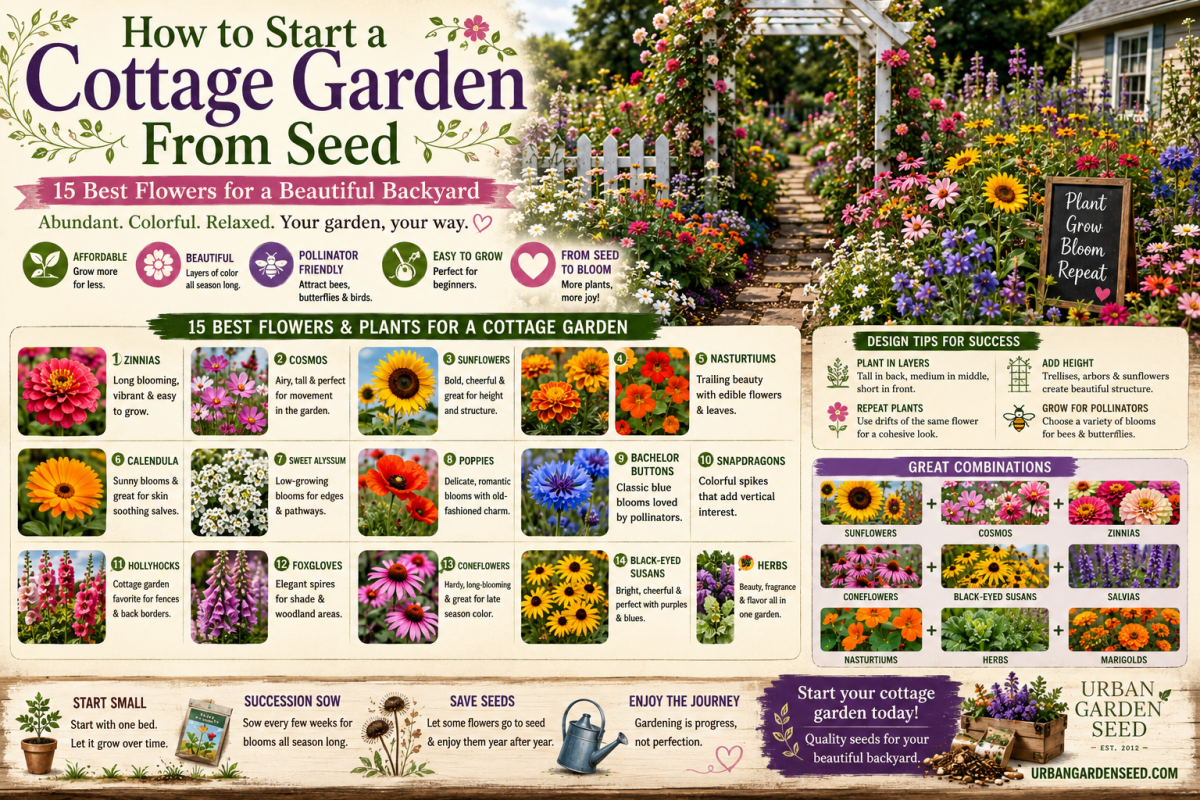
15 Best Flowers and Plants for a Cottage Garden
You do not need all 15.
Choose plants suited to your climate, available sunlight, soil, and garden size.
Then combine different heights, textures, colors, and bloom periods.
1. Zinnias
If you want a cottage garden filled with summer color, zinnias are an excellent place to begin.
They are available in:
- Pink
- Red
- Orange
- Yellow
- Purple
- White
- Green
- Multicolor combinations
Flower shapes also vary widely.
Some resemble dahlias.
Others are compact and rounded.
Tall varieties can create excellent middle and back-of-border color.
Why zinnias work
They provide bold color over a long summer period and can be grown in large groups for an abundant look.
Many branching varieties also respond well to regular flower harvesting.
Planting idea
Grow several colors together rather than planting every color separately.
A loose mixture creates the overflowing appearance associated with cottage gardens.
2. Cosmos
Cosmos bring softness and movement.
Their thin stems and airy foliage contrast beautifully with heavier plants such as zinnias and sunflowers.
They are particularly effective when allowed to weave naturally through other flowers.
Common colors include:
- White
- Pink
- Rose
- Burgundy
- Yellow
- Orange
Why cosmos belong in cottage gardens
They create height without appearing visually heavy.
A breeze moving through cosmos gives the entire border more life.
Planting tip
Avoid placing tall cosmos directly in front of small plants.
Use them toward the middle or rear of the bed.
3. Sunflowers
Sunflowers create instant vertical structure.
They work especially well against:
- Fences
- Barns
- Garden sheds
- Walls
- Trellises
- Rear garden boundaries
But not every sunflower becomes enormous.
Different varieties produce different heights, branching habits, flower colors and flower sizes.
Cottage-garden use
Use sunflowers as repeating vertical accents instead of placing all of them in one isolated row.
A few tall sunflowers appearing through other flowers can make the garden look more natural.
4. Marigolds
Marigolds add strong warm colors.
Their yellows, oranges, reds and golds combine particularly well with:
- Purple flowers
- Blue flowers
- White flowers
- Dark foliage
Different marigold types vary dramatically in height.
Compact French marigolds work well near edges.
Taller types can occupy the middle of a mixed border.
Additional advantage
Marigolds fit naturally beside vegetable plants, making them useful when you want your cottage garden to include edible crops.
5. Nasturtiums
Nasturtiums embody the cottage-garden spirit.
They can trail over:
- Bed edges
- Containers
- Walls
- Raised beds
Their rounded leaves provide a completely different texture from the narrow leaves and upright stems of many flowers.
Colors commonly include:
- Orange
- Yellow
- Red
- Cream
- Peach
Suitable nasturtium flowers and leaves are also edible.
Always positively identify edible plants before consuming them.
6. Calendula
Calendula offers warm yellow and orange flowers with an old-fashioned garden character.
It works particularly well in mixed edible-and-ornamental gardens.
Use calendula near:
- Herbs
- Lettuce
- Paths
- Raised-bed edges
- Other cool-season flowers
Its relatively simple flower shape provides visual contrast against highly doubled flowers.
7. Sweet Alyssum
A cottage garden needs plants near the ground as much as it needs tall flowers.
Sweet alyssum can create a low flowering edge around larger plants.
It works beautifully:
- Beside paths
- Around container edges
- Near raised beds
- Between taller flowers
Its small flowers soften hard lines and help the planting feel established rather than rigid.
8. Poppies
Poppies bring one of the most recognizable old-fashioned flower forms to the garden.
Different species and varieties have different climates, planting seasons, and legal considerations, so always identify the exact plant before purchasing.
Many poppies prefer direct sowing because they dislike substantial root disturbance.
Their fine texture works especially well among:
- Grasses
- Cosmos
- Bachelor buttons
- Other informal flowers
9. Bachelor Buttons
Bachelor buttons, also called cornflowers, bring classic blue tones into a cottage-style planting.
Blue is especially useful because it contrasts beautifully with:
- Yellow calendula
- Orange marigolds
- Pink cosmos
- Red poppies
They can also appear in white, pink and other shades depending on the variety.
Plant them in groups rather than isolated single plants.
10. Snapdragons
Snapdragons introduce vertical flower spikes.
This gives the garden a completely different flower shape from:
- Round zinnias
- Daisy-like cosmos
- Flat sunflower heads
That diversity of shapes is one reason mixed cottage borders feel visually rich.
Snapdragons can also extend the flowering season in climates where they perform well during cooler weather.
Use them in repeated groups through the border.
11. Hollyhocks
Few flowers communicate classic cottage style as strongly as hollyhocks.
Tall flower spikes can rise dramatically along:
- Fences
- Walls
- Outbuildings
- Rear garden borders
Because of their height, placement is important.
Do not put a tall hollyhock directly in front of short flowers.
Think of them as part of the garden’s architecture.
Some hollyhocks behave as biennials or short-lived perennials depending on variety and growing conditions, so understand their life cycle before planting.
12. Foxgloves
Foxgloves create elegant vertical spikes and a woodland-cottage appearance.
They are especially attractive toward the back of partially shaded or mixed borders where the species is suited to local conditions.
Important safety note
Foxglove is toxic if ingested.
Do not plant it where children, pets or livestock are likely to consume plant material.
A beautiful garden still needs to be designed around household safety.
13. Coneflowers
Coneflowers bring a more naturalistic prairie character into a cottage garden.
They combine well with:
- Black-eyed Susans
- Grasses
- Herbs
- Cosmos
- Native-style plantings
They can also contribute valuable late-season structure if dried seed heads are left standing.
Check whether the particular coneflower species is appropriate for your climate and garden objectives.
14. Black-Eyed Susans
Black-eyed Susans provide bright yellow flowers with dark centers.
They combine exceptionally well with:
- Purple coneflowers
- Blue flowers
- Ornamental grasses
- White cosmos
- Red or orange accents
Repeated groups can help tie a large mixed border together visually.
15. Herbs
A true cottage-style garden does not need to separate useful plants from beautiful plants.
Herbs can be part of the design.
Consider:
- Basil
- Parsley
- Chives
- Dill
- Thyme
- Oregano
- Sage
Many herbs have attractive flowers, foliage or texture.
Place frequently harvested culinary herbs close to pathways so you can reach them easily.
A cottage garden should be experienced—not simply viewed from a window.
Add Vegetables to Your Cottage Garden
Flowers and food can share the same garden.
Instead of hiding all vegetables in a separate plot, integrate attractive edible crops into suitable sunny spaces.
Possible additions include:
- Swiss chard
- Kale
- Lettuce
- Peppers
- Tomatoes
- Beans
- Artichokes
- Herbs
Swiss chard is especially attractive because its colorful stems can function almost like ornamental foliage.
Purple kale can create strong texture.
Peppers add glossy green foliage and colorful fruit.
A bean-covered trellis can become part of the garden architecture.
This approach is sometimes called foodscaping or edible landscaping.
The objective is to make productive plants part of the visual design.
The Secret to Cottage Garden Design: Layers
A great cottage garden should not look like a flat row of flowers.
Think vertically.
Tall layer
Use plants such as:
- Sunflowers
- Hollyhocks
- Tall cosmos
- Tall snapdragons
- Climbing vines
Place these near rear boundaries or structural elements.
Middle layer
Use:
- Zinnias
- Coneflowers
- Black-eyed Susans
- Medium cosmos
- Herbs
- Taller marigolds
These plants create the main body of the garden.
Front layer
Use:
- Sweet alyssum
- Compact marigolds
- Nasturtiums
- Low herbs
- Compact flowers
These soften the edges.
The different heights produce the overflowing effect without forcing plants to compete unnecessarily.
Use Paths to Control the Abundance
When every square foot contains plants, access becomes important.
Create paths before planting.
Suitable path materials include:
- Gravel
- Brick
- Stone
- Wood chips
- Stepping stones
Curving paths can reinforce the informal cottage style.
But pathways are practical as well as decorative.
You need access for:
- Weeding
- Watering
- Flower cutting
- Seed collecting
- Harvesting herbs
- Plant inspection
Do not create a beautiful garden you cannot enter.
Use Repetition to Keep the Garden From Looking Chaotic
This is one of the most important design techniques.
A cottage garden contains many plants.
But repeating certain flowers gives the eye something familiar to follow.
For example:
Plant purple coneflowers in three areas.
Repeat white alyssum along several edges.
Use yellow marigolds at intervals.
Allow pink cosmos to appear in multiple sections.
The garden remains informal, but repeated colors and plants tie everything together.
Choose a Color Palette
You can grow every color imaginable.
But some gardeners prefer a more controlled cottage-garden palette.
Romantic pastel garden
Use:
- Pink
- Lavender
- White
- Soft blue
- Pale yellow
Bold cottage garden
Use:
- Red
- Orange
- Yellow
- Purple
- Deep pink
White and green garden
Use white flowers against layers of green foliage.
Pollinator-inspired palette
Mix yellow, purple, blue, pink and white flowers from suitable pollinator-friendly species.
There is no correct palette.
Choose colors that make you want to spend time in the garden.
Add Vertical Structures
Cottage gardens become more interesting when plants climb.
Consider adding:
- Arbors
- Trellises
- Fences
- Pergolas
- Obelisks
Depending on your climate and available space, these can support:
- Sweet peas
- Beans
- Morning glories where appropriate
- Nasturtiums
- Other suitable climbing flowers and edibles
Vertical growing also makes better use of limited ground space.
Create an Entrance
One of the easiest ways to make a cottage garden feel special is to create a visible entrance.
It can be simple:
- A small arbor
- A wooden gate
- A path between flower beds
- Two containers marking the entry
The entrance changes the garden from a collection of plants into a place.
Add a Place to Sit
Do not design the entire garden around maintenance.
Give yourself somewhere to enjoy it.
Add:
- A bench
- Two chairs
- A small table
- A shaded seating area
Place seating where you can observe:
- Flowers
- Bees
- Butterflies
- Birds
- Seasonal changes
A garden should reward the gardener too.
How to Prepare the Soil
Before sowing large quantities of flower seed, understand the site.
Check:
- Drainage
- Sunlight
- Existing weeds
- Soil structure
Remove aggressive perennial weeds before planting.
A soil test may be valuable for larger permanent beds.
Avoid assuming every flower needs extremely rich soil.
Some plants produce excessive foliage and fewer flowers when heavily fertilized.
Match fertility to the plants you are growing.
Direct Sowing vs. Starting Indoors
Both methods belong in a cottage garden.
Excellent candidates for direct sowing may include:
- Sunflowers
- Cosmos
- Zinnias in warm soil
- Nasturtiums
- Bachelor buttons
- Poppies
- Calendula
Plants that may benefit from indoor starting include:
- Snapdragons
- Certain perennial flowers
- Some herbs
- Flowers with long growing seasons
Always follow variety-specific instructions.
A seed’s requirements matter more than the garden style.
When Should You Plant Cottage Garden Seeds?
There is no single national planting date.
Timing depends on:
- Your climate
- Frost dates
- Flower species
- Annual vs. perennial life cycle
- Heat tolerance
- Cold tolerance
Spring
After frost danger passes, warm-season flowers such as zinnias, sunflowers and many cosmos varieties can be planted.
Late summer and fall
Some cool-season annuals and hardy flowers can be planted during fall in appropriate climates.
Certain perennial seeds can also be dormant-sown so winter conditions contribute to germination.
Mild-winter regions
Fall may be one of the best planting periods for selected flowers.
Always check the exact species and local guidance.
Use Succession Sowing for Longer Color
Do not plant every annual flower on one day.
For suitable fast-growing annuals, sow smaller batches at intervals.
This is called succession sowing.
It can be particularly useful for:
- Sunflowers
- Zinnias
- Cosmos
- Other suitable annuals
If the first planting begins declining, later plants can continue the display.
This extends the season instead of creating one enormous peak followed by an empty garden.
Let Some Flowers Produce Seed
Not every faded bloom needs to be removed.
Deadheading can encourage continued flowering in many plants.
But if you want to collect seed, allow selected flowers to mature fully.
Good seed-saving candidates can include:
- Zinnias
- Marigolds
- Sunflowers
- Cosmos
- Calendula
Choose healthy plants whose characteristics you particularly enjoyed.
If maintaining a named variety is important, understand whether it is open-pollinated and whether nearby related varieties can cross.
Build a Cottage Garden for Pollinators
A flower-filled garden is an excellent opportunity to support pollinating insects.
Rather than selecting flowers only by color, consider bloom timing.
Aim for flowers during:
- Spring
- Early summer
- Midsummer
- Late summer
- Fall
Different pollinators also use different flower shapes.
Diversity makes the garden more useful.
Where possible, incorporate regionally appropriate native plants alongside traditional cottage flowers.
This combines old-fashioned style with ecological function.
Avoid Pesticide Problems
If your objective includes attracting bees and butterflies, think carefully before applying broad-spectrum insecticides to flowering plants.
Not every insect is a pest.
A cottage garden naturally contains life.
You may see:
- Bees
- Butterflies
- Beetles
- Caterpillars
- Hoverflies
- Spiders
- Birds
Learn which organisms are actually causing significant plant damage before treating the entire garden.
A Simple 10-by-12-Foot Cottage Garden Plan
You can begin relatively small.
Back
Plant:
- 3–5 sunflowers
- Tall cosmos
- Hollyhocks or other suitable vertical flowers
Middle
Plant groups of:
- Zinnias
- Coneflowers
- Black-eyed Susans
- Snapdragons
Front
Use:
- Sweet alyssum
- Marigolds
- Nasturtiums
- Thyme
Corner
Add:
- Basil
- Parsley
- Chives
Vertical feature
Install one trellis for:
- Sweet peas
- Beans
- Another suitable vine
Leave a narrow path for access.
That single garden can contain dozens of plants without requiring a large property.
Cottage Garden for a Large Backyard
If you have more space, do not simply make one enormous bed.
Create several garden rooms.
For example:
Entry garden
Colorful annual flowers.
Herb garden
Culinary and fragrant plants.
Pollinator border
Native and perennial flowers.
Cutting garden
Productive flowers for bouquets.
Vegetable cottage bed
Attractive edible plants mixed with flowers.
Connect everything with paths.
This makes a large property feel intentional rather than overwhelming.
Cottage Garden for a Homestead
Homesteads can take the concept even further.
Mix ornamental and productive systems.
Include:
- Herbs
- Fruit trees
- Berry shrubs
- Vegetables
- Cut flowers
- Pollinator habitat
- Seed-saving plants
- Perennial edibles
A cottage garden does not have to be decorative landscaping surrounding a productive farm.
It can be productive itself.
Common Cottage Garden Mistakes
Planting everything too close together
Young seedlings become much larger.
Respect mature plant size.
Forgetting pathways
You still need access.
Growing only tall flowers
Use several height layers.
Using one of everything
Repeated groups create stronger visual design.
Ignoring bloom periods
Choose plants that flower at different times.
Overfertilizing
Excess nitrogen can encourage foliage instead of flowers in some species.
Allowing aggressive plants to take over
Informal does not mean unmanaged.
Buying seeds without checking mature height
A dwarf zinnia and cutting zinnia serve very different roles.
Ignoring your climate
Cottage style is universal.
Individual plants are not.
Trying to finish the entire garden in one season
The best cottage gardens evolve.
Let the Garden Change Over Time
Your first-year cottage garden will not look like a ten-year-old garden.
That is okay.
In year one, annual flowers may dominate.
In later years:
- Perennials become larger
- Shrubs mature
- Self-sown flowers appear
- Paths soften
- Ground covers spread
- Trees add structure
You can edit the garden as it develops.
Move plants.
Remove plants.
Add new colors.
Save seeds from favorites.
A cottage garden is never completely finished.
Why Growing From Seed Makes the Style Better
Seed-grown gardens naturally contain variation.
One flower may emerge slightly taller.
Another may bloom earlier.
A self-sown plant may appear beside a path.
Instead of looking manufactured, the garden develops personality.
Seeds also make it economical to plant the generous quantities that cottage style requires.
One packet can become:
- A border
- A drift
- A pollinator patch
- A cutting section
- A mass of color
That is difficult to achieve economically when purchasing every plant at mature nursery size.
Why Choose Urban Garden Seed?
Urban Garden Seed offers a broad selection of flower, vegetable, herb, fruit, tree and specialty seeds for gardeners throughout the United States.
A cottage garden is an ideal place to explore that variety.
You can combine:
- Zinnias
- Cosmos
- Sunflowers
- Marigolds
- Herbs
- Pollinator flowers
- Vegetables
- Unusual flowering plants
Rather than limiting the garden to one plant category, build a landscape that reflects your own style.
When selecting seeds, always review:
- Mature height
- Light requirements
- Planting season
- Climate suitability
- Germination instructions
Then design around plants that actually suit your property.
Start With Seeds, Then Let the Garden Evolve
A cottage garden does not need to begin with an expensive landscape installation.
Start with a path.
Prepare one bed.
Choose five or six flower varieties.
Plant them generously.
Add herbs.
Install a trellis.
Watch which plants thrive.
Save seeds from favorites.
Add perennials next year.
Then allow the garden to become richer with each season.
Eventually, what began as packets of seed can become a landscape filled with:
- Color
- Fragrance
- Food
- Pollinators
- Flowers for cutting
- Herbs for cooking
- Seeds for another year
That is the beauty of cottage gardening.
It is not built all at once.
It grows into itself.
Ready to Start Your Cottage Garden?
Explore flower, herb, vegetable and specialty seeds at UrbanGardenSeed.com and begin choosing plants for your own cottage-style landscape.
Start with a few packets.
Plant generously.
Mix flowers with useful plants.
And create a garden that becomes more beautiful every year.
Grow more flowers. Welcome more life. Make the garden your own.
Frequently Asked Questions
What is a cottage garden?
A cottage garden is an informal garden style characterized by abundant, layered planting that may combine annual and perennial flowers, herbs, shrubs, vegetables and climbing plants.
What flowers are best for a cottage garden?
Popular choices include zinnias, cosmos, sunflowers, marigolds, nasturtiums, calendula, alyssum, poppies, bachelor buttons, snapdragons, hollyhocks, coneflowers and black-eyed Susans.
Can I start a cottage garden from seed?
Yes. Starting from seed can be one of the most economical ways to create the generous plant quantities associated with cottage gardens.
When should I plant cottage garden seeds?
Timing depends on the species and your climate. Warm-season annuals are generally planted after frost danger, while some hardy flowers can be fall- or winter-sown in suitable regions.
Can vegetables grow in a cottage garden?
Yes. Tomatoes, peppers, Swiss chard, kale, beans, lettuce and herbs can be incorporated into ornamental planting when their growing requirements are met.
How do I make a cottage garden look intentional?
Use defined edges, pathways, repeated plant groups, several plant-height layers and a consistent color palette.
Are cottage gardens low maintenance?
Not necessarily. Dense mixed plantings can require deadheading, weeding, pruning, thinning, watering and plant management.
Can a cottage garden attract pollinators?
Yes. A diverse garden with suitable flowering plants across multiple seasons can provide nectar and pollen for pollinating insects.
Can I create a cottage garden in a small backyard?
Yes. Even one flower bed can use cottage-garden principles such as dense planting, layered heights, informal arrangement and mixed flowers and herbs.
Should cottage garden flowers be planted in rows?
They can be, but visible rigid rows are generally softened by planting in drifts and groups.
What should I plant at the front of a cottage garden?
Low-growing plants such as sweet alyssum, compact marigolds, nasturtiums and suitable herbs can work well near paths and borders.
What should I plant at the back?
Tall sunflowers, hollyhocks, tall cosmos, snapdragons and climbing plants can provide vertical structure when appropriate for the site.
Can I save seeds from my cottage garden?
Yes. Suitable open-pollinated annual flowers such as zinnias, marigolds, cosmos and sunflowers can be candidates for seed saving when seeds are allowed to mature fully.
Where can I buy cottage garden seeds?
Visit UrbanGardenSeed.com to explore flower, herb, vegetable and specialty seeds for cottage gardens, flower beds, homesteads and backyard landscapes.
