
Adenium, Backyard Gardening, Cactus & Succulent, Family & Kids' Gardening, Flower Seeds, Garden Planning & Design, Herb Seeds, Homesteading & Self-Reliance, Sensory & Wellness Gardening, Sustainable & Regenerative Living, The Horticulturist’s Lab, Vegetables
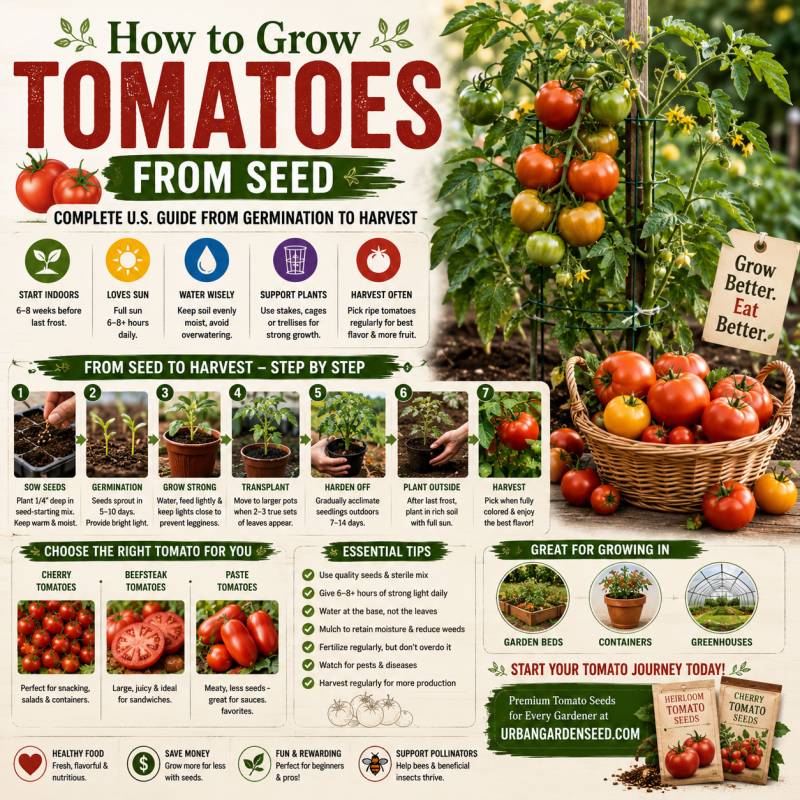
How to Grow Tomatoes From Seed: Complete U.S. Guide From Germination to Harvest
Aug
Few garden plants deliver the same satisfaction as tomatoes.
One tiny seed can become a sprawling plant covered with cherry tomatoes, slicing tomatoes, colorful heirlooms, paste tomatoes, or enormous beefsteak fruit.
But successful tomato growing begins long before the first red fruit appears.
It begins with choosing the right seed.
Then comes germination, lighting, transplanting, watering, feeding, supporting, disease prevention, and finally harvesting.
Whether you have a backyard garden, raised beds, a homestead, a farm, a greenhouse, or several large containers, this guide will take you through the entire process of growing tomatoes from seed.
Why Grow Tomatoes From Seed?
Buying tomato transplants is convenient.
Starting from seed gives you something much more valuable:
choice.
Local garden centers may offer only a handful of tomato varieties.
Seed growers can choose from tomatoes that differ dramatically in color, size, flavor, shape, maturity, and growth habit.
You may grow:
Cherry tomatoes for snacking.
Paste tomatoes for sauce.
Large slicing tomatoes for sandwiches.
Compact varieties for containers.
Early varieties for short growing seasons.
Heirlooms for unusual colors and flavors.
Dark tomatoes.
Yellow tomatoes.
Striped tomatoes.
Multicolored tomatoes.
Starting from seed allows the garden to reflect what you actually want to harvest.
When Should You Start Tomato Seeds Indoors?
Tomatoes are warm-season plants and are usually started indoors before outdoor conditions become suitable.
A practical starting point for many gardeners is approximately six to eight weeks before the planned outdoor transplanting date.
Do not simply count backward from January 1.
Instead, determine when tomatoes can safely be transplanted outdoors in your area.
Tomatoes are frost sensitive.
They should generally be moved outdoors permanently only after frost danger has passed and conditions have become appropriately warm.
A gardener in South Florida will follow a very different schedule from a gardener in Minnesota.
That is why local frost information matters more than one national calendar.
Do Not Start Tomato Seeds Too Early
One of the most common mistakes is assuming that an older tomato seedling will always produce an earlier harvest.
It does not necessarily work that way.
Tomato seedlings kept indoors too long may become:
Leggy.
Root-bound.
Crowded.
Nutrient stressed.
Difficult to water.
Harder to transport.
More vulnerable during transplanting.
A compact, vigorous seedling started at the appropriate time may establish more successfully than an oversized plant that has spent months struggling indoors.
Earlier is not automatically better.
Better timing is better.
Determinate vs. Indeterminate Tomatoes
Before buying tomato seeds, understand these two important growth types.
Determinate Tomatoes
Determinate tomatoes are often described as bush-type tomatoes.
They grow to a more limited size and generally produce much of their crop during a concentrated period.
They can be particularly useful for gardeners who want tomatoes for:
Canning.
Sauce making.
Preserving.
Smaller growing spaces.
More concentrated harvests.
Some determinate varieties are also excellent container candidates.
Indeterminate Tomatoes
Indeterminate tomatoes continue growing and producing flowers and fruit until cold weather or another major stress ends the season.
Many popular slicing, cherry, and heirloom tomatoes are indeterminate.
These plants can become large.
They usually benefit from substantial support such as:
Tall cages.
Stakes.
Trellises.
Other strong structures.
If you want tomatoes throughout a long summer rather than one concentrated harvest period, indeterminate types are worth considering.
Which Tomato Type Should You Buy?
Do not shop by photograph alone.
Choose according to how you will use the fruit.
Cherry Tomatoes
Excellent for:
Snacking.
Salads.
Children’s gardens.
Containers when a suitable variety is selected.
Frequent harvesting.
Cherry tomatoes can also be excellent choices for gardeners in shorter growing seasons because many varieties mature relatively quickly.
Beefsteak Tomatoes
These are the tomatoes people often imagine on sandwiches and burgers.
They produce large fruit with substantial slices.
Large-fruited tomatoes can require more time to mature and sturdy plant support.
Paste Tomatoes
Paste tomatoes generally contain more flesh and less watery interior than many slicing varieties.
They are popular for:
Tomato sauce.
Paste.
Salsa.
Cooking.
Preserving.
Heirloom Tomatoes
Heirlooms are valued for their history, unusual appearance, diversity, and flavor.
They may produce fruit in:
Purple.
Pink.
Yellow.
Orange.
Green.
Striped.
Dark red.
Nearly black shades.
If saving tomato seeds for future seasons is important to you, look for clearly identified open-pollinated varieties.
Compact and Dwarf Tomatoes
Gardeners with patios, decks, containers, or limited bed space should investigate varieties bred for more manageable plant size.
Small plant does not necessarily mean small fruit.
Choose based on both mature plant dimensions and fruit characteristics.
How to Plant Tomato Seeds
Starting tomato seeds successfully does not require complicated equipment.
You need good seeds, a suitable growing medium, containers with drainage, warmth, moisture, and strong light after germination.
Step 1: Use Seed-Starting Mix
Do not fill small seed trays with heavy backyard soil.
A quality seed-starting medium is designed to provide both moisture retention and air around young roots.
Heavy soil can compact inside small containers and drain poorly.
Fill your seed trays or pots with fresh growing medium.
Moisten it before sowing.
The mix should be moist—not dripping wet.
Step 2: Sow the Seeds
Plant tomato seeds approximately one-quarter inch deep.
You can sow one or more seeds per cell depending on how you intend to thin or transplant later.
Cover the seeds lightly with growing mix.
Label the container immediately.
Write:
Tomato variety.
Planting date.
Any useful notes.
Never depend entirely on memory.
Young tomato seedlings can look almost identical.
Step 3: Water Gently
Water carefully so seeds remain in place.
Strong streams of water can wash seeds into corners or bury them too deeply.
The growing medium should remain consistently moist during germination without becoming saturated.
What Temperature Helps Tomato Seeds Germinate?
Tomato seeds germinate best under warm conditions.
A seedling heat mat can be particularly useful in cool homes or propagation areas.
Warmth is most important during germination.
Once seedlings emerge, strong light becomes one of the biggest priorities.
Do not confuse air temperature with growing-medium temperature.
A windowsill may feel warm during the afternoon but become surprisingly cold overnight.
Consistent conditions usually produce more predictable germination.
How Long Do Tomato Seeds Take to Germinate?
Under good conditions, tomato seedlings can emerge relatively quickly.
But do not throw away a tray simply because every seed did not emerge on the same day.
Germination speed varies with:
Seed age.
Variety.
Growing-medium temperature.
Moisture.
Planting depth.
Seed quality.
Some seedlings naturally emerge earlier than others.
If germination is poor, first check temperature and moisture before assuming the seed has failed.
Remove Covers After Germination
Humidity covers can help maintain moisture while seeds are germinating.
Once seedlings emerge, remove the cover.
Young plants need airflow.
Leaving a closed humidity dome over growing tomato seedlings for too long can create overly wet conditions.
After germination, shift your attention from maintaining a humid seed environment to growing compact, sturdy young plants.
Tomato Seedlings Need Strong Light
This is where many indoor tomato-growing projects go wrong.
A bright-looking window does not always provide enough light for strong seedlings.
Tomatoes stretching toward weak light can become:
Tall.
Thin.
Pale.
Bent.
Weak-stemmed.
Provide strong overhead light.
Grow lights are often the most reliable option when natural winter and early-spring light is inadequate.
Position lights according to the manufacturer’s instructions and adjust them as seedlings grow.
A timer can provide a consistent lighting schedule.
Why Tomato Seedlings Become Leggy
Leggy tomato seedlings usually indicate that the plants are stretching for light.
Possible causes include:
Weak light.
Lights positioned too far above the seedlings.
Crowded seedlings.
Excessive warmth combined with insufficient light.
Starting seeds much too early.
Improve the light before trying to solve the problem with fertilizer.
Fertilizer cannot replace photons.
When Should You Transplant Tomato Seedlings Into Larger Pots?
Once seedlings develop true leaves and begin filling their original cells, they may benefit from being moved into larger containers.
Do not confuse the first seed leaves with true tomato leaves.
The first leaves that emerge are cotyledons.
True leaves develop afterward and begin looking more recognizably tomato-like.
Move seedlings carefully.
Handle them primarily by the leaves rather than squeezing their delicate stems.
Use clean containers and an appropriate potting mix.
Tomato Plants Can Develop Roots Along Their Stems
Tomatoes have a useful characteristic.
Portions of the stem that are buried can develop additional roots.
This allows growers to set elongated tomato seedlings somewhat deeper when potting up or transplanting.
However, do not bury every plant species this way.
The technique is particularly associated with tomatoes.
When moving a tomato seedling into a larger pot, you may place part of the lower stem beneath the growing medium after removing leaves that would otherwise be buried.
Give Seedlings Airflow
Indoor tomato seedlings benefit from gentle air movement.
Airflow can help reduce excessively humid conditions and encourage sturdier growth.
A small fan can be useful.
The objective is gentle movement—not hurricane-force wind blowing directly across tender plants.
Good spacing also matters.
Crowded foliage holds moisture and reduces airflow.
As seedlings grow, give them enough room.
When to Fertilize Tomato Seedlings
Seeds contain enough stored energy to begin germination.
New seedlings do not require heavy fertilizer immediately.
Once true leaves develop and plants are actively growing, they may eventually benefit from appropriate nutrition depending on the growing medium being used.
Follow fertilizer instructions carefully.
More fertilizer does not automatically produce better tomato plants.
Excess nutrients can:
Damage roots.
Create weak excessive growth.
Build salts in containers.
Cause other nutritional problems.
Feed plants because they need it—not because feeding feels productive.
Harden Tomato Seedlings Before Transplanting
Indoor seedlings are accustomed to a protected environment.
Outdoor conditions include:
Direct sunlight.
Wind.
Cool nights.
Changing humidity.
Faster moisture loss.
Moving tomato plants directly from indoor lights into intense all-day sun can scorch leaves.
Gradually acclimate plants over approximately one to two weeks.
Begin with limited outdoor exposure in a protected location.
Then slowly increase sunlight and time outside.
Bring frost-sensitive tomatoes back inside whenever temperatures become unsafe.
When Should Tomatoes Be Transplanted Outdoors?
Do not transplant tomatoes simply because the average last frost date has arrived.
Use it as a guide, then check actual conditions.
Tomatoes prefer warm conditions.
Wait until frost danger has passed and both the weather and soil have warmed appropriately.
A cold, wet tomato plant may survive but sit nearly motionless for weeks.
A slightly later transplant into warm soil can sometimes establish much faster.
Watch the forecast.
Choose the Sunniest Location
Tomatoes are sun-loving plants.
Place them where they receive abundant direct sunlight.
Do not use valuable tomato seeds in a location receiving only weak or heavily filtered light and then blame the variety for poor production.
A strong location provides:
Sun.
Good drainage.
Air circulation.
Easy access to water.
Enough space for the mature plant.
For indeterminate tomatoes, also consider where the support structure will go.
Prepare the Soil Before Planting
Healthy tomato plants need healthy roots.
Before transplanting, evaluate:
Drainage.
Soil structure.
Organic matter.
Soil fertility.
A soil test is particularly valuable if you are creating a large permanent vegetable garden or repeatedly experiencing poor results.
Do not automatically add large amounts of every fertilizer.
Tomatoes do not need an unlimited supply of nitrogen.
Excessive nitrogen can produce tremendous leafy growth without a corresponding increase in fruit.
How Far Apart Should Tomato Plants Be?
Spacing depends on variety and growing system.
Compact determinate plants can usually be placed more closely than enormous indeterminate vines.
Always check the mature dimensions and seed information for the specific tomato you are growing.
Do not use seedling size to determine spacing.
That six-inch transplant may eventually become a plant several feet across.
Crowding can reduce airflow and make harvesting and disease management more difficult.
Install Tomato Supports Early
Do not wait until the plant is collapsing under fruit before thinking about support.
Install stakes, cages, trellises, or other structures at planting time or soon afterward.
Early installation reduces the risk of damaging an established root system later.
Support requirements depend on variety.
A compact determinate tomato may need only moderate support.
A vigorous indeterminate tomato may need something substantial.
Cheap undersized cages can become frustrating once the plant is fully grown.
Plan for the mature plant.
How to Water Tomato Plants
Tomatoes benefit from consistent moisture.
The objective is neither:
Constantly waterlogged soil.
Nor repeated severe drying.
Large fluctuations in soil moisture can contribute to fruit-quality problems.
Water deeply enough to moisten the root zone.
Then allow conditions to guide the next irrigation.
Frequency depends on:
Soil type.
Temperature.
Rainfall.
Wind.
Plant size.
Container size.
Mulch.
Do not follow an inflexible calendar.
Check the soil.
Water the Soil, Not the Leaves
Where practical, deliver irrigation near the root zone.
Drip irrigation and soaker systems can be useful.
Constantly wetting tomato foliage can contribute to conditions favorable for some diseases.
Watering near the base also places moisture where roots can use it.
For large gardens or farms, efficient irrigation becomes even more important.
Mulch Around Tomatoes
Mulch can help:
Reduce soil evaporation.
Suppress some weeds.
Reduce soil splash.
Moderate soil temperatures.
Possible materials include:
Straw.
Shredded leaves.
Suitable grass clippings.
Other locally appropriate organic mulches.
Allow the soil to warm adequately before applying an extremely heavy early-season mulch in cool climates.
Keep mulch from being piled tightly around the stem.
Should You Prune Tomato Plants?
The answer depends largely on the growth type.
Indeterminate tomatoes may be pruned to control growth, improve access, and manage the plant on a trellis or stake.
Determinate tomatoes require different treatment because their growth and fruiting habit is more limited.
Aggressive pruning is not automatically better.
Leaves produce energy.
Removing excessive foliage can expose fruit to intense sunlight and reduce the plant’s photosynthetic capacity.
Prune for a reason.
Do not prune because a social-media video told you every tomato sucker is an enemy.
What Is a Tomato Sucker?
A sucker is a shoot that develops where a leaf joins the main stem.
On indeterminate tomatoes, gardeners using single- or limited-stem training systems often remove selected suckers.
Other gardeners allow several stems to grow.
Both approaches can work.
The best choice depends on:
Space.
Support system.
Climate.
Variety.
Gardening goals.
A heavily pruned tomato plant and a minimally pruned tomato plant are simply different management systems.
Tomato Flowers but No Fruit?
A tomato plant can look healthy and produce flowers without setting much fruit.
Possible reasons include:
Extreme heat.
Cold temperatures.
Poor pollination conditions.
Excessive nitrogen.
Plant stress.
Some tomato varieties are more sensitive to extreme temperatures than others.
Do not immediately add fertilizer when flowers drop.
First examine the weather and overall plant condition.
Why Do Tomatoes Crack?
Fruit cracking is often associated with rapid changes in water availability.
A tomato developing during relatively dry conditions may suddenly receive abundant water after irrigation or heavy rain.
The fruit expands quickly and the skin can split.
Consistent irrigation and mulch can reduce extreme soil-moisture fluctuations.
Different varieties also vary in cracking resistance.
What Causes Blossom-End Rot?
Blossom-end rot appears as a dark, damaged area at the blossom end of developing fruit.
It involves calcium movement within the plant and is commonly associated with irregular water availability rather than simply a lack of calcium fertilizer in the soil.
Consistent soil moisture is important.
Before adding calcium products, understand the actual soil and watering conditions.
Randomly adding amendments is not a substitute for diagnosis.
Watch for Tomato Diseases
Tomatoes can be affected by several fungal, bacterial, and viral diseases.
Symptoms may include:
Leaf spots.
Yellowing.
Wilting.
Stem damage.
Fruit lesions.
Premature leaf loss.
Prevention begins with good cultural practices.
Use healthy seed and plants.
Provide appropriate spacing.
Avoid constantly wet foliage.
Remove seriously diseased plant material when necessary.
Rotate tomatoes away from closely related crops when practical.
Tomatoes share the nightshade family with peppers, eggplants, and potatoes, so rotating from tomatoes directly into peppers is not a meaningful family rotation.
Choose Disease-Resistant Varieties When Needed
If your region or garden has a history of a particular tomato disease, variety selection can be one of your best defenses.
Seed descriptions may include resistance codes or disease information.
Do not assume disease resistance means complete immunity to every disease.
Resistance is usually specific.
The best tomato for one gardener may not be the best tomato for another.
Climate and local disease pressure matter.
Growing Tomatoes in Containers
Tomatoes can grow successfully in containers when the variety and pot are properly matched.
Container gardens are especially useful for:
Patios.
Decks.
Rental properties.
Driveways.
Small sunny spaces.
Choose a container large enough for the mature root system.
Small pots dry rapidly and can stress large plants.
Use:
Good drainage.
Quality potting mix.
Reliable support.
Consistent watering.
Adequate sunlight.
Compact or dwarf varieties can simplify container management, but larger tomatoes can also be container-grown when given enough root space.
Why Containers Need More Water Monitoring
In-ground plants have access to a much larger volume of soil.
Container plants do not.
A pot can become dry remarkably quickly during:
Hot weather.
Wind.
Peak fruit production.
Check container tomatoes frequently.
Do not assume yesterday’s watering means the plant is fine today.
But also do not keep the pot permanently waterlogged.
Drainage remains essential.
Tomatoes in Raised Beds
Raised beds work extremely well for tomatoes.
They provide control over:
Soil.
Spacing.
Irrigation.
Mulching.
Support structures.
However, raised beds can dry more rapidly than some in-ground soils.
Plan irrigation before the plants become enormous.
Position tall tomato plants so they do not unnecessarily shade shorter crops.
Tomatoes for Short Growing Seasons
Gardeners in northern states and high elevations should pay particular attention to days to maturity.
Choose varieties capable of ripening within the available warm season.
Cherry tomatoes and early determinate varieties can be particularly useful.
Starting seeds indoors gives the plants a head start.
Season-extension techniques such as:
Row covers.
Cold frames.
Protected locations.
Warm microclimates.
may also help.
Do not choose a very long-season giant tomato merely because the photograph looks impressive if your first frost regularly arrives before the fruit can mature.
Tomatoes for Hot Southern Climates
Southern gardeners face a different problem.
Summer may become too hot for reliable fruit set during parts of the season.
In very warm climates, tomato planting schedules may focus on:
Early spring.
Late summer.
Fall.
Winter in frost-free areas.
Local Extension planting calendars are much more useful than a generic national schedule.
Growing tomatoes successfully is often about fitting the crop between temperature extremes.
How to Harvest Tomatoes
Harvest tomatoes when they have reached the appropriate mature color and texture for the variety.
Not all ripe tomatoes are red.
A ripe tomato may be:
Yellow.
Orange.
Pink.
Purple.
Green.
Striped.
Dark brown-red.
Learn what your specific variety looks like when mature.
For delicate heirloom tomatoes, harvesting slightly before full softness can sometimes reduce cracking and damage.
Handle fruit gently.
What to Do Before the First Fall Frost
When frost threatens at the end of the season, harvest remaining usable fruit.
Tomatoes that have begun physiological ripening may continue ripening indoors.
Very immature green fruit may never develop excellent flavor.
Remove remaining plants after the season and evaluate the garden.
Record:
Which varieties tasted best.
Which produced earliest.
Which handled heat well.
Which resisted disease.
Which you want to grow again.
That information becomes valuable when purchasing next year’s seeds.
Can You Save Tomato Seeds?
Yes—especially from suitable open-pollinated varieties.
Tomato seed saving typically involves fermenting the seeds and surrounding gel briefly before rinsing and drying them thoroughly.
If you grow an F1 hybrid, seeds may still germinate, but the next generation may not reproduce the original hybrid’s characteristics.
If saving seed is one of your priorities, choose clearly identified open-pollinated tomatoes.
Common Tomato Growing Mistakes
Starting seeds far too early is one of the biggest.
Weak lighting is another.
Other frequent problems include transplanting into cold soil, overcrowding plants, using inadequate supports, watering inconsistently, growing tomatoes in too much shade, applying excessive nitrogen, ignoring disease symptoms, and choosing a variety poorly suited to the local growing season.
Most tomato problems are easier to prevent than correct.
Success begins with planning.
A Simple Tomato Growing Timeline
During winter or early spring, choose varieties and order tomato seeds.
About six to eight weeks before your expected transplanting window, sow seeds indoors.
After germination, provide strong overhead light and good airflow.
Pot seedlings up if necessary.
Approximately one to two weeks before transplanting, begin hardening them off.
After frost danger has passed and conditions are warm enough, transplant outdoors.
Install supports early.
Water consistently throughout growth and fruit development.
Harvest regularly as fruit ripens.
Before frost, collect remaining usable tomatoes and evaluate which varieties earned a place in next year’s garden.
Why Start With Good Tomato Seeds?
A tomato plant occupies valuable garden space for months.
If you are going to invest that much:
Time.
Water.
Soil.
Support.
Fertilizer.
Garden space.
begin with seed you actually want to grow.
Choose varieties based on:
Climate.
Flavor.
Maturity.
Plant size.
Disease resistance.
Intended use.
Container suitability.
Seed-saving goals.
A good tomato garden is not simply a collection of random plants.
It is a collection chosen for the harvest you want.
Why Choose Urban Garden Seed for Tomato Seeds?
Urban Garden Seed offers multiple tomato seed selections, including colorful, unusual, cherry, large-fruited, and multi-variety options.
Gardeners can use these choices to build a tomato collection around different goals.
Grow one variety for salads.
Another for sandwiches.
One for sauce.
A cherry tomato for snacking.
An unusual color simply because gardening should also be fun.
When shopping, review each product’s characteristics carefully and match the variety to your local climate and available space.
Starting tomatoes from seed opens the door to much more variety than relying only on whichever seedlings happen to be available locally in spring.
One Seed Can Become an Entire Harvest
The remarkable thing about tomatoes is the scale of the transformation.
You begin with something tiny.
A seed.
You place it into a small amount of growing mix.
A root emerges.
Then leaves.
The seedling becomes a transplant.
The transplant becomes a plant.
Flowers appear.
Then tiny green fruit.
Weeks later, you are carrying baskets of tomatoes into the kitchen.
All of that began with one seed.
That is why learning how to grow tomatoes from seed is one of the most useful skills a gardener can develop.
Ready to Grow Tomatoes From Seed?
Explore tomato seed varieties at UrbanGardenSeed.com and choose tomatoes for your backyard garden, raised beds, homestead, containers, greenhouse, or farm.
Choose varieties suited to your climate.
Start them at the right time.
Give seedlings strong light.
Transplant into warm conditions.
Water consistently.
Support the plants.
Then enjoy the harvest.
Start with a seed. Grow the plant. Harvest the flavor.
Frequently Asked Questions
When should I start tomato seeds indoors?
A common guideline is approximately six to eight weeks before your expected outdoor transplanting date. Local frost dates and weather conditions should determine the final schedule.
How deep should tomato seeds be planted?
Tomato seeds are generally planted around one-quarter inch deep in a suitable seed-starting medium.
How long do tomato seeds take to germinate?
Germination varies according to variety, seed quality, moisture, and temperature. Warm, consistently moist conditions generally improve germination speed.
Do tomato seeds need light to germinate?
Warmth and moisture are particularly important during germination. Once seedlings emerge, strong light becomes essential for compact growth.
Do I need a heat mat?
Not always, but bottom heat can help maintain suitable germination temperatures in cool homes.
Why are my tomato seedlings tall and thin?
Insufficient light is a common cause. Provide stronger overhead lighting and appropriate spacing.
When should tomato seedlings be transplanted?
Move them outdoors after hardening off, frost danger has passed, and outdoor conditions have warmed enough for tomato growth.
What is the difference between determinate and indeterminate tomatoes?
Determinate tomatoes have a more limited growth habit and concentrated harvest, while indeterminate tomatoes continue growing and fruiting through the season until cold weather stops them.
Which tomatoes are best for containers?
Compact, dwarf, and many determinate varieties are easier to manage in containers, although larger tomatoes can also be container-grown with sufficient root space and support.
How much sun do tomato plants need?
Tomatoes perform best with abundant direct sunlight. Poor light can reduce plant growth and fruit production.
How often should tomatoes be watered?
There is no universal schedule. Water according to soil moisture, weather, plant size, rainfall, and container or soil conditions. Aim for consistent root-zone moisture.
Should I prune tomato suckers?
It depends on the variety and training system. Indeterminate tomatoes may be selectively pruned, while determinate plants generally require less sucker removal.
Why are my tomatoes splitting?
Rapid changes in water availability can contribute to cracking. Consistent soil moisture can help.
What causes blossom-end rot?
Blossom-end rot is associated with disrupted calcium movement in the developing fruit and is commonly connected with inconsistent moisture conditions.
Can I save tomato seeds?
Yes. Open-pollinated tomatoes are especially suitable when you want future generations to remain similar to the parent variety.
Can tomatoes grow in raised beds?
Yes. Raised beds work very well when tomatoes receive adequate soil volume, sunlight, water, spacing and support.
Where can I buy tomato seeds online?
Visit UrbanGardenSeed.com to browse multiple tomato seed selections, including colorful, cherry, rare and multi-variety options.
