
Adenium, Backyard Gardening, Cactus & Succulent, Family & Kids' Gardening, Flower Seeds, Garden Planning & Design, Herb Seeds, Homesteading & Self-Reliance, Sensory & Wellness Gardening, Sustainable & Regenerative Living, The Horticulturist’s Lab, Urban & Small-Space Gardening, Vegetables
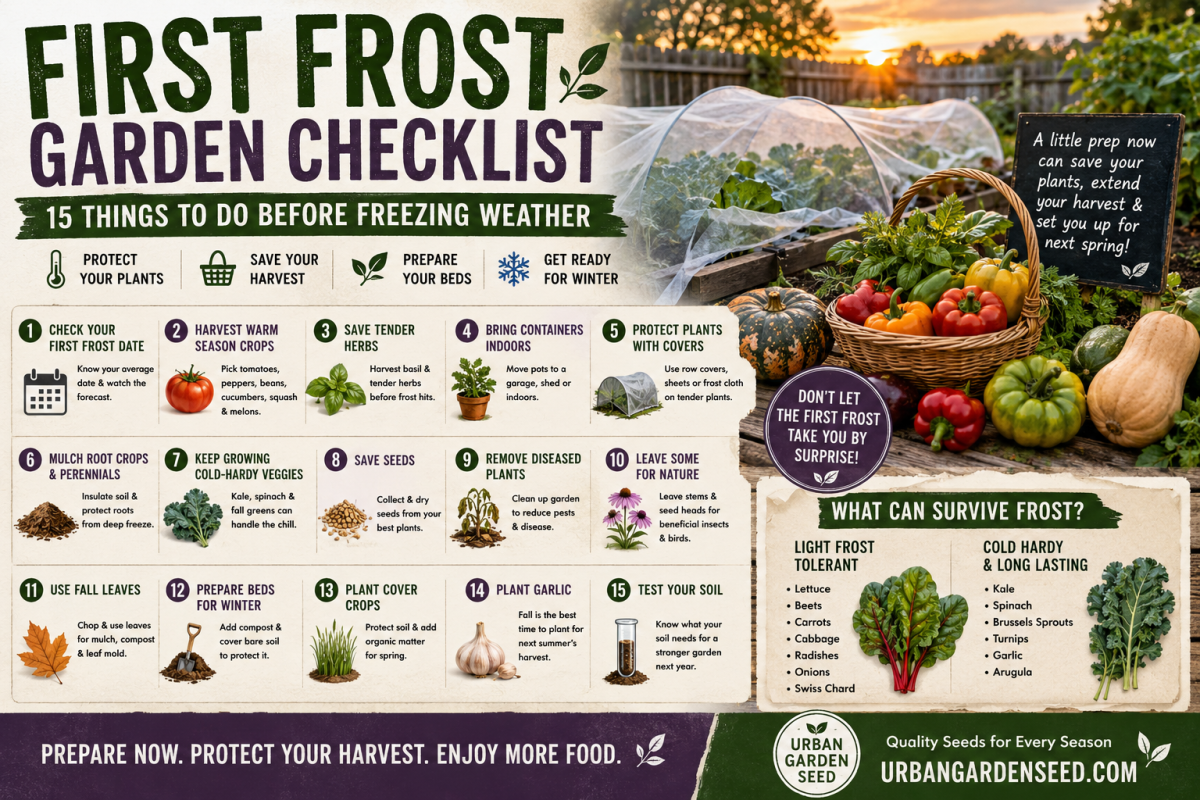
First Frost Garden Checklist: 15 Things to Do Before Freezing Weather
Sep
The first frost of fall can arrive surprisingly fast.
One afternoon, your garden may still be filled with tomatoes, peppers, basil, cucumbers, flowers, and green leaves.
The next morning, tender plants can be blackened and collapsed.
But an early frost does not necessarily mean your entire gardening season is finished.
With the right preparation, you may be able to:
- Save vegetables that are nearly ready to harvest
- Protect tender plants through one cold night
- Keep cold-hardy vegetables growing longer
- Ripen remaining tomatoes indoors
- Harvest herbs before they are damaged
- Protect root crops with mulch
- Prepare beds for winter
- Save seeds for next year
- Plant garlic and other fall crops
- Get a head start on next spring
For gardeners throughout the United States and Canada, September and October are transition months.
In Saskatchewan, Alberta, Manitoba, Minnesota, North Dakota, and other cold regions, frost may already be close.
In Ontario, Quebec, New England, the Midwest, and the Pacific Northwest, the first frost may arrive several weeks later depending on location.
Gardeners in the southern United States may have considerably more time.
That is why your first step should not be guessing.
It should be checking your local forecast.
What Is the First Frost?
The first frost date is the approximate point during fall when temperatures are expected to become cold enough for frost to form.
But an average first frost date is not a deadline written in stone.
It is based on historical weather.
Your actual first frost can occur:
Earlier.
Later.
Or very close to the average.
Local conditions matter too.
A low area at the bottom of a hill may frost earlier than a nearby garden on higher ground because cold air settles into low spots.
Gardens near large bodies of water may remain warmer longer.
Urban neighborhoods can also experience different temperatures from nearby rural areas.
Use historical frost dates for planning.
Use the actual weather forecast for decisions.
Frost vs. Freeze: What’s the Difference?
Gardeners often use the words interchangeably, but they are not exactly the same.
Frost
Frost forms when surfaces become cold enough for water vapor to turn into ice crystals.
Plants can sometimes experience frost damage even when the official air temperature remains slightly above 32°F or 0°C because leaf surfaces can become colder than the measured air.
Freeze
A freeze generally refers to air temperatures reaching 32°F or 0°C or below.
A more severe or prolonged freeze can damage plants much more extensively.
The duration matters too.
A short dip near freezing may have a very different effect from several hours of subfreezing temperatures.
Which Vegetables Are Most Vulnerable to Frost?
Not every vegetable reacts to cold the same way.
This is one of the biggest advantages fall gardeners have.
Some plants need immediate protection.
Others can remain outdoors.
Very frost-sensitive vegetables
Prioritize these when freezing weather is forecast:
- Tomatoes
- Peppers
- Eggplants
- Cucumbers
- Summer squash
- Zucchini
- Pumpkins and squash vines
- Melons
- Beans
- Basil
These warm-season plants can suffer significant damage around freezing temperatures.
Do not assume they will survive simply because the forecast is only slightly below freezing.
More frost-tolerant vegetables
These may tolerate light frost better:
- Lettuce
- Beets
- Carrots
- Cabbage
- Cauliflower
- Radishes
- Onions
- Swiss chard
Tolerance varies with variety, maturity, plant health, temperature, and duration.
Cold-hardy vegetables
Some fall crops can survive temperatures that destroy summer vegetables.
Examples include:
- Kale
- Spinach
- Turnips
- Brussels sprouts
- Kohlrabi
- Arugula
- Garlic
- Some hardy onions
That means your tomato season may end while your kale and spinach continue growing.
The first frost does not necessarily mean the entire vegetable garden is finished.
1. Find Your Local First Frost Date
Before doing anything else, determine your approximate first fall frost.
For American gardeners, use local Cooperative Extension services, regional weather records, or reliable frost-date tools.
For Canadian gardeners, use provincial agriculture resources, university horticulture programs, Environment and Climate Canada data, or regional gardening resources.
Do not use one national date.
Canada alone ranges from short Prairie growing seasons to much milder coastal British Columbia.
The United States ranges from Alaska to South Florida.
Your ZIP or postal code matters much more than your country.
2. Start Watching Nighttime Forecasts
Once autumn approaches, pay particular attention when overnight forecasts fall into the mid-30s°F, or around 2–4°C.
Your garden may experience frost even when the official air temperature remains slightly above freezing.
Watch for nights that are:
Clear.
Calm.
Dry.
Cold.
These conditions can be favorable for radiational frost.
If frost-sensitive crops are valuable, prepare before sunset rather than waiting until midnight.
3. Harvest Ripe Tomatoes Before Frost
Do not sacrifice ripe tomatoes trying to extend the season one extra night.
When frost is approaching, harvest tomatoes that are already ripe or nearly ripe.
Also inspect plants for fruit beginning to change color.
Tomatoes that have begun the ripening process may continue ripening indoors.
Handle them carefully.
Damaged fruit stores poorly.
If a major freeze is expected and you cannot protect the plants, harvest usable green tomatoes too.
They can be used for:
- Green tomato recipes
- Pickling
- Chutney
- Indoor ripening experiments
Do not leave an entire mature crop outside simply because the calendar says autumn technically begins later.
The forecast wins.
4. Harvest Peppers
Peppers are warm-season crops and should also be prioritized before frost.
You can harvest peppers at multiple stages.
A green pepper may already be mature enough to eat even if you originally intended to let it turn:
Red.
Yellow.
Orange.
Purple.
Or another mature color.
If a freeze is coming, a slightly early pepper is better than a frozen one.
Harvest healthy fruit before temperatures become damaging.
5. Pick Cucumbers, Beans and Summer Squash
Cucumbers, green beans, zucchini, and summer squash can be quickly damaged by frost.
Walk through the garden before the cold night arrives.
Harvest everything that has reached usable size.
Even slightly smaller vegetables can be eaten.
This is also a good time to decide whether plants are worth protecting.
A healthy cucumber vine covered with developing fruit might deserve one more night under row cover.
A diseased vine producing almost nothing may be better removed.
Use your effort where it produces value.
6. Harvest Winter Squash and Pumpkins
Mature winter squash and pumpkins should generally be harvested before a hard freeze.
Look for signs of maturity such as:
- Developed mature color
- Firm rind
- Drying stem
- Full expected size
Cut fruit rather than pulling it from the vine.
Leave an appropriate portion of stem attached.
Handle carefully.
Bruised squash stores poorly.
If a squash is immature, protecting the vine through one early frost may buy additional ripening time.
But once repeated freezing weather begins, the season is usually finished.
7. Harvest Tender Herbs
A large basil plant can disappear overnight after frost.
Before freezing weather, harvest tender herbs such as:
- Basil
- Thai basil
- Lemon basil
- Other frost-sensitive herbs
Use the harvest fresh or preserve it.
Depending on the herb, you may:
Freeze it.
Dry it.
Make pesto.
Make herb butter.
Make sauces.
Root cuttings indoors.
Do not assume all herbs behave the same way.
Parsley, chives, thyme, sage, and some perennial herbs tolerate cooler conditions much better than basil.
8. Bring Container Plants Indoors
Container plants have one major advantage:
They can move.
Bring valuable frost-sensitive containers into:
- A house
- Garage
- Shed
- Greenhouse
- Protected porch
depending on the temperature requirements of the plant.
Before bringing plants permanently inside, inspect them for:
- Aphids
- Spider mites
- Whiteflies
- Scale
- Slugs
- Other insects
You do not want to turn frost protection into an indoor pest infestation.
Plants being brought indoors for the entire winter should also be introduced to lower indoor light levels appropriately.
9. Cover Plants Correctly
If only one or two cold nights are expected, covering plants can extend the harvest.
Possible covers include:
- Floating row cover
- Frost cloth
- Old bedsheets
- Lightweight blankets
- Low tunnels
- Cloches
The objective is to trap heat rising from the soil around the plant.
For best results, cover the plant before temperatures fall sharply.
Extend the material toward the ground.
Secure the edges so wind cannot lift it.
Remove or ventilate covers once temperatures warm the following day.
Do Not Let Thin Plastic Rest Directly on Leaves
Plastic can be useful as part of a properly designed low tunnel, but thin plastic touching leaves can transmit cold and damage plant tissue.
If you use plastic, support it above the plants with hoops or another structure.
Fabric row cover is generally easier for beginners because it allows some light, moisture, and air through.
Whatever material you use, make sure plants do not overheat when sunshine returns.
A covered garden can become surprisingly hot during the day.
10. Use Low Tunnels to Extend the Season
If you regularly grow fall vegetables, consider building a simple low tunnel.
A low tunnel typically consists of:
- Hoops over the garden bed
- Row-cover fabric or appropriate greenhouse material
- Anchored edges
It creates a protected microclimate around the crop.
Low tunnels are especially useful for:
- Lettuce
- Spinach
- Kale
- Asian greens
- Radishes
- Carrots
- Beets
- Other cool-season vegetables
They do not turn a Canadian winter into summer.
They do, however, help moderate early cold and extend useful harvest periods.
11. Mulch Root Crops
Some root vegetables can remain in the ground after frost.
Depending on region and variety, these may include:
- Carrots
- Parsnips
- Beets
- Turnips
A thick layer of suitable mulch can help slow soil freezing and make harvesting possible later into fall.
In colder regions, gardeners may use clean straw or leaves for insulation.
The colder your climate, the more challenging true winter harvesting becomes.
Canadian Prairie gardeners will require much more protection than gardeners in coastal British Columbia or the southeastern United States.
Do not wait until the ground is frozen solid before applying mulch.
12. Keep Growing Kale and Spinach
Do not automatically pull cold-hardy vegetables because tomatoes died.
Kale and spinach can continue providing valuable harvests through cold weather.
In fact, cool temperatures can improve the eating quality of certain crops.
Keep harvesting outer kale leaves while the growing point remains healthy.
Harvest spinach as baby leaves or mature leaves depending on conditions.
Use row covers or cold frames to extend production further.
Your fall garden should transition—not disappear.
13. Save Seeds Before Plants Are Removed
Fall is seed-saving season.
Before cleaning the garden, inspect mature plants for seeds you may want next year.
Beginner-friendly possibilities include selected open-pollinated:
- Beans
- Peas
- Tomatoes
- Peppers
- Lettuce
- Zinnias
- Marigolds
- Cosmos
- Calendula
Allow seeds to reach full maturity.
Dry them thoroughly.
Label them with:
Crop.
Variety.
Year.
Do not save seed only because it exists.
Save from healthy, desirable plants when possible.
14. Remove Diseased Plants
Fall cleanup is particularly important when plants have serious disease problems.
Remove badly diseased vegetable material rather than leaving it in the bed indefinitely.
This can help reduce opportunities for some pathogens and pests to remain close to next year’s crops.
Inspect:
- Tomato vines
- Squash leaves
- Cucumber vines
- Bean plants
- Brassicas
Healthy residue can sometimes contribute organic matter depending on your gardening system.
Diseased material needs more careful management.
Know what you are leaving behind.
15. Do Not Over-Clean the Entire Garden
This may sound contradictory.
Remove problematic vegetable debris—but do not assume every perennial flower stem and seed head must be cut down immediately.
Some beneficial insects use standing plant stems and garden debris as winter habitat.
Seed heads can also provide food for birds.
A more ecological fall cleanup might mean:
Remove diseased material.
Remove invasive weeds.
Clean food-production beds where necessary.
But leave selected healthy perennial stems and seed heads until later.
A garden does not need to look sterile to be prepared for winter.
What Should You Do With Fallen Leaves?
Fall leaves are valuable garden material.
Instead of automatically sending every leaf away, use healthy leaves for:
- Mulch
- Compost
- Leaf mold
- Pathways
- Winter protection
Shredded leaves usually break down faster and are less likely to form a dense mat.
Avoid using leaves heavily contaminated with serious disease where doing so could create problems for susceptible plants.
Fall leaves can become next year’s organic matter.
Prepare Empty Beds for Winter
When summer crops are finished, do not leave soil completely exposed if you can avoid it.
Possible options include:
- Organic mulch
- Compost where needed
- Fall cover crops
- Winter-killed cover crops
- Overwintering cover crops
Bare soil is vulnerable to:
- Erosion
- Crusting
- Nutrient loss
- Weed establishment
Protect the surface.
Fall is part of the next growing season.
Plant Cover Crops
If enough growing time remains, empty beds can be planted with suitable cover crops.
Depending on your climate, options may include:
- Oats
- Cereal rye
- Clover
- Field peas
- Other regionally suitable species
Some winterkill.
Others survive into spring.
Choose based on your climate and how you plan to terminate the crop.
Canadian and northern U.S. gardeners need to pay particular attention to cold hardiness.
A crop that survives winter in Maryland may behave very differently in Alberta.
Plant Garlic
Fall is also garlic-planting season across much of the United States and Canada.
Garlic is normally planted as individual cloves rather than ordinary botanical seed.
Timing varies.
In colder regions, garlic may be planted in September or October.
In milder regions, October or November may be more appropriate.
The objective is to allow roots to establish before winter without producing excessive tender top growth.
Plant healthy cloves.
Mulch where winter conditions require it.
Then harvest the bulbs the following summer.
Take a Soil Test
Fall is an excellent time to evaluate garden soil.
A laboratory soil test can provide information about:
- pH
- Nutrient levels
- Organic matter
- Amendment requirements
Testing in fall gives you time to interpret the results and make informed decisions before spring.
Do not add fertilizer simply because the growing season ended.
Apply what the soil actually needs.
Prepare Your Compost
Add appropriate healthy garden material to your compost pile.
Possible materials include:
- Vegetable residues
- Leaves
- Grass clippings
- Spent annuals
Avoid putting severely diseased material into a home compost system unless you know your composting process can manage the pathogen.
Balance fresh green material with dry brown material.
Keep the pile adequately moist.
Your fall garden can become next year’s compost.
Protect Newly Planted Perennials
Fall is an excellent planting season for many perennials, shrubs, and trees in suitable climates.
But newly planted material still needs care.
Continue watering as necessary until the ground freezes or plants enter dormancy.
Do not assume cooler weather means roots no longer need moisture.
New plants have limited root systems.
Adequate establishment before winter improves their chances of returning successfully.
What Should Canadian Gardeners Prioritize?
Canada covers an enormous range of climates.
But many Canadian gardeners should begin frost preparation earlier than their American counterparts.
Prairies
Gardeners in Alberta, Saskatchewan, and Manitoba may face frost from late August through September depending on location and year.
Prioritize:
Tender vegetable harvest.
Frost protection.
Root-crop management.
Garlic preparation.
Mulching.
Season-extension structures.
Ontario and Quebec
September is a major transition month.
Harvest warm-season crops as frost risk increases while continuing cold-hardy vegetables.
Plant garlic according to local timing.
Protect greens with row covers.
Atlantic Canada
Cool weather and ocean influences produce different frost patterns depending on proximity to the coast.
Use local forecasts rather than broad provincial averages.
Coastal British Columbia
The growing season can extend far beyond that of the Prairies.
Cool-season vegetables, overwintering crops, garlic, and cover crops may remain viable much later.
Again:
Local conditions win.
What Should U.S. Gardeners Prioritize?
Northern U.S.
Minnesota, North Dakota, Montana, Wisconsin, northern Michigan, New England and similar regions should already be frost-conscious during September.
Have covers ready.
Harvest warm-season crops.
Transition toward hardy vegetables.
Midwest
September and October can provide several weeks of productive cool-season gardening.
Use row covers when early frost threatens.
Pacific Northwest
Cool-season greens and overwintering crops can remain productive, particularly in milder locations.
Mid-Atlantic
Fall gardening can continue well beyond the first light frost with appropriate crop selection.
Southeast
September may still feel like summer.
The primary focus may be planting cool-season crops rather than immediate frost preparation.
However, save this checklist.
Your frost window will arrive later.
Deep South and Florida
First frost may be very late or absent in subtropical areas.
Use local climate data instead of following northern schedules.
What Temperature Kills Tomatoes?
Tomatoes are frost-sensitive.
Damage can occur around freezing, and plants may be badly injured or killed by a significant frost or freeze.
Do not focus only on one exact temperature because:
Plant health matters.
Duration matters.
Wind matters.
Humidity matters.
Leaf temperature matters.
Microclimate matters.
If tomatoes are valuable and forecasts are approaching the mid-30s°F—roughly 2–4°C—begin preparing.
Should You Water Before Frost?
Moist soil can retain more heat than extremely dry soil.
If your garden is dry and frost is expected, normal irrigation earlier in the day may be useful.
But this does not mean soaking foliage immediately before a freeze.
Commercial frost-protection irrigation is a specialized technique requiring continuous, carefully controlled water application.
Home gardeners should not casually imitate that method.
For most home gardens:
Keep soil normally hydrated.
Then use appropriate covers.
Should You Cover Plants With Plastic?
Plastic can protect plants when used properly as part of a supported structure.
But it should generally not rest directly on delicate foliage during freezing conditions.
Use hoops or supports to maintain an air gap.
For simple overnight protection, frost cloth, floating row cover, sheets, or lightweight blankets are often easier.
Remove or ventilate protective materials as temperatures rise.
What Should You Harvest After a Light Frost?
Some vegetables may actually improve after cool temperatures.
Possible cold-tolerant crops include:
- Kale
- Brussels sprouts
- Carrots
- Parsnips
- Turnips
- Collards
But tolerance differs among varieties and temperatures.
Inspect plants after frost.
Do not assume every leaf exposed to freezing weather is automatically damaged.
First Frost Emergency Checklist
If frost is forecast tonight, prioritize your work in this order:
First: Harvest ripe tomatoes, peppers, cucumbers, beans, squash, basil, and other tender crops.
Second: Move valuable containers indoors.
Third: Cover tender plants worth saving.
Fourth: Secure row covers over fall vegetables.
Fifth: Harvest or protect pumpkins and winter squash.
Sixth: Check that hoses, irrigation equipment, and outdoor containers are ready for colder weather.
Do the highest-value jobs first.
There is little benefit spending two hours protecting a nearly finished plant while ripe vegetables freeze elsewhere.
Your Garden After the First Frost
The morning after frost can feel discouraging.
Tomatoes may be black.
Basil may be finished.
Cucumber vines may collapse.
But look closer.
Spinach may still be green.
Kale may look completely normal.
Carrots are still underground.
Garlic can soon be planted.
Cover crops may be developing roots.
Saved seeds are drying indoors.
Leaves are becoming mulch.
The gardening season has not disappeared.
It has changed form.
Build a Four-Season Gardening Mindset
The most productive gardeners do not think only in terms of spring and summer.
They think in cycles.
Spring: Seed starting and planting.
Summer: Growth and harvest.
Fall: Harvest, frost protection, cool-season planting, seed saving, garlic, cover crops, and soil building.
Winter: Planning, winter sowing, seed organization, and preparing for spring.
Once you think this way, the first frost stops being an ending.
It becomes a transition point.
Why Choose Urban Garden Seed?
Urban Garden Seed offers vegetable, flower, herb, fruit, tree, ground-cover, and specialty seeds for gardeners in different climates and growing systems.
As fall approaches, gardeners can shift their seed selection toward:
- Spinach
- Kale
- Lettuce
- Radishes
- Turnips
- Other cool-season vegetables
- Flowers for fall or dormant sowing
- Seeds for winter-sowing projects
- Seeds for next spring
Choose varieties according to your actual climate, days to maturity, and local frost dates.
Gardeners in Canada and the United States should not assume that the same variety and planting schedule work everywhere.
The better you understand your growing season, the more useful every packet of seed becomes.
Frost Is Coming—But the Garden Isn’t Finished
The first frost creates urgency.
That can be useful.
It forces us to look at the garden and decide:
What should be harvested?
What should be protected?
What should stay?
What should be removed?
What should be planted next?
Walk through your garden before the cold arrives.
Pick the peppers.
Harvest the basil.
Bring the containers inside.
Cover the tomatoes if they are worth saving.
Leave the kale.
Mulch the carrots.
Save the seeds.
Prepare the garlic bed.
Protect your soil.
Then when frost appears the next morning, you will not be looking at everything you lost.
You will be looking at everything you saved—and everything you are already preparing to grow next.
Ready for Fall Gardening?
Explore vegetable, herb, flower, and specialty seeds at UrbanGardenSeed.com and prepare your garden for the colder seasons ahead.
Protect the harvest. Save the seeds. Build the soil. Keep growing.
Frequently Asked Questions
What should I do before the first frost?
Harvest tender vegetables and herbs, bring sensitive containers indoors, cover valuable plants, mulch suitable root crops, monitor cold-hardy vegetables, and begin fall garden cleanup and soil preparation.
What vegetables need protection from frost?
Tomatoes, peppers, eggplants, cucumbers, beans, summer squash, melons, basil, and other warm-season plants should be prioritized.
What vegetables can survive frost?
Kale, spinach, turnips and several other cool-season crops can tolerate colder conditions than tomatoes and peppers. Exact tolerance depends on variety and the severity and duration of cold.
How do I protect tomatoes from frost?
Cover plants before temperatures fall using frost cloth, row cover, sheets, or supported protective material. Extend the covering to the ground and remove or ventilate it when temperatures warm.
Can I cover vegetables with bedsheets?
Yes. Lightweight sheets can provide temporary frost protection. Secure them so they do not blow away.
Can I use plastic to protect plants?
Yes, but keep plastic from resting directly against delicate foliage and ventilate it during warm daylight hours.
At what temperature should I cover my garden?
Begin paying close attention when forecast lows enter the mid-30s°F, roughly 2–4°C, especially on clear, calm nights.
Should I harvest tomatoes before frost?
Yes. Harvest ripe and partially ripened fruit if frost is expected and protection is uncertain.
Can green tomatoes ripen indoors?
Many mature green or partially colored tomatoes can continue ripening after harvest.
Should I harvest pumpkins before frost?
Mature pumpkins and winter squash should generally be harvested before a hard freeze that could damage fruit and reduce storage quality.
Can carrots stay in the ground after frost?
Yes in many climates. Mulch can help insulate the soil and extend the harvest period.
Does kale survive frost?
Kale is considerably more cold tolerant than warm-season crops and can continue producing after light frost.
Should I clean up my entire garden after frost?
Remove seriously diseased vegetable debris and invasive weeds, but consider leaving selected healthy perennial stems and seed heads for winter structure and wildlife habitat.
Is September too late to plant vegetables in Canada?
It depends on location. Prairie gardeners have a much shorter remaining season than coastal British Columbia, while some fast-growing or overwintering crops may still be appropriate in other regions.
Is September too late to plant vegetables in the United States?
No. Many regions can still plant cool-season vegetables, and southern areas may just be entering their main fall planting season.
Where can I buy seeds for fall and winter gardening?
Visit UrbanGardenSeed.com to explore vegetable, herb, flower, and specialty seeds for fall planting, winter-sowing projects, and future growing seasons.
