
Adenium, Cactus & Succulent, Family & Kids' Gardening, Flower Seeds, Herb Seeds, Sensory & Wellness Gardening, Sustainable & Regenerative Living, The Horticulturist’s Lab, Urban & Small-Space Gardening, Vegetables
Rare Tree Seeds for Sale: How to Grow Exotic Trees From Seed Successfully
Jun
Shop high-quality rare tree seeds, exotic flower seeds, vegetable seeds, and Non-GMO untreated seeds at Urban Garden Seed. Learn how to germinate tree seeds successfully with expert tips.
Rare Tree Seeds for Sale: How to Grow Exotic Trees From Seed Successfully
Growing rare and exotic trees from seed is one of the most rewarding experiences for gardeners, collectors, homesteaders, and plant lovers. Whether you want to grow a tropical flowering tree, a beautiful bonsai candidate, a rare ornamental, or a productive backyard tree, everything starts with one important choice:
quality seeds.
At Urban Garden Seed, we help gardeners grow with confidence by offering Non-GMO, untreated, high-germination seeds sourced from trusted suppliers around the world. Our collection includes rare tree seeds, flower seeds, vegetable seeds, and unique varieties for passionate growers who want something beyond ordinary garden-center plants.
If you are looking for rare tree seeds for sale online, this guide will help you choose the right seeds, understand germination, avoid common mistakes, and start growing successfully.
Why Buy Rare Tree Seeds Online?
Local nurseries usually carry common plants, but rare and exotic species are often difficult to find as live plants. Buying seeds online gives you access to a much wider selection of plants, including tropical trees, flowering trees, fruit trees, ornamental trees, bonsai-friendly species, and unusual garden varieties.
Growing from seed also gives you several benefits:
You can grow rare plants at a lower cost than buying mature specimens.
You can start multiple seedlings and choose the strongest plants.
You can watch the full life cycle from seed to tree.
You can grow unique varieties that may not be available locally.
You can build a more diverse and interesting garden.
For collectors, rare tree seeds are especially valuable because some species are only practical to ship and grow as seeds.
What Makes Urban Garden Seed Different?
When buying seeds online, quality matters. Poorly stored, old, or low-viability seeds can lead to disappointing germination results. That is why Urban Garden Seed focuses on seed quality, proper sourcing, and customer success.
At UrbanGardenSeed.com, our seeds are:
Non-GMO
Untreated
Selected for high germination
Sourced from trusted suppliers
Available in rare, exotic, heirloom, flower, vegetable, and tree varieties
Backed by our 30-Day Satisfaction Guarantee
We source seeds from multiple regions, including Australia, Canada, South Africa, Thailand, the Philippines, China, the Netherlands, the United Kingdom, and Taiwan, giving gardeners access to a broad selection of global varieties.
Whether you are growing a backyard garden, container garden, tropical landscape, seed collection, or small nursery project, Urban Garden Seed helps you start with confidence.
Best Rare Tree Seeds to Grow From Seed
Here are some popular categories of rare and exotic tree seeds that gardeners often search for online.
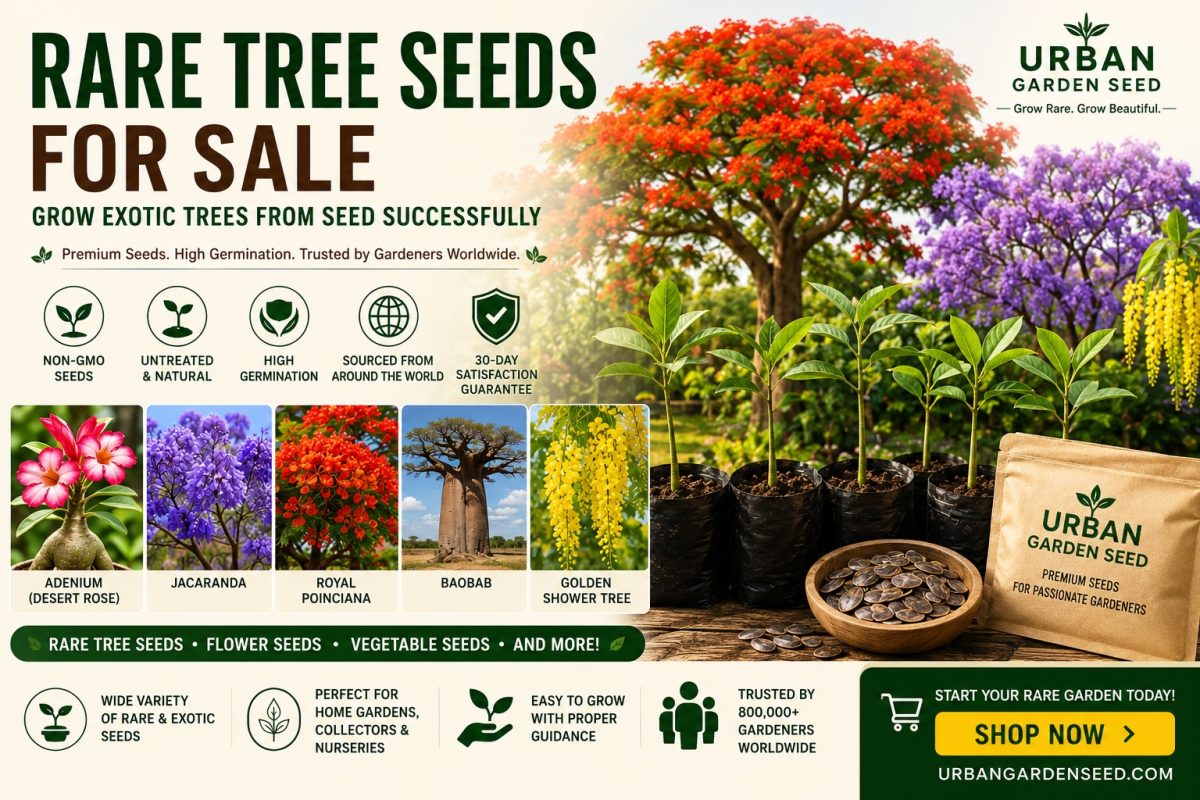
1. Adenium Seeds, also called Desert Rose Seeds
Adenium is a favorite among collectors because of its swollen caudex, beautiful flowers, and suitability for containers. It is excellent for patios, balconies, bonsai-style growing, and warm climates.
Best for: container growing, bonsai-style plants, collectors, tropical gardens
Why gardeners love it: beautiful flowers, sculptural trunk, compact size
2. Jacaranda Seeds
Jacaranda trees are famous for their soft fern-like leaves and stunning purple-blue flowers. They are often planted as ornamental landscape trees in warm climates.
Best for: ornamental landscapes, tropical and subtropical gardens
Why gardeners love it: dramatic purple blooms and graceful shape
3. Royal Poinciana Seeds
Royal Poinciana is one of the most spectacular flowering trees in the world. Its bright red-orange blooms make it a standout tropical landscape tree.
Best for: warm-climate landscapes, large gardens, tropical collections
Why gardeners love it: fiery flowers and fast-growing canopy
4. Baobab Seeds
Baobab trees are iconic, unusual, and highly collectible. They are often grown by plant enthusiasts because of their massive trunk form and ancient-tree appearance.
Best for: collectors, bonsai projects, rare plant enthusiasts
Why gardeners love it: unique trunk, rare appearance, conversation-piece value
5. Golden Shower Tree Seeds
The Golden Shower Tree produces beautiful hanging clusters of yellow flowers. It is a popular tropical ornamental and a favorite for warm-climate gardens.
Best for: tropical gardens, flowering landscapes, collectors
Why gardeners love it: bright yellow cascading flowers
How to Germinate Rare Tree Seeds Successfully
Different tree species have different germination requirements. Some seeds sprout quickly, while others need special preparation. The most important factors are fresh seed quality, moisture, temperature, airflow, and the correct pre-treatment.
Here is a practical seed-starting process.
Step 1: Read the Seed Requirements First
Before planting, check whether your seed type needs any special treatment. Some rare tree seeds have hard seed coats or natural dormancy. In nature, these seeds may germinate only after seasonal changes, weathering, or exposure to specific conditions.
Some seeds may need:
Soaking
Scarification
Cold stratification
Warm stratification
Fresh sowing
Light exposure
Dark germination
USDA Forest Service research on tree and shrub seeds highlights that stratification techniques and moisture regulation can influence germination response in several species.
Step 2: Soak Hard Seeds Before Planting
Many tropical and ornamental tree seeds benefit from soaking before sowing. Soaking helps soften the seed coat and allows moisture to enter the seed.
A general method:
Place seeds in clean room-temperature water.
Soak for 12 to 24 hours.
Plant immediately after soaking.
Do not leave seeds soaking for too long unless the species specifically requires it.
This method is often useful for many hard-coated tree seeds, but not every seed needs soaking. Very small seeds or delicate seeds may be damaged by unnecessary soaking.
Step 3: Use Scarification for Hard-Coated Seeds
Some seeds have a tough outer shell that prevents water from entering. This is called physical dormancy. Scarification helps weaken or open the seed coat so germination can begin.
Common scarification methods include:
Lightly sanding the seed coat
Carefully nicking the outer shell
Using hot-water treatment for suitable species
Mechanical scarification and hot-water treatments have been studied in tree seed research, with results showing improved germination in some hard-coated species when the correct method is used.
Important: scarification must be done carefully. Damaging the embryo inside the seed can prevent germination.
Step 4: Use Stratification When Needed
Some tree and shrub seeds need a period of cold or warm conditions before they germinate. This process is called stratification.
Cold stratification usually means keeping seeds in a slightly moist medium in the refrigerator for a specific period. This mimics winter conditions.
Warm stratification may be needed for some tropical or temperate species before cold stratification.
Forest Service research has shown that stratification length and temperature can affect germination speed and uniformity in certain species.
Not all seeds need stratification. Tropical seeds often prefer warmth instead of cold treatment.
Step 5: Choose the Right Germination Medium
The best seed-starting medium should be:
Light
Clean
Well-draining
Moist but not soggy
Able to hold enough air around the roots
Good options include:
Seed-starting mix
Coco coir
Peat-based seed mix
Perlite blends
Vermiculite blends for suitable species
Avoid heavy garden soil for germinating rare seeds. It may compact too much, hold excess water, and increase the risk of fungal problems.
Step 6: Keep Moisture Consistent
Seeds need moisture to germinate, but too much water can cause rot.
The goal is:
moist, not waterlogged.
Good watering practices:
Mist gently when needed.
Use containers with drainage holes.
Avoid standing water.
Do not let the medium completely dry out.
Use a humidity dome only when helpful, and open it daily for airflow.
Overwatering is one of the most common causes of seed failure. If the growing medium smells sour, grows mold, or stays wet for too long, reduce watering and improve airflow.
Step 7: Maintain the Right Temperature
Many tropical and exotic tree seeds germinate best in warm conditions. For many warm-climate species, a common germination range is about 75°F to 90°F, depending on the plant.
Warmth helps activate growth, but excessive heat can damage seeds. Consistent temperature is usually better than big temperature swings.
Useful tools include:
Seed heat mats
Indoor seed-starting trays
Warm bright windowsills
Greenhouse shelves
Covered propagation containers
Always check the needs of your specific seed variety.
Step 8: Give Seedlings Proper Light After Germination
Once seedlings sprout, they need light to grow strong.
Weak light can cause seedlings to become tall, thin, and leggy. Bright indirect light or grow lights can help seedlings develop stronger stems and healthier leaves.
Seedling care tips:
Move sprouted seedlings to bright light.
Avoid harsh direct sun at first.
Increase light exposure gradually.
Keep air moving gently.
Do not fertilize too heavily when seedlings are very young.
Common Mistakes When Growing Rare Tree Seeds
Mistake 1: Planting Seeds Too Deep
Planting too deep can prevent seedlings from reaching the surface. A common rule is to plant seeds about two to three times as deep as the seed’s diameter. Very tiny seeds may only need to be pressed onto the surface or lightly covered.
Mistake 2: Overwatering
Too much water can suffocate seeds and encourage fungal disease. Always use well-draining media and containers with drainage.
Mistake 3: Giving Up Too Early
Some seeds germinate in days. Others take weeks or months. Rare tree seeds can vary widely by species, freshness, dormancy, and growing conditions.
Mistake 4: Using the Wrong Treatment
Not every seed should be scarified, soaked, or stratified. The wrong treatment can reduce germination instead of improving it.
Mistake 5: Buying Poor-Quality Seeds
Even perfect growing conditions cannot fix old, dead, or poorly stored seeds. Start with a trusted seed supplier.
Why Non-GMO and Untreated Seeds Matter
Many gardeners prefer Non-GMO, untreated seeds because they want a natural seed-starting experience without chemical seed coatings or genetic modification.
Urban Garden Seed proudly offers Non-GMO and untreated seeds for gardeners who care about seed quality, plant diversity, and clean growing practices.
Whether you are growing vegetables for your family, flowers for pollinators, or rare trees for your collection, choosing quality seeds is the first step toward success.
Rare Seeds Are Perfect for Gardeners, Collectors, and Small Growers
Rare seeds are not only for expert botanists. They are also excellent for:
Home gardeners
Balcony gardeners
Bonsai growers
Plant collectors
Homesteaders
Greenhouse growers
Small nursery owners
Flower garden enthusiasts
Vegetable gardeners
Tropical plant lovers
With the right seeds and basic germination knowledge, even beginners can grow beautiful and unusual plants from seed.
Shop Rare Tree Seeds, Flower Seeds, and Vegetable Seeds Online
Urban Garden Seed offers a wide selection of seeds for passionate gardeners, including:
Rare tree seeds
Exotic tree seeds
Tropical seeds
Flower seeds
Vegetable seeds
Heirloom seeds
Non-GMO seeds
Untreated seeds
Container garden seeds
Ornamental plant seeds
If you want to grow something unique, beautiful, and rewarding, start with seeds from UrbanGardenSeed.com.
Frequently Asked Questions About Rare Tree Seeds
What are the easiest rare tree seeds to grow?
Adenium, Jacaranda, Royal Poinciana, Golden Shower Tree, and some Acacia species are popular choices for many growers. Ease of germination depends on freshness, temperature, moisture, and whether the seed needs pre-treatment.
How long do rare tree seeds take to germinate?
Some seeds sprout within a few days, while others may take several weeks or months. Rare and exotic tree seeds vary widely, so patience is important.
Do I need to soak tree seeds before planting?
Some tree seeds benefit from soaking, especially hard-coated seeds. Others do not need soaking. Always check the recommended method for your specific seed.
What is scarification?
Scarification is the process of weakening or opening a hard seed coat so water can enter. It may involve sanding, nicking, or hot-water treatment depending on the species.
What is stratification?
Stratification is a pre-treatment that exposes seeds to specific cold or warm conditions to help break dormancy. It is commonly used for some tree, shrub, and perennial seeds.
Can I grow rare trees in pots?
Yes. Many rare and exotic trees can be started in pots. Some, like Adenium, are especially suitable for container growing. Larger trees may need repotting or outdoor planting as they mature.
Why are my seeds not germinating?
Common causes include old seeds, incorrect temperature, overwatering, planting too deep, lack of dormancy treatment, or poor drainage.
Where can I buy rare tree seeds online?
You can shop rare tree seeds, exotic seeds, flower seeds, vegetable seeds, Non-GMO seeds, and untreated seeds at UrbanGardenSeed.com.
Start Growing Something Rare Today
Your dream garden starts with one seed.
Whether you want a tropical flowering tree, a rare ornamental plant, a vegetable garden, or a collection of unusual plants, Urban Garden Seed gives you access to high-quality seeds trusted by gardeners worldwide.
Visit UrbanGardenSeed.com today and explore our collection of rare tree seeds, flower seeds, vegetable seeds, Non-GMO seeds, and untreated seeds.
Grow rare. Grow beautiful. Grow with Urban Garden Seed.
