
Backyard Gardening, Cactus & Succulent, Family & Kids' Gardening, Flower Seeds, Garden Planning & Design, Herb Seeds, Homesteading & Self-Reliance, Sensory & Wellness Gardening, Sustainable & Regenerative Living, The Horticulturist’s Lab, Urban & Small-Space Gardening, Vegetables
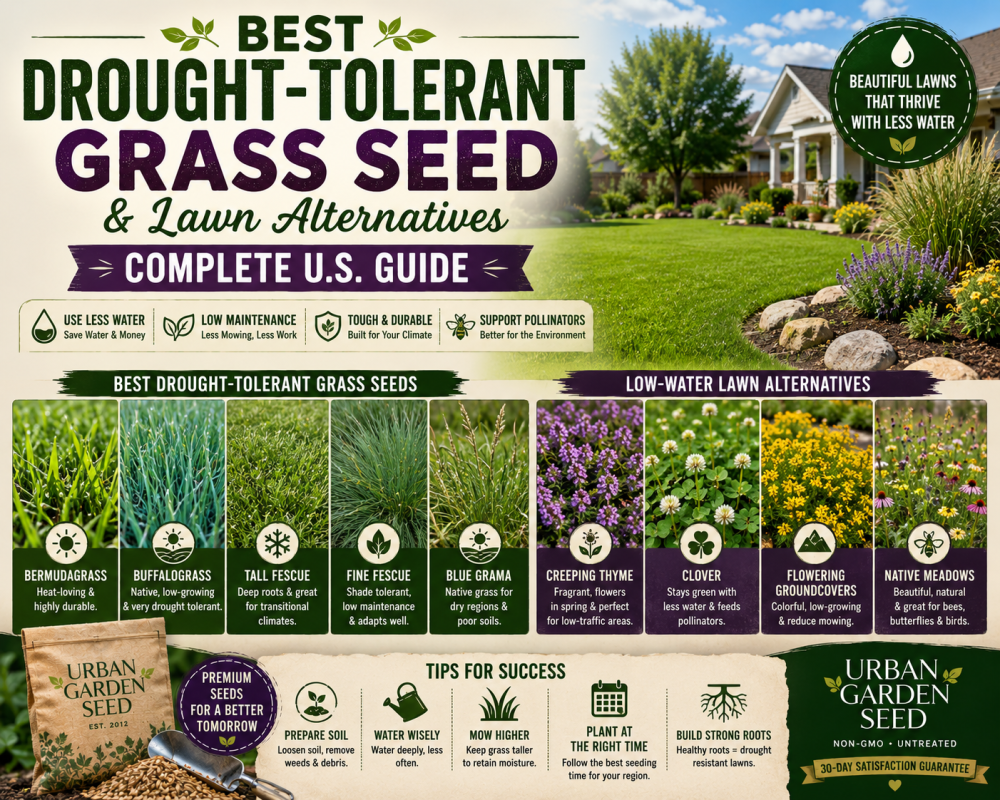
Best Drought-Tolerant Grass Seed & Lawn Alternatives: Complete U.S. Guide
Aug
Keeping a traditional lawn green through extreme summer heat can require a lot of water, time, fertilizer, and maintenance.
That is why more homeowners are asking a different question:
What can I plant instead of a thirsty lawn?
The answer depends on where you live.
A grass that performs well in Texas may struggle in Minnesota. A drought-tolerant lawn for California may not be appropriate for Pennsylvania. Some homeowners still want durable turf, while others would rather replace part of the lawn with flowering ground covers, native-style grasses, or low-maintenance plants.
This guide compares drought-tolerant grass seeds and lawn alternatives for:
- Front yards
- Backyards
- Large residential properties
- Homesteads
- Farms
- Vacation properties
- Slopes
- Pathways
- Low-traffic lawn areas
- Water-wise landscapes
The goal is not to find one “perfect” grass.
The goal is to choose the right plant for your climate, soil, water availability, and how you actually use your yard.
Quick Answer: What Is the Best Drought-Tolerant Grass?
Some of the most commonly considered drought-tolerant grasses include:
- Bermudagrass
- Buffalograss
- Tall fescue
- Fine fescue
- Sheep fescue
- Blue grama
- Zoysiagrass
- Certain regionally adapted native grasses
For areas that do not need conventional turf, possible alternatives include:
- Creeping thyme
- Clover
- Low-growing flowering ground covers
- Native meadow or prairie-style plantings
The best option depends heavily on region.
First: Decide Whether You Need a Traditional Lawn
Before buying grass seed, ask what you actually expect from the area.
Do children play there?
Do dogs run across it?
Do you regularly entertain outdoors?
Is it mainly decorative?
Does anyone walk on it?
Could part of the yard become a flower meadow or ground-cover planting instead?
Traditional turf is useful where people need a durable walking and recreation surface.
But maintaining turf where nobody ever walks may mean spending water and time on an area that could serve another purpose.
A practical landscape can include several zones:
- Durable turf around activity areas
- Drought-tolerant grass in open areas
- Ground cover beside pathways
- Flowering plants around borders
- Pollinator plantings in unused corners
- Vegetable or herb beds where food production is desired
You do not have to replace your entire lawn at once.
1. Bermudagrass
Bermudagrass is one of the best-known warm-season grasses in the United States.
It performs particularly well in warm climates and grows aggressively once established.
Best suited for:
- Southern states
- Hot summers
- Full sun
- High-traffic lawns
- Athletic areas
- Large sunny yards
Why homeowners choose it:
Bermudagrass develops a spreading growth habit that can help fill damaged areas.
It also handles heat better than many cool-season lawn grasses.
Once established, Bermudagrass can survive periods of reduced water by slowing growth or entering dormancy.
Important limitation:
Bermudagrass is a warm-season grass.
It should generally be seeded when soil temperatures are warm enough for germination rather than during cold fall conditions.
In colder climates it may turn brown during winter dormancy.
It also performs poorly in deep shade.
Best choice if:
You live in a warm region and want a durable, sunny lawn.
Product opportunity:
Shop Bermudagrass Seeds at UrbanGardenSeed.com
2. Buffalograss
Buffalograss is a warm-season grass native to portions of the North American Great Plains.
It is often considered for low-water lawns because established plants can survive dry conditions with less irrigation than many conventional turf grasses.
Best suited for:
- Great Plains
- Dry continental climates
- Sunny sites
- Lower-maintenance lawns
- Areas where water conservation is important
Advantages:
- Low-growing habit
- Reduced mowing potential
- Drought tolerance once established
- Adaptation to dry grassland climates
Limitations:
Buffalograss is not ideal everywhere.
It may struggle in:
- Heavy shade
- High rainfall
- Very humid climates
- Constant heavy traffic
Always match the grass to the climate rather than buying it simply because the label says “drought tolerant.”
3. Tall Fescue
Tall fescue is a cool-season grass widely used across much of the United States.
Its relatively deep root system can help it remain more resilient during periods of heat and reduced rainfall than some shallow-rooted cool-season grasses.
Best suited for:
- Transition zones
- Cooler regions
- Lawns receiving both sun and some shade
- Homeowners who want green cool-season turf
Advantages:
- Good heat tolerance for a cool-season grass
- Deep rooting
- Useful across a broad range of climates
- Can handle moderate traffic
Limitations:
Tall fescue does not spread aggressively like Bermudagrass.
Bare patches may require reseeding.
In areas with extremely hot summers, it may still require supplemental irrigation.
4. Fine Fescues
Fine fescues include several grasses known for narrow leaves and relatively low maintenance requirements.
Depending on the type, they can tolerate:
- Shade
- Lower fertility
- Cooler climates
- Reduced mowing
Examples may include:
- Creeping red fescue
- Hard fescue
- Sheep fescue
- Chewings fescue
Best suited for:
Northern and transition climates where homeowners want a lower-input lawn.
Some fine fescues are particularly useful in shaded areas where warm-season turf struggles.
5. Blue Grama
Blue grama is a warm-season native grass found across large portions of central and western North America.
It can tolerate dry conditions and poor soils once established.
Best suited for:
- Western landscapes
- Great Plains
- Naturalistic yards
- Lower-water landscapes
- Meadow-style lawns
Blue grama can be especially attractive when homeowners want a landscape that looks more natural than conventional manicured turf.
6. Zoysiagrass
Zoysiagrass forms a dense warm-season turf and is commonly grown in warmer parts of the United States.
Advantages:
- Dense growth
- Good wear tolerance
- Heat tolerance
- Can reduce weed establishment once mature
Limitations:
Zoysia may establish slowly.
Some types are commonly installed by sod or plugs rather than seed.
It can also become dormant and brown during winter in colder climates.
Which Grass Is Best for Your U.S. Region?
Northeast
Consider:
- Tall fescue
- Fine fescue
- Kentucky bluegrass mixtures where appropriate
For lower-input areas, fine fescues may be particularly useful.
Midwest
Consider:
- Tall fescue
- Fine fescue
- Kentucky bluegrass mixtures
- Buffalograss in suitable western portions
Climate varies substantially between the humid Midwest and the drier Great Plains.
Southeast
Consider:
- Bermudagrass
- Zoysiagrass
- Other locally recommended warm-season grasses
Warm-season turf generally handles southern summer heat better than traditional northern grasses.
Southwest
Consider:
- Bermudagrass
- Buffalograss
- Blue grama
- Regionally appropriate low-water grasses
Water availability should be a major part of the decision.
West Coast
The best choice depends on location.
California alone contains coastal, inland, desert, mountain, and Mediterranean-style climates.
Select based on local climate and irrigation availability rather than using one statewide recommendation.
Pacific Northwest
Cool-season grasses generally dominate, but summer drought can still create stress.
Fine fescues and drought-conscious lawn mixtures may be worth considering depending on location.
When Is the Best Time to Plant Grass Seed?
This is where many homeowners make expensive mistakes.
Cool-season grasses
Cool-season grasses generally establish best when daytime temperatures begin moderating but the soil remains warm.
For many northern regions, late summer through early fall is an important seeding window.
Examples include:
- Tall fescue
- Fine fescue
- Kentucky bluegrass
- Perennial ryegrass
Why fall?
The soil is still warm enough for germination while cooler air reduces stress on young grass.
There is also usually less competition from many warm-season weeds.
Warm-season grasses
Warm-season grasses should generally be established during late spring or early summer when soil temperatures are warm.
Examples include:
- Bermudagrass
- Buffalograss
- Some Zoysia varieties
Trying to establish Bermudagrass late in fall may leave seedlings without enough time to develop before cold weather.
What If You Do Not Want Grass at All?
A growing number of homeowners are reducing lawn area rather than replacing one turfgrass with another.
This can significantly change the amount of irrigation, mowing, and fertilizer required.
Here are several alternatives.
7. Creeping Thyme
Creeping thyme is one of the most popular flowering lawn alternatives.
It forms a low-growing mat with tiny aromatic leaves and small flowers.
Best for:
- Pathway edges
- Between stepping stones
- Rock gardens
- Dry slopes
- Small front-yard sections
- Decorative low-traffic areas
Advantages:
- Fragrant foliage
- Attractive flowers
- Pollinator interest
- Low-growing form
- Reduced mowing
Important:
Creeping thyme is not a replacement for an athletic lawn.
It cannot tolerate the same repeated traffic as durable turfgrass.
It also needs excellent drainage.
Do not plant it in soggy soil.
Product opportunity:
Shop Creeping Thyme Seeds at UrbanGardenSeed.com
8. Clover
Clover is often included in alternative or mixed lawns.
It can create a green surface while producing flowers that attract pollinators.
Advantages:
- Low-growing habit
- Nitrogen-fixing ability
- Pollinator flowers
- Can remain green under conditions that stress some turf grasses
Limitations:
Clover may not be appropriate where homeowners need a highly uniform turf appearance.
Local rules, homeowner association restrictions, and regional suitability should also be checked.
9. Flowering Ground Covers
Many homeowners can replace unused lawn edges with low-growing flowering plants.
Possible uses include:
- Around mailboxes
- Along driveways
- Beside walkways
- Around patios
- On dry slopes
- Between ornamental beds
Ground covers reduce the amount of lawn that needs regular mowing.
Choose plants suited to your climate and avoid invasive species.
10. Native Meadow Plantings
A sunny unused section of lawn can be converted into a regionally appropriate meadow.
A meadow may contain:
- Native grasses
- Wildflowers
- Pollinator plants
- Low-growing perennials
This works especially well for:
- Large lots
- Homesteads
- Rural properties
- Farms
- Areas far from the house
- Slopes that are difficult to mow
A meadow is not maintenance-free.
Weed control during establishment is extremely important.
But once mature, it may require far less weekly mowing than traditional turf.
Drought-Tolerant Does Not Mean No Water
This is one of the most important points in this guide.
Most drought-tolerant grasses and ground covers need regular moisture while they are establishing roots.
A new seedling has a tiny root system.
An established plant may have roots extending far deeper into the soil.
That means a grass advertised as drought tolerant can still fail if newly planted seed is allowed to dry repeatedly.
Think of drought tolerance as:
Greater resilience after establishment.
Not:
Never needs water.
How to Prepare Soil Before Seeding a Lawn
Grass seed performs best when it has direct contact with soil.
Throwing seed onto a thick layer of dead grass often produces disappointing results.
Step 1: Remove debris
Rake away:
- Dead grass
- Leaves
- Heavy thatch
- Loose debris
Step 2: Address weeds
Control aggressive weeds before sowing.
Young grass seedlings compete poorly against established weeds.
Step 3: Loosen compacted areas
Core aeration can improve compacted soil in established lawns.
For bare areas, lightly prepare the surface so roots can penetrate.
Step 4: Level major low spots
Correct obvious drainage and grading problems before planting.
Step 5: Spread seed evenly
Use the recommended seeding rate.
More seed is not automatically better.
Overcrowded seedlings compete with each other.
Step 6: Improve seed-to-soil contact
Lightly rake or press the seed into the surface according to the grass species.
Avoid burying small grass seed too deeply.
How to Water New Grass Seed
Newly seeded soil needs more frequent moisture than an established lawn.
During germination, keep the upper seed zone consistently moist.
Use:
- Light irrigation
- Gentle sprinklers
- Multiple short applications when conditions require them
Avoid creating puddles or washing seed into piles.
Once seedlings begin developing stronger roots, gradually reduce watering frequency and increase the depth of watering.
The long-term goal is to encourage deeper root development.
Should You Overseed or Start Over?
Overseeding may be appropriate when:
- Most of the lawn is still healthy
- Thin areas need improvement
- Summer heat caused moderate damage
- You want to increase turf density
Starting over may be more practical when:
- Large areas are dead
- The wrong grass type was originally planted
- Weeds dominate most of the site
- Soil drainage is poor
- You want to switch completely to another lawn type
Do not spend money on seed until you understand why the previous lawn failed.
If the original problem was:
- Poor drainage
- Deep shade
- Incorrect grass species
- Compacted soil
- Irrigation failure
new seed alone will not solve it.
How to Reduce Lawn Water Use
Choosing better grass is only one part of water-wise lawn care.
Water deeply once established
Frequent shallow watering encourages shallow roots.
Water during cooler parts of the day
Early morning irrigation generally reduces evaporation.
Avoid excessive fertilizer
Heavy nitrogen applications can encourage lush growth that requires more water.
Maintain an appropriate mowing height
Scalping grass can expose soil and stress plants.
Repair irrigation leaks
Broken sprinklers can waste large amounts of water.
Reduce unnecessary lawn area
The easiest square foot of lawn to water is the square foot you replaced with an appropriate low-water landscape.
Lawn vs. Ground Cover vs. Meadow
| Landscape Type | Best For | Foot Traffic | Water Needs After Establishment | Mowing |
|---|---|---|---|---|
| Bermudagrass | Warm sunny lawns | High | Moderate to lower | Regular |
| Tall fescue | Cool/transition lawns | Moderate | Moderate | Regular |
| Buffalograss | Dry sunny regions | Light to moderate | Low | Low |
| Fine fescue | Cool, lower-input lawns | Light to moderate | Low to moderate | Low to moderate |
| Creeping thyme | Decorative areas | Light | Low | Very little |
| Clover mix | Informal lawns | Light to moderate | Low to moderate | Reduced |
| Native meadow | Large unused areas | Very light | Low after establishment | Seasonal |
Use this table as a starting point.
Always confirm that the species you choose is appropriate for your local climate.
Which Option Saves the Most Water?
There is no universal answer.
Water use depends on:
- Climate
- Soil
- Rainfall
- Grass species
- Mowing height
- Irrigation system
- Shade
- Root depth
- Expectations for summer color
A homeowner who allows grass to enter summer dormancy may use far less irrigation than someone who expects a perfectly green lawn through every heat wave.
Likewise, a regionally adapted ground cover may need significantly less water than turf once established.
The biggest savings often come from combining strategies:
- Keep durable turf where people walk and play
- Replace unused lawn with lower-water plants
- Add trees and shrubs where appropriate
- Use ground covers around pathways
- Create pollinator or meadow areas in larger unused sections
Common Drought-Tolerant Lawn Mistakes
Mistake 1: Buying seed based only on the word “drought tolerant”
Climate compatibility matters more.
Mistake 2: Planting warm-season grass in cold fall weather
Bermudagrass needs warm soil.
Mistake 3: Planting cool-season grass during extreme summer heat
New seedlings may struggle badly.
Mistake 4: Assuming new seed does not need water
Young seedlings need consistent moisture.
Mistake 5: Planting creeping thyme in wet soil
Poor drainage can damage thyme roots.
Mistake 6: Expecting ground cover to tolerate football-field traffic
Choose turf for heavy-use areas.
Mistake 7: Ignoring shade
Many heat-loving grasses also require strong sun.
Mistake 8: Seeding without preparing the soil
Seed-to-soil contact is essential.
Why Start Your Landscape From Seed?
Growing grasses, ground covers, and flowers from seed can provide several advantages.
Seeds allow homeowners to:
- Cover larger areas more economically
- Select more varieties
- Establish ground covers gradually
- Create meadow plantings
- Repair bare lawn sections
- Experiment with new landscape designs
Establishment takes patience, but the long-term result can be a landscape better adapted to your property.
Why Buy Seeds From Urban Garden Seed?
Urban Garden Seed offers a wide range of seeds for homeowners, gardeners, homesteaders, landscapers, collectors, and growers.
Our selection includes:
- Grass and ground-cover seeds
- Flower seeds
- Vegetable seeds
- Herb seeds
- Fruit seeds
- Tree seeds
- Specialty plant seeds
- Rare and unusual varieties
Urban Garden Seed focuses on Non-GMO, untreated seeds and backs seed purchases with a 30-Day Satisfaction Guarantee.
Whether you are reseeding a lawn, replacing part of your grass, creating a pollinator strip, building a homestead landscape, or planning a large garden, choosing the right seed is the first step.
Build a Yard That Works With Your Climate
The future of lawn care does not have to mean watering more.
It can mean planting smarter.
Choose grass adapted to your region.
Reduce turf where you do not need it.
Use flowering ground covers in low-traffic areas.
Create meadow plantings on larger properties.
And treat drought tolerance as part of an entire landscape strategy rather than a marketing label.
A resilient yard starts with the right plant in the right place.
Ready to Start?
Explore grass, ground-cover, flower, and landscape seeds at UrbanGardenSeed.com.
Grow smarter. Water wisely. Build a landscape made for your climate.
Frequently Asked Questions
What is the most drought-tolerant grass?
The answer depends on climate. Bermudagrass can perform well in hot southern climates, while buffalograss and blue grama can be useful in dry Great Plains and western regions. Tall and fine fescues may be better options in cooler climates.
Is Bermudagrass drought tolerant?
Established Bermudagrass has good heat and drought resilience compared with many cool-season grasses. It may become dormant and brown during extended drought.
When should Bermudagrass seed be planted?
Bermudagrass is generally seeded during warm weather in late spring or early summer when soil temperatures are high enough for germination.
When should cool-season grass seed be planted?
Late summer through early fall is generally the preferred seeding period in many northern and transition regions.
Can I plant grass seed in August?
Yes, depending on your grass type and region. Late August can be an excellent starting period for cool-season lawn seeding in colder areas, while it may be too late for establishing some warm-season grasses.
What is the best lawn alternative?
For low-traffic sunny areas, creeping thyme, clover, native meadow plants, and other regionally suitable ground covers may work well. Heavy-use areas generally still benefit from durable turf.
Can creeping thyme replace grass?
Creeping thyme can replace grass in sunny, well-drained, low-traffic areas. It is not appropriate for athletic areas or constant foot traffic.
Does drought-tolerant grass still need watering?
Yes. New seed requires consistent moisture during germination and establishment. Mature drought-tolerant plants generally need less irrigation than newly established seedlings.
Should I overseed a drought-damaged lawn?
Overseeding can help when much of the existing lawn remains healthy. Correct drainage, soil, irrigation, shade, or grass-selection problems before reseeding.
Where can I buy Bermudagrass and ground-cover seeds?
Visit UrbanGardenSeed.com to explore Bermudagrass, creeping thyme, ground-cover, flower, vegetable, and specialty seeds.
