
Adenium, Backyard Gardening, Cactus & Succulent, Family & Kids' Gardening, Flower Seeds, Garden Planning & Design, Herb Seeds, Homesteading & Self-Reliance, Sensory & Wellness Gardening, Sustainable & Regenerative Living, The Horticulturist’s Lab, Urban & Small-Space Gardening, Vegetables
Winter Sowing Seeds: The Complete U.S. Guide to Starting Seeds Outdoors
Aug
What if you could start dozens of flowers, vegetables, herbs, and perennial plants without filling your house with seed trays?
No expensive grow-light setup.
No shelves covering the spare bedroom.
No seed trays taking over every sunny window.
Instead, you place the seeds outside during winter and let seasonal temperature changes help determine when they germinate.
That is the idea behind winter sowing.
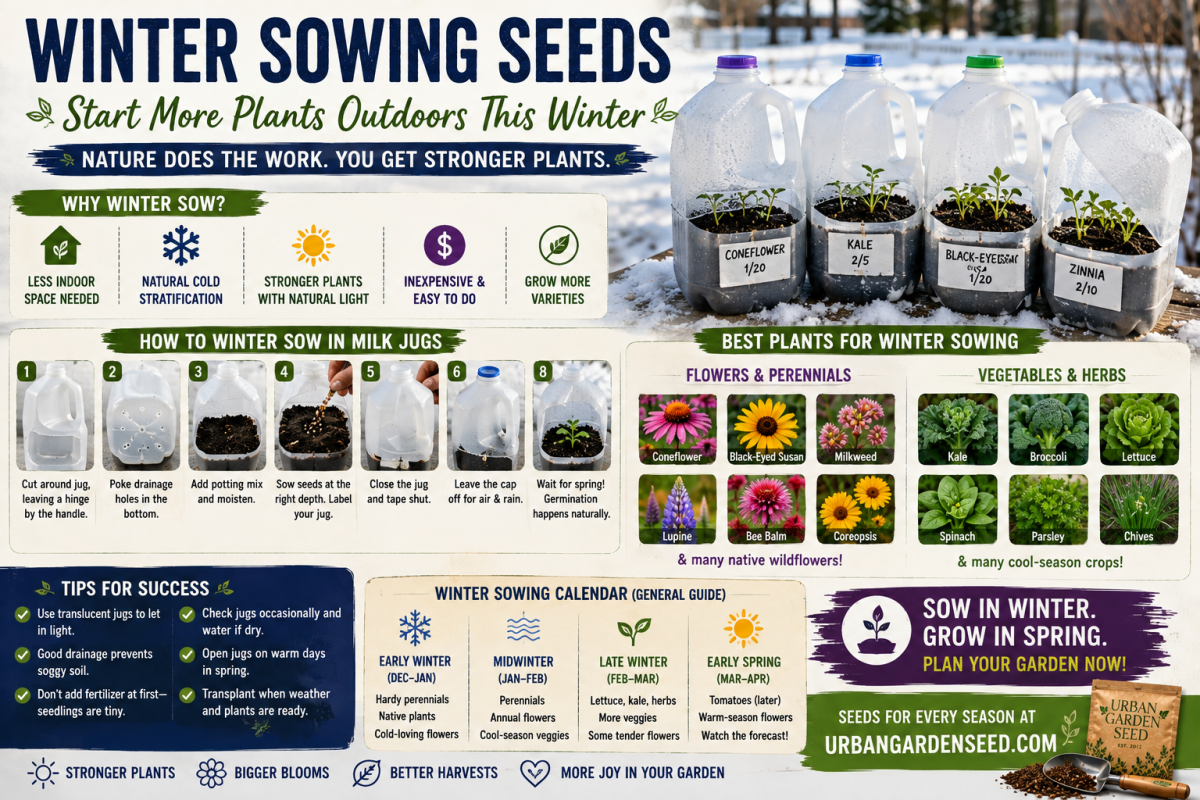
Winter sowing uses covered outdoor containers—often recycled translucent milk jugs—as miniature greenhouses. Seeds remain outdoors through winter and begin germinating when conditions become suitable.
For gardeners trying to grow more plants from seed, it can be an inexpensive and remarkably practical technique.
And although winter may seem far away during late summer, planning early gives you time to choose seeds, save suitable containers, and organize the varieties you want to grow next spring.
What Is Winter Sowing?
Winter sowing is a method of starting seeds outdoors inside ventilated containers during winter.
A translucent container helps protect the seeds and seedlings while still allowing them to experience:
- Cold
- Rain
- Snow
- Temperature fluctuations
- Natural daylight
- Increasing spring warmth
The container functions like a miniature greenhouse.
Seeds that require winter chilling can receive that exposure naturally.
Cold-tolerant seeds remain dormant until conditions become suitable.
When temperatures rise, germination begins without the gardener having to predict the exact day.
Why Are Gardeners Winter Sowing Seeds?
Traditional indoor seed starting works extremely well.
But it requires:
- Indoor space
- Trays
- Strong lighting
- Regular watering
- Temperature management
- Hardening off
- Frequent monitoring
Winter sowing moves much of that process outdoors.
It is especially useful for gardeners who want to start large numbers of flowers and perennials without building an enormous indoor propagation system.
7 Benefits of Winter Sowing
1. You Need Less Indoor Space
Anyone who starts a large garden from seed knows what happens by February and March.
Every table becomes a seed table.
Every shelf holds seedlings.
Grow lights appear everywhere.
Winter sowing allows many suitable plants to remain outside.
Save valuable indoor space for crops that genuinely need warmth, such as peppers and eggplants.
2. Many Seeds Receive Natural Cold Exposure
Some perennial and native plant seeds have dormancy mechanisms that help prevent them from germinating at the wrong time.
Certain species benefit from a period of cold, moist conditions before they will germinate successfully.
Instead of reproducing those conditions artificially in a refrigerator, winter sowing can allow nature to provide them.
Not every seed requires cold stratification.
Always check the individual species.
3. Seedlings Grow Under Natural Light
Winter-sown seedlings emerge outdoors.
That means they develop under natural sunlight rather than stretching toward a distant window.
Strong light can help create more compact seedlings.
The protective container still provides a moderated environment during early growth.
4. Less Traditional Hardening Off
Indoor seedlings must gradually adjust to outdoor sunlight, wind, and changing temperatures.
Winter-sown seedlings already experience outdoor conditions as they develop.
They may still need thoughtful handling before final transplanting, but the transition is often easier because they were never grown entirely inside a controlled house environment.
5. It Can Be Inexpensive
A winter-sowing setup can use containers that might otherwise be discarded.
Common choices include:
- Translucent gallon milk jugs
- Large water jugs
- Clear food containers
- Other food-safe translucent containers
You still need quality growing medium and seeds.
But expensive propagation equipment is not necessarily required.
6. You Can Start More Varieties
Starting 30 perennial flower varieties indoors can become a logistical challenge.
Starting multiple labeled outdoor containers is much more manageable.
That makes winter sowing especially attractive for:
- Pollinator gardens
- Native gardens
- Cottage gardens
- Flower borders
- Large properties
- Homesteads
- Meadow plantings
7. It Makes Seed Growing More Accessible
Not everyone owns:
- A greenhouse
- Grow lights
- Heating mats
- Propagation racks
Winter sowing gives gardeners another option.
A porch, patio, deck, backyard, or protected outdoor area may be enough.
What Seeds Are Best for Winter Sowing?
The strongest candidates are generally plants that tolerate cold conditions or naturally experience winter before spring germination.
Good categories to investigate include:
- Hardy perennial flowers
- Native wildflowers
- Cold-tolerant annual flowers
- Cool-season vegetables
- Certain herbs
- Plants requiring cold stratification
The exact list depends on your climate.
Best Flowers for Winter Sowing
Flower seeds are one of the biggest opportunities for winter sowing.
Depending on species and regional climate, gardeners may consider:
- Coneflowers
- Black-eyed Susans
- Milkweeds
- Columbines
- Lupines
- Bee balm
- Coreopsis
- Asters
- Certain poppies
- Snapdragons
- Calendula
- Sweet alyssum
- Bachelor buttons
- Selected native wildflowers
Do not assume every flower should be started on the same date.
Hardy perennials can often be started earlier in winter.
Tender annuals usually need to wait until later.
Winter Sowing Native Plants
Native plants are particularly interesting candidates because many species naturally drop seeds in summer or fall.
Those seeds remain outdoors through winter before germinating.
Winter sowing can imitate part of that natural cycle while keeping seeds contained and labeled.
This can be useful when growing:
- Native pollinator flowers
- Prairie plants
- Meadow flowers
- Woodland perennials
- Native grasses
However, native does not automatically mean suitable for your property.
Before ordering, verify:
- Geographic native range
- Sun preference
- Soil moisture
- Mature size
- Germination requirements
Choose species appropriate for your actual region.
Winter Sowing Milkweed
Many gardeners become interested in winter sowing because of milkweed.
Milkweed species can have dormancy requirements that make natural winter exposure useful.
But do not treat all milkweed species as interchangeable.
The United States has many milkweed species adapted to different regions and habitats.
Select one appropriate for your area.
Then follow the germination requirements for that specific species.
Winter Sowing Coneflowers
Coneflowers are another popular group for winter sowing.
Certain perennial coneflower species benefit from cold exposure.
Their eventual flowers can add color to:
- Pollinator beds
- Cottage gardens
- Naturalistic landscapes
- Perennial borders
Again, check the exact species and variety.
Can You Winter Sow Vegetables?
Yes.
Several cool-season vegetables can be suitable for winter sowing.
Possible candidates include:
- Kale
- Broccoli
- Cabbage
- Cauliflower
- Brussels sprouts
- Spinach
- Swiss chard
- Lettuce
- Onions
- Leeks
Cold-tolerant vegetables can be especially useful because they are capable of growing during cooler spring conditions.
Winter sowing may allow you to produce transplants without dedicating indoor space to every cool-season crop.
What About Tomatoes?
Tomatoes can be winter-sown using protected outdoor containers, but they should not be treated like cold-hardy perennial flowers.
Tomatoes are frost sensitive.
In cold-winter climates, sow them later in the winter-sowing season when spring is approaching.
Starting them too early during a temporary warm spell can encourage germination followed by damaging cold.
Your local climate matters.
Gardeners in Minnesota and Florida should not follow the same schedule.
What About Peppers?
Peppers generally need more consistent warmth for germination than many other vegetables.
For most gardeners, peppers are better candidates for conventional indoor seed starting with warm growing conditions.
Save valuable indoor propagation space for crops like:
- Peppers
- Eggplants
- Other warmth-demanding plants
Then winter sow suitable cold-tolerant crops outside.
Using both methods creates a more efficient seed-starting system.
Can Herbs Be Winter Sown?
Selected herbs can be.
Depending on species and climate, possibilities may include:
- Parsley
- Chives
- Oregano
- Thyme
- Sage
- Mint
Some perennial herbs benefit from exposure to winter conditions.
Tender herbs such as basil should generally be treated differently because they prefer warm conditions.
Always research the individual herb.
Winter Sowing Calendar
There is no single national calendar.
The United States contains vastly different winter climates.
Use the following as a planning framework rather than fixed planting dates.
Early Winter
Focus primarily on:
- Cold-hardy perennials
- Native species requiring stratification
- Hardy wildflowers
These seeds can benefit from extended exposure to winter conditions.
Midwinter
Continue with:
- Perennial flowers
- Hardy annual flowers
- Native plants
- Cool-season vegetables
January and February are commonly important winter-sowing months in cold and moderate climates.
Late Winter
As spring approaches, begin considering:
- Lettuce
- Kale
- Broccoli
- Cabbage
- Herbs
- Other cool-season vegetables
You may also begin selected less-cold-tolerant flowers based on regional weather.
Early Spring
In climates where freezing weather remains possible, protected outdoor sowing can continue.
Later containers might contain:
- Tomatoes
- Zinnias
- Cosmos
- Other frost-sensitive plants
But timing becomes increasingly dependent on local frost dates and weather forecasts.
Mild-Winter Regions Need a Different Strategy
If you live in:
- Southern California
- Coastal areas
- Florida
- South Texas
- Desert climates
- Other mild-winter regions
you may not have the long, consistently cold conditions experienced by northern gardeners.
Starting hardy seeds extremely early can sometimes cause them to germinate during a warm winter period.
A later sowing schedule may be more appropriate.
The principle is more important than the calendar:
You want the seed to remain dormant until conditions support healthy growth.
How to Winter Sow Seeds in Milk Jugs
Milk jugs are popular because they are inexpensive, translucent, deep enough for growing medium, and easy to modify.
Here is the basic method.
Step 1: Save Translucent Containers
Choose clean food-safe containers that allow light to pass through.
A one-gallon translucent milk jug works extremely well.
Avoid containers that:
- Block nearly all light
- Are too shallow
- Held hazardous substances
- Cannot drain properly
Wash containers thoroughly.
Step 2: Create Drainage Holes
Drainage is essential.
Make several holes in the bottom of each container.
Water needs to escape.
Without drainage, winter rain and melting snow can turn the container into a swamp.
Saturated growing medium can damage seeds and roots.
Step 3: Cut the Jug
Cut around the milk jug horizontally several inches above the bottom.
Leave a small section attached near the handle.
This creates a hinged lid.
The bottom becomes the planting container.
The top becomes the miniature greenhouse cover.
Step 4: Add Growing Medium
Add several inches of quality potting or seed-starting medium.
Do not use an extremely shallow layer.
Seedlings may remain in the container long enough to develop substantial roots.
Moisten the mix before sowing.
It should be evenly moist but not dripping wet.
Step 5: Sow the Seeds
Follow the appropriate planting depth for the species.
Do not use one depth for everything.
Tiny seeds may need to remain near the surface.
Larger seeds can often be planted more deeply.
Label the jug immediately.
Include:
- Plant name
- Variety
- Sowing date
Outdoor labels face rain, snow, sunlight, and temperature changes.
Use a durable labeling method.
Step 6: Close the Container
Bring the top and bottom portions back together.
Secure them appropriately with weather-resistant tape.
The jug should function like a miniature greenhouse while still allowing ventilation.
Do not create an airtight container.
Step 7: Leave the Cap Off
For a typical milk-jug setup, leaving the cap off creates an important ventilation and precipitation opening.
Rain and snow can enter.
Excess heat can escape.
The jug should be protected—not sealed like a jar.
Step 8: Put the Jugs Outside
Place them where they can experience real winter weather.
They should receive:
- Rain
- Snow where applicable
- Cold
- Sunlight
- Seasonal temperature changes
Do not put them inside a heated garage.
That defeats the purpose.
Also avoid placing them directly beneath a roof overhang where they receive no natural moisture.
Choose a stable location where wind will not repeatedly knock them over.
Step 9: Leave Them Alone—but Not Completely
Winter sowing is low maintenance.
It is not no maintenance.
Check periodically.
The growing medium should not become completely dry during extended periods without precipitation.
At the same time, containers should never remain waterlogged.
Drainage and ventilation are critical.
Step 10: Watch for Germination
As days lengthen and temperatures rise, seeds begin responding.
Different containers will germinate at different times.
That is normal.
Do not assume a slow container failed simply because another variety emerged first.
Some perennial seeds are naturally slow.
What to Do When Seedlings Appear
Once seedlings emerge, management becomes more active.
On cold days, the container continues providing protection.
On unusually warm sunny days, temperatures inside a closed jug can rise rapidly.
Increase ventilation as spring progresses.
Eventually, the top can be opened during favorable weather.
Monitor moisture more frequently because growing seedlings consume more water.
When Should You Transplant Winter-Sown Seedlings?
Do not transplant simply because seedlings are visible.
Wait until:
- Plants have developed adequately
- Outdoor conditions suit the species
- Soil can be worked
- Frost tolerance matches current weather
A kale seedling and tomato seedling should not be transplanted on the same schedule simply because they were started with the same technique.
Follow the needs of the crop.
How Many Seeds Should You Put in Each Jug?
You do not need one seed per milk jug.
Many gardeners sow multiple seeds and later divide the seedlings.
But avoid creating an impossibly dense mat.
Remember:
Those tiny seedlings will grow.
Larger seeds and larger mature plants generally need more space.
If you have plenty of containers, spreading varieties across several jugs can make transplanting easier.
What Growing Medium Should You Use?
Use a quality growing medium designed for containers or seed starting.
It should:
- Drain properly
- Hold enough moisture
- Remain loose enough for roots
- Avoid becoming a dense block
Do not fill milk jugs with heavy compacted yard soil.
Container conditions are different from garden-bed conditions.
Do Winter-Sown Seeds Need Fertilizer?
Seeds contain stored energy to begin germination.
Young seedlings generally do not need heavy fertilizer immediately.
If seedlings remain in containers for an extended period, their nutritional requirements may eventually increase.
Use fertilizer cautiously and according to the plant and growing-medium instructions.
More fertilizer does not automatically produce stronger seedlings.
Winter Sowing vs. Indoor Seed Starting
These methods should not be treated as competitors.
The best gardeners use whichever method fits the plant.
Winter sowing works particularly well for:
- Hardy perennial flowers
- Native plants
- Cold-tolerant annual flowers
- Some cool-season vegetables
- Seeds requiring cold stratification
Indoor seed starting works especially well for:
- Peppers
- Eggplants
- Warm-season vegetables
- Crops needing consistent heat
- Plants requiring an especially long controlled growing season
Use both.
That lets you grow significantly more plants without overwhelming your indoor space.
Winter Sowing vs. Direct Sowing
Direct sowing places seed directly into its final garden location.
Winter sowing places seed into a protected container before transplanting.
Both have advantages.
Direct sowing is excellent for crops such as:
- Carrots
- Radishes
- Peas
- Beans
- Many root vegetables
Winter sowing is useful when:
- Seeds need winter conditions
- You want more control over seedlings
- Weed competition would make direct sowing difficult
- You want to grow transplants inexpensively
Choose the method according to the plant.
Common Winter Sowing Mistakes
Starting tender seeds too early
A warm spell can trigger germination before dangerous cold returns.
Forgetting drainage holes
Containers become waterlogged.
Sealing containers completely
Seedlings need ventilation.
Using very little soil
Roots quickly run out of growing space.
Putting containers beneath a covered porch
They may receive too little rain, snow, or light.
Forgetting labels
Twenty green seedlings can look surprisingly similar.
Assuming every seed needs cold stratification
Many do not.
Allowing germinated containers to dry out
Once active growth begins, moisture monitoring becomes more important.
Leaving jugs closed during hot spring weather
Mini-greenhouses can heat rapidly.
Transplanting everything at the same time
Different plants tolerate different temperatures.
A Simple Winter Sowing Plan for Beginners
Do not begin with 75 containers.
Start with five.
Jug 1: Coneflowers
Learn how a perennial behaves.
Jug 2: Black-eyed Susans
Add another pollinator flower.
Jug 3: Kale
Experiment with a cold-tolerant vegetable.
Jug 4: Parsley or chives
Try an herb.
Jug 5: A locally appropriate native flower
Learn about native seed requirements.
Record:
- Sowing date
- First germination
- Weather
- Transplant date
- Final performance
Next winter, expand.
Create a Winter Sowing Seed Collection
Planning becomes easier when seeds are organized by sowing period.
Group A — Hardy Perennials
Seeds that can receive long winter exposure.
Group B — Hardy Annual Flowers
Cold-tolerant annual species.
Group C — Cool-Season Vegetables
Kale, cabbage, broccoli, lettuce and similar crops.
Group D — Herbs
Selected cold-tolerant herbs and perennials.
Group E — Tender Seeds
Warm-season crops to sow much later or start indoors.
This simple organization prevents you from planting everything on one January weekend.
Buy Seeds Before Winter Arrives
One strategic advantage of planning in late summer and fall is selection.
Do not wait until the exact week you want to sow before deciding what to grow.
Create your list ahead of time.
Research each species.
Determine whether it needs:
- Cold stratification
- Early winter sowing
- Late winter sowing
- Indoor starting
- Direct sowing
Then order accordingly.
A well-planned seed collection can supply multiple seed-starting methods throughout winter and spring.
What Should You Winter Sow First?
If your main goal is flowers, begin with:
- Cold-hardy perennials
- Pollinator flowers
- Regionally appropriate native species
If your goal is vegetables, begin with:
- Kale
- Broccoli
- Cabbage
- Lettuce
- Other cool-season crops suited to your region
If your goal is an herb garden, research:
- Parsley
- Chives
- Thyme
- Oregano
- Sage
Start simple.
Learn how your local winter interacts with the containers.
Then improve your system each season.
Why Seed Quality Still Matters
Winter sowing is not magic.
Seeds still need to be viable.
Starting with good seed matters because the containers may remain outside for weeks or months before germination.
Use seeds that are:
- Properly identified
- Appropriate for the intended climate
- Stored correctly
- Suitable for the sowing method
Always review variety-specific germination requirements.
A seed adapted to tropical conditions should not automatically be treated like a cold-hardy perennial simply because both arrived in an envelope.
Why Choose Urban Garden Seed?
Urban Garden Seed offers a broad seed collection for gardeners throughout the United States.
Our selection includes:
- Flower seeds
- Vegetable seeds
- Plant seeds
- Herb selections
- Tree seeds
- Specialty and unusual varieties
For winter sowing, this variety gives gardeners the opportunity to build a collection containing flowers, vegetables, herbs, and longer-term perennial plants.
When selecting seeds, always check the exact species and growing requirements to determine whether winter sowing is appropriate.
Let Winter Start Your Spring Garden
Winter does not have to be the season when gardening stops.
It can be when the next garden begins.
Save a few containers.
Choose the seeds.
Prepare the growing medium.
Label everything.
Place the containers outside.
Then allow winter to do what winter does.
Cold arrives.
Snow falls.
Temperatures change.
Days slowly become longer.
And eventually, inside one of those ordinary milk jugs, something green appears.
That tiny seedling is your first sign that the next growing season has already begun.
Ready to Plan Your Winter-Sowing Garden?
Visit UrbanGardenSeed.com to explore flower, vegetable, herb, plant, tree, and specialty seeds for your next growing season.
Choose your varieties now.
Organize them by planting method.
And when winter arrives, turn those saved containers into miniature outdoor greenhouses.
Sow in winter. Grow into spring. Plant more from seed.
Frequently Asked Questions About Winter Sowing
What is winter sowing?
Winter sowing is a seed-starting method in which seeds are planted inside ventilated containers and placed outdoors during winter. The containers function as small protective greenhouses.
When should I start winter sowing?
Timing depends on climate and species. Cold-hardy perennials may be started during winter, while tender flowers and vegetables should generally be delayed until closer to spring.
What seeds are best for winter sowing?
Hardy perennial flowers, native plants, cold-tolerant annual flowers, and selected cool-season vegetables are among the strongest candidates.
Can you winter sow vegetable seeds?
Yes. Kale, broccoli, cabbage, lettuce, onions and other cool-season vegetables may be suitable depending on climate.
Can tomatoes be winter sown?
They can be started using protected outdoor containers later in the season, but tomatoes are frost sensitive and should not be treated like hardy perennial seeds.
Can peppers be winter sown?
Peppers generally benefit from consistent warmth and are usually better started indoors under warm conditions.
Why do people use milk jugs for winter sowing?
Translucent milk jugs are inexpensive, relatively deep, easy to ventilate, and can function as miniature outdoor greenhouses.
Should the milk-jug cap stay on?
A common winter-sowing setup leaves the cap off to provide ventilation and allow precipitation to enter.
Do milk jugs need drainage holes?
Yes. Proper drainage is essential so seeds and roots are not left in waterlogged growing medium.
Do winter-sown seeds need watering?
Natural precipitation may provide much of the moisture, but containers should still be monitored and watered when the growing medium begins becoming too dry.
Do winter-sown seedlings need grow lights?
No. The seedlings grow outdoors under natural light.
Do winter-sown seedlings need hardening off?
They already experience outdoor conditions, although seedlings should still be transitioned carefully as containers are opened and plants are prepared for their final garden locations.
Can native flowers be winter sown?
Many can, especially species that naturally benefit from winter conditions or cold stratification. Always check the exact species.
Is winter sowing cheaper than indoor seed starting?
It can reduce the need for grow lights, heating equipment, trays and indoor growing space, although quality seed and growing medium are still important.
Where can I buy seeds for winter sowing?
Visit UrbanGardenSeed.com to browse flower and vegetable seeds plus other plant varieties. Check each species’ requirements before deciding whether to winter sow it.
