
Backyard Gardening, Cactus & Succulent, Family & Kids' Gardening, Flower Seeds, Garden Planning & Design, Herb Seeds, Homesteading & Self-Reliance, Sensory & Wellness Gardening, Sustainable & Regenerative Living, The Horticulturist’s Lab, Urban & Small-Space Gardening, Vegetables
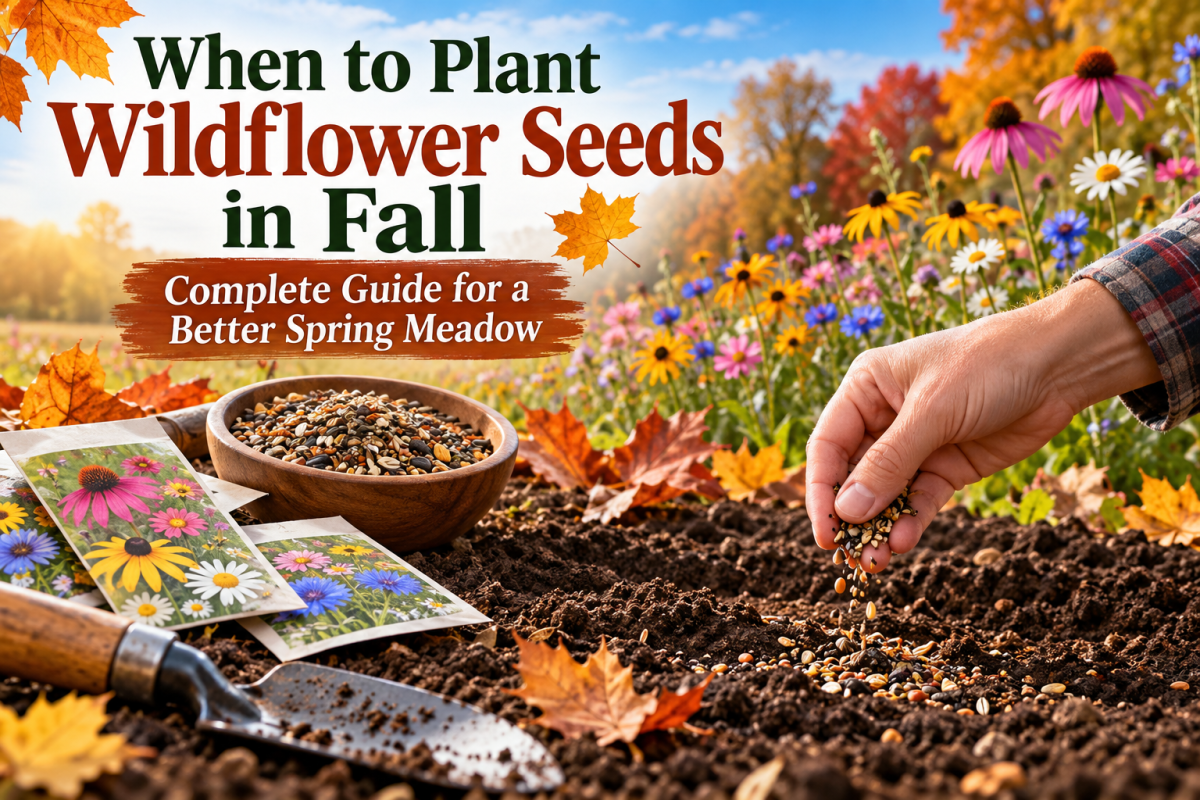
When to Plant Wildflower Seeds in Fall: Complete Guide for a Better Spring Meadow
Sep
Many gardeners assume spring is the best time to plant everything. But when it comes to wildflowers, fall can be one of the best planting seasons of the entire year.
For many perennial and native wildflowers, autumn sowing closely follows what happens naturally. Mature plants release their seeds during late summer and fall. Those seeds remain outdoors through winter, exposed to cold temperatures and moisture, before germinating as conditions become favorable in spring.
That natural winter treatment can be especially beneficial for species whose seeds need cold stratification before they germinate.
If you are wondering when to plant wildflower seeds in fall, the answer depends on your climate, your first frost date, and the species you intend to grow. This guide explains how to time your planting, prepare the soil, sow your seeds, and avoid the mistakes that commonly prevent a wildflower planting from succeeding.
Why Plant Wildflower Seeds in Fall?
Fall sowing can give certain wildflowers a natural head start.
Many perennial and native species have evolved mechanisms that prevent their seeds from germinating immediately after they fall from the parent plant. If they germinated during a brief warm spell in late autumn, the tender seedlings could be killed when winter arrived.
Instead, some seeds remain dormant until they experience an extended period of cold and moisture.
This process is known as cold stratification.
University of Illinois Extension notes that numerous woody plants and herbaceous perennials require temperature changes to break dormancy. Examples include milkweed, purple coneflower, false indigo, and black-eyed Susan. Illinois Extension
By planting suitable seeds outdoors in fall, gardeners can allow winter weather to provide this treatment naturally rather than recreating it later in a refrigerator.
When Should You Plant Wildflower Seeds in Fall?
The ideal date is not the same everywhere.
For many cool-climate gardeners, the goal is to sow late enough that the seeds are unlikely to germinate before winter, but early enough that the soil is still workable.
In northern New England, for example, University of New Hampshire Extension describes a fall wildflower seeding season stretching roughly from late September into early December, with mid- to late October often providing a useful planting window. Conditions vary considerably from year to year and region to region. Extension | University of New Hampshire
That does not mean every gardener should plant in October.
A gardener in Minnesota, Montana, or southern Canada may need to sow earlier than someone gardening in Virginia, Tennessee, or the Pacific Northwest.
A better rule is to watch local temperatures and soil conditions rather than relying only on the calendar.
General Fall Wildflower Planting Timeline
| Climate | Typical Fall Sowing Approach |
|---|---|
| Very cold northern regions | Early to mid-fall before the ground freezes |
| Northern and central U.S. | Mid to late fall |
| Transition zones | Late fall as temperatures remain consistently cool |
| Mild-winter regions | Late fall into early winter, depending on species |
| Warm frost-free climates | Check individual species requirements; traditional cold stratification may not occur naturally |
Always check the growing requirements for the individual species you are planting.
Don’t Plant Too Early
One of the biggest fall-seeding mistakes is planting while the soil is still warm enough for rapid germination.
You generally want seeds that require winter stratification to remain dormant rather than producing vulnerable seedlings immediately before freezing weather.
An unusually warm autumn can complicate timing, so gardeners should consider current conditions rather than simply planting on the same date every year.
If your region normally experiences a true winter, sowing closer to the onset of consistently cold weather can reduce the chance of premature germination.
Choose Wildflowers Suited to Your Region
A beautiful photograph on a seed package does not necessarily mean every species in that mixture is appropriate for your garden.
Wildflowers differ in their requirements for sunlight, moisture, soil type, temperature, and winter chilling.
Before planting, consider whether your site is sunny or shaded, whether the soil drains quickly or remains moist, and which plants are appropriate for your USDA hardiness zone and local ecosystem.
Native species can be particularly valuable in pollinator-focused landscapes because they can provide habitat and food resources for local insects and wildlife.
University of New Hampshire Extension notes that wildflower meadows can provide floral resources, nesting habitat, shelter, stormwater benefits, and food for a wide variety of wildlife. Extension | University of New Hampshire
Wildflowers That May Benefit From Fall Sowing
Many popular perennial flowers can benefit from winter exposure, although germination requirements differ by species.
Plants commonly associated with cold-stratification requirements include purple coneflower, milkweed, bee balm, columbine, black-eyed Susan, gentian, and several other native perennial species. Illinois Extension
The important point is that not every wildflower seed needs exactly the same treatment.
Some need only a short cold period. Others need considerably longer. Some have hard seed coats that may require scarification in addition to stratification.
Always check the germination instructions for the specific seeds you purchase.
Prepare the Site Before You Sow
Good seed will not compensate for poor site preparation.
One of the biggest misconceptions about wildflower gardening is that you can simply throw seed onto an established lawn and expect a meadow to develop.
Existing turfgrass and perennial weeds are already established and have extensive root systems. They can quickly outcompete emerging wildflower seedlings.
University of New Hampshire Extension emphasizes that successful meadow establishment requires preparing a clean seedbed and reducing competing vegetation before sowing. Extension | University of New Hampshire
Remove dense weeds, grasses, fallen debris, and excessive plant material from the planting area.
However, avoid unnecessarily deep cultivation immediately before planting because disturbing deeper soil can bring dormant weed seeds to the surface.
The objective is a relatively clean surface where your wildflower seeds can make direct contact with the soil.
Seed-to-Soil Contact Matters
Wildflower seeds need contact with the soil to absorb moisture and establish themselves.
After broadcasting your seeds, gently press them into the surface.
For very small wildflower seeds, deep burial can actually reduce germination.
UNH Extension recommends only very light raking—approximately ¼ inch where appropriate—or pressing the seed into firm soil with a roller or similar method. Extension | University of New Hampshire
Think contact rather than burial.
How to Spread Tiny Wildflower Seeds Evenly
Wildflower seeds can be surprisingly difficult to distribute evenly because many are extremely small.
A practical approach is to mix the seeds with a larger volume of a clean carrier such as sand or vermiculite. This gives you more material to work with and makes it easier to see where you have already planted.
For a larger area, divide your seed into two portions.
Spread the first portion while walking in one direction across the garden. Then spread the second portion while walking perpendicular to your first passes.
This cross-pattern helps reduce bare areas and excessively dense patches.
Should You Fertilize Before Planting Wildflowers?
Usually, more fertilizer is not necessarily better.
Many wildflower species perform well in soils that are not excessively fertile. Heavy fertilization may instead encourage aggressive grasses and weeds.
A soil test is much more useful than automatically adding fertilizer.
If your soil has a serious pH or nutrient problem, amend it based on reliable soil-test recommendations rather than guessing.
What Happens to the Seeds During Winter?
After sowing, the garden may appear completely inactive.
That is normal.
Cold-stratification-dependent seeds are undergoing biological changes that prepare them for eventual germination.
Cold, moist winter conditions help signal that winter has occurred and that warmer spring conditions can eventually trigger growth.
Illinois Extension describes this dormancy mechanism as a survival strategy that helps prevent seeds from germinating at an inappropriate time. Illinois Extension
So although nothing may appear to be happening above ground, winter can be an important part of the germination process.
When Will Fall-Planted Wildflowers Bloom?
Do not expect every perennial wildflower to produce a spectacular display immediately.
Some species germinate quickly and may flower during their first growing season. Others concentrate on developing roots and foliage before producing significant blooms in later years.
Meadow plantings in particular should be considered a long-term project.
UNH Extension notes that many wildflowers grow primarily roots and leaves during the first season and that some species may take multiple seasons to become established. Extension | University of New Hampshire
This is one reason mixtures containing both annual and perennial flowers can be useful. Annuals can provide earlier color while slower-growing perennial species establish themselves.
Can You Plant Wildflower Seeds After a Frost?
Yes, depending on the species and your local conditions.
In fact, dormant seeding after temperatures have fallen can be useful because the seeds are less likely to germinate immediately.
The more important limitation is whether the ground is still accessible and whether the seeds can achieve good soil contact.
Once the soil is deeply frozen or covered with persistent snow, preparing a new seedbed becomes considerably more difficult.
Fall Planting vs. Spring Planting
Neither season is universally better.
Spring planting works well for many annuals and flowers that do not require cold stratification.
Fall planting is particularly useful for perennial and native species that benefit from winter exposure.
Some gardeners even use both approaches, sowing certain species in autumn and others in spring to diversify establishment and bloom timing.
The correct method ultimately depends on the seed.
The Most Important Rule: Read the Seed Instructions
Wildflower seeds are not interchangeable.
Some prefer surface sowing. Others need shallow covering. Some require weeks or months of cold stratification. Some germinate readily without any cold treatment.
For the best results, identify the species you are growing and follow its specific germination requirements.
This becomes especially important when planting perennial, native, or specialty flower seeds.
Start Your Wildflower Garden This Fall
Fall does not have to mean the end of the gardening season.
For many wildflowers, it can be the beginning of next year’s garden.
By selecting suitable varieties, preparing the planting area carefully, providing good seed-to-soil contact, and allowing winter to provide natural stratification where appropriate, you can establish a garden that returns with color and life as temperatures warm.
Whether you are creating a small pollinator patch, adding flowers around an existing garden, or developing an entire wildflower meadow, starting from seed offers an economical way to grow a diverse landscape.
Explore Urban Garden Seed’s selection of flower and specialty seeds and start planning what you’ll grow next.
