
Adenium, Backyard Gardening, Cactus & Succulent, Family & Kids' Gardening, Flower Seeds, Garden Planning & Design, Herb Seeds, Homesteading & Self-Reliance, Sensory & Wellness Gardening, Sustainable & Regenerative Living, The Horticulturist’s Lab, Urban & Small-Space Gardening, Vegetables
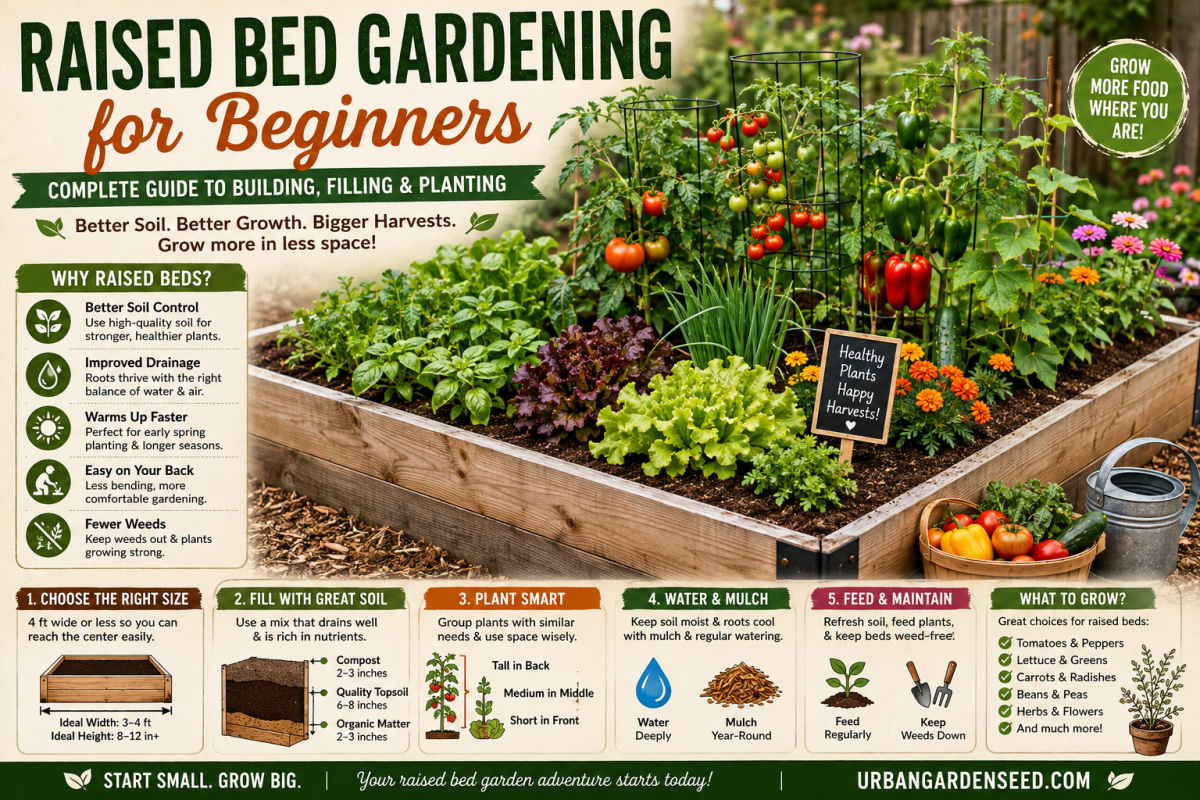
Raised Bed Gardening for Beginners: Complete Guide to Building, Filling & Planting
Aug
A productive vegetable garden does not need acres of land.
It does not require perfect native soil.
And it certainly does not need to begin with a tractor.
For millions of gardeners, one of the simplest ways to start growing food is with a raised bed garden.
Raised beds give you greater control over where you grow, what soil you use, how plants are spaced, and how easily you can reach your crops.
A well-designed raised bed can produce tomatoes, peppers, lettuce, carrots, beans, cucumbers, herbs, flowers, and many other crops in a relatively compact area.
But successful raised-bed gardening begins before you buy lumber or open a packet of seeds.
You need to choose the right location, bed dimensions, soil, crops, irrigation method, and planting schedule.
This complete beginner’s guide walks through the process from an empty yard to your first harvest.
What Is a Raised Bed Garden?
A raised bed is a defined growing area in which the soil surface is elevated above the surrounding ground.
Some raised beds are framed with wood, metal, stone, brick, or other materials.
Others are simply mounded areas of soil without permanent sides.
The concept is simple:
Create a permanent growing area.
Keep walking paths outside it.
Fill or improve the bed with suitable soil.
Plant crops intensively enough to use the space efficiently without overcrowding them.
Raised beds can be used for vegetables, herbs, flowers, strawberries, perennial crops, pollinator plants, or combinations of several plant types.
Why Are Raised Beds So Popular?
Raised beds solve several common gardening problems at once.
They can give you greater control over soil quality when the native ground is rocky, compacted, poorly drained, or otherwise difficult to grow in.
They can also reduce soil compaction because gardeners work from pathways instead of repeatedly stepping into the growing area.
Raised beds often warm earlier during spring than surrounding ground, which can be useful for early cool-season crops.
They are also easy to organize.
One bed can contain salad greens.
Another can contain tomatoes and peppers.
Another can grow herbs and flowers.
As your experience increases, additional beds can be added without redesigning the entire property.
Start With the Right Location
Location matters more than the appearance of the raised bed.
Before building anything permanent, observe the property.
Most fruiting vegetables such as tomatoes, peppers, cucumbers, beans, and eggplants perform best with abundant direct sunlight.
For these crops, look for approximately six to eight hours of direct sun when possible.
Also consider water access.
A beautiful raised bed located far from the nearest faucet becomes frustrating during July heat.
Place the garden where watering is convenient.
Finally, consider accessibility.
You should be able to reach the garden easily for harvesting, watering, weeding, and daily observation.
A garden you walk past every day is much easier to manage than one hidden in a forgotten corner of the property.
What Is the Best Size for a Raised Bed?
There is no universal size, but one principle matters more than almost anything else:
You should be able to reach the center without stepping into the bed.
A width of about four feet works well for many beds that can be accessed from both sides.
If the bed sits against a wall or fence and can only be reached from one side, make it considerably narrower.
Length is flexible.
Common home-garden dimensions include:
4 × 4 feet.
4 × 6 feet.
4 × 8 feet.
4 × 12 feet.
Beginners often find a 4 × 8-foot bed large enough to produce a meaningful harvest while remaining manageable.
Do not assume bigger is automatically better.
It is easier to maintain two organized beds than one enormous bed you cannot comfortably reach.
How Deep Should a Raised Bed Be?
Many framed vegetable beds are approximately 8 to 12 inches high.
That provides useful growing depth for a wide range of common vegetables when the bed is positioned over usable ground.
Deeper beds can be beneficial when:
The soil underneath is extremely poor.
The bed is installed over a hard surface.
You want easier access with less bending.
You plan to grow crops requiring substantial root space.
You are constructing a tall accessible garden.
Remember that a 30-inch-tall bed requires dramatically more material to fill than a 10-inch bed.
Do not build unnecessary depth simply because a photograph on social media looks impressive.
Design around the crops, site, accessibility needs, and budget.
What Material Should You Use?
Raised beds can be constructed from many materials.
Wood is popular because it is relatively easy to work with and gives gardens a traditional appearance.
Metal raised beds have become increasingly popular because they are available in many sizes and can provide long service life.
Stone and brick can create attractive permanent beds but require more labor and expense.
Fabric raised beds and grow-bed systems offer another alternative when portability is important.
Before using any reclaimed construction material, make sure you know what it contained or how it was treated.
Avoid materials that could introduce unwanted chemicals or contaminants into food-growing soil.
What Should You Put at the Bottom?
This depends on what lies underneath.
If you are building directly over healthy garden soil, you may not need a complicated bottom layer.
If you are converting lawn, existing grass and weeds need to be controlled before they become persistent problems.
If burrowing animals are a serious local issue, appropriate hardware cloth may be installed beneath some framed beds.
Avoid filling the entire lower half of an ordinary vegetable bed with random garbage, plastic, or materials simply to avoid purchasing soil.
The root zone should remain stable and suitable for plant growth.
What Is the Best Soil for Raised Beds?
This is one of the most important decisions you will make.
Raised-bed soil needs to perform several jobs simultaneously.
It should retain useful moisture without remaining permanently waterlogged.
It should allow oxygen around roots.
It should provide nutrients.
And it should remain structurally useful through repeated seasons.
Avoid filling an entire bed with extremely heavy native clay.
Also avoid assuming that 100% compost is automatically the ideal permanent growing medium.
A practical raised-bed mix often contains good-quality soil combined with finished compost and other appropriate organic material.
The exact mixture depends on what is available locally.
The most important qualities are good drainage, reasonable water retention, appropriate fertility, and freedom from contaminants.
When buying bulk soil, ask the supplier what the material actually contains.
“Garden mix” is not a standardized recipe.
Should You Test Raised-Bed Soil?
Yes, particularly after the garden has been in production for several seasons.
A soil test can help identify pH and nutrient conditions before you begin adding fertilizer simply because plants look unhappy.
Repeated annual applications of compost and fertilizer can eventually cause certain nutrients to accumulate.
More fertility is not always better.
Apply amendments according to actual need.
Never Walk Inside the Bed
One major advantage of raised beds is maintaining loose growing soil.
Do not defeat that advantage by repeatedly standing in the bed.
Create permanent pathways.
Reach plants from the sides.
Use a narrow board temporarily only when absolutely necessary in very large beds.
Keeping foot traffic out of the root zone helps reduce compaction.
This is also why bed width matters so much.
What Are the Best Vegetables for Raised Beds?
Raised beds can grow almost every common garden vegetable.
For beginners, some especially useful crops include lettuce, radishes, carrots, beets, beans, peas, tomatoes, peppers, cucumbers, kale, Swiss chard, onions, herbs, and zucchini when adequate space is available.
The secret is not finding vegetables labeled “for raised beds.”
The secret is matching each crop’s mature size to the available space.
Lettuce
Lettuce is one of the easiest raised-bed crops.
It grows quickly and can make excellent use of cooler spring and fall conditions.
Leaf lettuce is especially useful because individual outer leaves can often be harvested while the plant continues growing.
Lettuce also fits into spaces that would be inadequate for large tomatoes or squash.
Use it at the front of beds or between crops that will become larger later.
Radishes
Radishes are ideal for beginners because many varieties mature quickly.
They are excellent for succession planting.
Rather than sowing the entire packet on one day, plant smaller quantities at intervals during suitable weather.
This spreads the harvest.
Radishes can also occupy temporary spaces before larger warm-season vegetables fill the bed.
Carrots
Raised beds can be excellent for carrots because you have more control over soil texture.
Carrots perform best in loose soil without large rocks or severe compaction.
Choose the carrot variety according to available soil depth.
Shorter varieties can be useful when growing depth is limited.
Direct sow carrots where they will mature rather than routinely transplanting them.
Beets
Beets give gardeners two useful harvests.
The roots are edible.
The leaves are edible too.
Give seedlings enough room for root development and avoid excessive crowding.
Beets fit beautifully into mixed spring and fall raised beds.
Beans
Bush beans provide substantial production without requiring a tall support structure.
Pole beans use vertical space and can be trained onto trellises.
That makes beans extremely flexible.
Place trellises where they will not shade lower crops excessively.
In many Northern Hemisphere gardens, locating the tallest structures toward the north side of the bed can reduce shading of shorter plants.
Peas
Peas are another excellent vertical crop.
They prefer cooler conditions than summer beans and can be grown on trellises during spring or fall where climate permits.
Use the same vertical-space principle:
Grow upward instead of allowing every plant to occupy valuable horizontal ground.
Tomatoes
Tomatoes can thrive in raised beds.
But one tomato seedling can eventually become a very large plant.
Do not overcrowd them.
Use strong cages, stakes, or trellises from the beginning.
Indeterminate tomatoes can continue growing throughout the season and may require substantial vertical support.
Compact or determinate varieties may fit smaller beds more easily.
Peppers
Peppers work well in raised beds because they appreciate warm conditions and good drainage.
They generally require less horizontal space than huge indeterminate tomato plants.
Grow sweet peppers, hot peppers, or unusual colored varieties depending on what your household enjoys.
Cucumbers
Cucumbers can consume a surprising amount of space when allowed to trail across the ground.
Train suitable varieties vertically.
A sturdy trellis can turn a cucumber plant from a sprawling ground crop into a productive vertical feature.
Vertical growing also makes fruit easier to spot and harvest.
Zucchini and Summer Squash
Zucchini is productive but enormous.
One mature plant can occupy a significant portion of a small raised bed.
Give it room.
Do not plant four zucchini seedlings in a tiny bed because they looked small at the garden center.
Plan according to mature dimensions.
Herbs
Herbs fit naturally into raised-bed gardens.
Basil works beautifully around tomatoes and peppers when their growing requirements are compatible.
Parsley, dill, chives, cilantro, thyme, oregano, and other herbs can occupy edges or dedicated sections.
Be careful with aggressively spreading plants such as mint.
Mint is usually easier to manage in its own container.
Add Flowers to the Vegetable Garden
Raised beds do not need to contain only food crops.
Flowers can add color and attract insects to the garden.
Depending on your climate and planting objectives, consider flowers such as marigolds, zinnias, nasturtiums, calendula, alyssum, or regionally appropriate pollinator plants.
Use smaller flowers around bed edges.
Place taller flowers where they will not shade vegetables excessively.
A productive raised bed can also be beautiful.
A Simple 4 × 8-Foot Beginner Layout
Imagine an eight-foot-long bed receiving strong sunlight.
Along the back, install a trellis.
Grow peas there during the cool season, then transition to cucumbers or pole beans when conditions become warm.
Place two tomato plants or several peppers in the middle portion, depending on mature size.
Use the front for lettuce, radishes, carrots, herbs, and compact flowers.
The result uses three dimensions:
Tall crops above.
Medium crops in the middle.
Small crops below.
This is much more efficient than treating the bed like a miniature farm field with wide empty rows.
Do Not Overcrowd the Bed
Raised-bed gardening encourages efficient spacing.
It does not eliminate plant competition.
Overcrowded crops compete for:
Light.
Water.
Nutrients.
Root space.
Dense foliage can also reduce airflow.
That may increase disease pressure.
Follow mature spacing recommendations for each variety.
A garden that looks slightly empty after planting can look completely full six weeks later.
Use Succession Planting
One raised bed can produce several crops during a year.
For example, you might grow peas and lettuce in spring.
After those crops finish, plant beans or cucumbers.
Later, transition back into radishes, kale, lettuce, or another suitable cool-season crop.
The exact sequence depends on climate.
This technique is called succession planting.
Instead of asking, “What do I plant in this bed this year?” ask:
What can this bed produce during each part of the growing season?
Use Your Local Frost Dates
The United States does not have one vegetable-planting calendar.
Planting time should be based on local climate, frost dates, soil temperature, current weather, and the specific crop.
Cool-season vegetables can often tolerate conditions that would damage tomatoes, peppers, cucumbers, and beans.
Do not plant all vegetables on the same weekend just because spring has arrived.
Use crop-specific timing.
Watering Raised Beds
Raised beds often drain well.
That is helpful for roots.
But it also means they can dry more quickly than surrounding in-ground soil.
New gardeners sometimes underestimate this.
Check moisture regularly, especially during:
Hot weather.
Dry wind.
Flowering.
Fruit production.
The goal is consistent root-zone moisture rather than constant surface sprinkling.
Water deeply enough to reach roots.
Then allow actual soil conditions to determine when to irrigate again.
Drip Irrigation Can Save Time
For several raised beds, drip irrigation can simplify watering.
A basic system can deliver water near plant roots while reducing unnecessary wetting of pathways and foliage.
Timers can make the system even more convenient.
But automation should not replace observation.
A broken emitter, clogged line, or unexpected heat wave can still stress plants.
Visit the garden.
Look at the soil.
Look at the plants.
Mulch the Surface
Mulch can help conserve moisture and suppress some weeds.
Suitable materials may include straw, shredded leaves, or other locally appropriate organic mulches.
Do not bury newly germinating tiny seeds beneath thick coarse mulch.
Keep direct-sowing rows clear until seedlings become established.
Then mulch around them where useful.
Fertilizing a Raised Bed
Raised beds can be productive enough that gardeners are tempted to fertilize constantly.
Avoid that approach.
Nutrient requirements depend on:
The crop.
Existing soil.
Compost history.
Previous fertilizer applications.
Tomatoes, leafy greens, carrots, and beans do not all need identical fertility management.
A soil test gives you a much better starting point than guessing.
Rotate Crops When Practical
Growing the same plant family in the same soil repeatedly can increase certain disease and pest problems.
When you have multiple beds, rotate crop families when practical.
For example, tomatoes, peppers, potatoes, and eggplants are related.
Moving from tomatoes to peppers is not a meaningful family rotation.
Likewise, broccoli, cabbage, kale, cauliflower, radishes, and turnips are all members of the brassica family.
Keeping basic records makes rotation much easier.
Keep a Garden Journal
Record what you plant.
Write down:
Variety.
Sowing date.
Transplanting date.
Harvest date.
Production.
Flavor.
Pest problems.
Disease issues.
Whether you would grow it again.
This information becomes more valuable every year.
You will eventually know which tomato performs best in your bed, which lettuce survives your spring weather, and which cucumber your family actually likes.
That knowledge is more useful than any generic national planting list.
Extend the Growing Season
Raised beds are easy to cover.
Simple hoops can support row cover during cold weather.
More substantial structures can turn the bed into a temporary low tunnel.
Cold frames can also be built over suitable beds.
Season extension can help gardeners grow cold-tolerant crops earlier in spring or later into fall.
Good candidates may include:
Spinach.
Lettuce.
Kale.
Radishes.
Other locally appropriate cool-season crops.
Do not expect row cover to turn a Minnesota January into tomato season.
Use season extension to modify conditions—not ignore climate completely.
Common Raised-Bed Gardening Mistakes
The first major mistake is placing the bed in poor light.
Beautiful construction cannot compensate for deep shade when you want to grow tomatoes.
Another mistake is building the bed too wide.
If you must step inside to reach the center, the design is working against you.
Poor soil is another common problem.
Do not spend hundreds of dollars building an attractive frame and then fill it with unknown low-quality material.
Overcrowding causes problems too.
So does ignoring irrigation.
Raised beds can dry surprisingly quickly in summer.
Finally, avoid planting vegetables simply because they are popular.
Grow what your household will actually eat.
Garden space is valuable.
How Many Raised Beds Do You Need?
Start with one or two.
A single 4 × 8-foot bed can teach you almost everything you need to know about:
Direct sowing.
Transplanting.
Watering.
Mulching.
Spacing.
Harvesting.
Succession planting.
Adding eight beds immediately means eight times the soil, irrigation, maintenance, and planning.
Expand after you understand how much produce and garden work your household actually wants.
Raised Beds for a Homestead
Larger properties can use raised beds as part of a broader food-production system.
Permanent beds might grow:
Salad crops.
Herbs.
High-value vegetables.
Seed crops.
Perennial vegetables.
Meanwhile, larger field areas can produce potatoes, corn, squash, storage crops, or other crops better suited to greater acreage.
Raised beds do not have to replace traditional growing.
They can become the intensively managed core of the garden.
Raised Beds for Flowers
Flowers grow beautifully in raised beds.
A dedicated flower bed can contain:
Zinnias.
Cosmos.
Sunflowers.
Snapdragons.
Calendula.
Pollinator flowers.
Cut flowers.
Raised flower beds make harvesting easy and keep valuable flower varieties organized.
They can also sit beside vegetable beds to create an attractive mixed garden.
What Should a Beginner Plant First?
Keep the first season manageable.
A strong beginner raised bed might include lettuce, radishes, bush beans, one or two tomatoes, basil, carrots, and several flowers.
That collection teaches several different growing techniques.
You direct sow roots.
You transplant tomatoes.
You harvest leafy greens.
You grow a fruiting crop.
You use herbs.
You observe flowers and pollinators.
By the end of one season, you will understand your garden much better.
Why Starting From Seed Works So Well
Raised beds and seeds are a natural combination.
A small amount of carefully prepared soil can grow many plants from relatively inexpensive seed packets.
Starting from seed also gives you access to varieties that may never appear at local garden centers.
Instead of choosing from three tomatoes, you may choose from dozens.
Instead of buying one color of carrot, you can grow a rainbow mixture.
Instead of one common lettuce, you can create an entire salad blend.
Seed transforms a raised bed from a wooden box filled with soil into a garden designed around your own preferences.
Why Choose Urban Garden Seed?
Urban Garden Seed offers vegetable, flower, herb, fruit, tree, and specialty seeds for gardeners growing in raised beds, backyards, homesteads, containers, and larger properties.
A raised-bed garden gives you the opportunity to build a diverse collection from seed.
Choose fast crops for early harvests.
Add warm-season vegetables for summer.
Use herbs around the edges.
Grow flowers for beauty and pollinators.
Then plant another cool-season crop when summer begins to end.
The bed remains the same.
The garden continually changes.
Build One Bed and Start Growing
Do not wait until you can build the perfect garden.
Choose a sunny location.
Build one manageable bed.
Fill it with good soil.
Plan what your family actually eats.
Choose quality seeds.
Plant according to the season.
Water consistently.
Keep records.
Then harvest something.
Your first raised bed does not need to feed your entire family for a year.
It needs to teach you how to grow.
Once it does that, adding the second bed becomes much easier.
Then the third.
Eventually, what began as one small growing area can become a highly productive home garden.
Ready to Start Your Raised Bed Garden?
Explore vegetable, herb, flower, and specialty seeds at UrbanGardenSeed.com and choose varieties for your next raised-bed growing season.
Build the bed. Plant the seeds. Grow the harvest.
Frequently Asked Questions About Raised Bed Gardening
What is the best size for a beginner raised bed?
A 4 × 4-foot or 4 × 8-foot bed is manageable for many beginners. The important factor is being able to reach the center without stepping into the growing area.
How deep should a raised bed be?
Many framed vegetable beds are approximately 8 to 12 inches high, although depth should be chosen according to the site, crops, soil underneath, and accessibility needs.
What vegetables grow best in raised beds?
Tomatoes, peppers, lettuce, radishes, carrots, beans, peas, cucumbers, kale, Swiss chard, onions, herbs, and many other vegetables grow well in properly prepared raised beds.
How much sunlight does a raised vegetable bed need?
Many fruiting vegetables perform best with roughly six to eight hours of direct sunlight. Leafy crops can tolerate less light than tomatoes or peppers.
What is the best soil for a raised bed?
Use a well-draining, moisture-retentive growing mix with appropriate soil and finished compost rather than assuming one universal recipe works everywhere.
Should I put rocks in the bottom of a raised bed?
A layer of rocks is generally unnecessary for an ordinary raised bed built over soil. Focus on appropriate soil, drainage, and bed placement instead.
Can I put a raised bed directly over grass?
Yes, but existing vegetation should be controlled so grass does not grow aggressively into the new bed.
Do raised beds need more water?
They can dry more quickly than surrounding garden soil, particularly tall containerized beds, so regular moisture monitoring is important.
Can I grow tomatoes in a raised bed?
Yes. Give tomatoes enough root space, sunlight, irrigation, airflow, and strong support.
Can I grow carrots in raised beds?
Yes. Loose raised-bed soil can be particularly suitable for carrots when it is free of large stones and severe compaction.
Can I grow flowers with vegetables?
Yes. Flowers such as zinnias, marigolds, nasturtiums, calendula, and suitable pollinator plants can be incorporated into vegetable beds.
Should I fertilize every year?
Fertilize according to soil fertility and crop needs. Periodic soil testing can help prevent unnecessary or excessive nutrient applications.
Can raised beds be used in fall and winter?
Yes. Raised beds can grow cool-season vegetables and can be fitted with row covers or cold frames for additional season extension where climate permits.
Where can I buy seeds for a raised bed garden?
Visit UrbanGardenSeed.com to explore vegetable, herb, flower, fruit, and specialty seeds for raised beds and home gardens.
