
Adenium, Backyard Gardening, Cactus & Succulent, Family & Kids' Gardening, Flower Seeds, Garden Planning & Design, Herb Seeds, Homesteading & Self-Reliance, Sensory & Wellness Gardening, Sustainable & Regenerative Living, The Horticulturist’s Lab, Urban & Small-Space Gardening, Vegetables
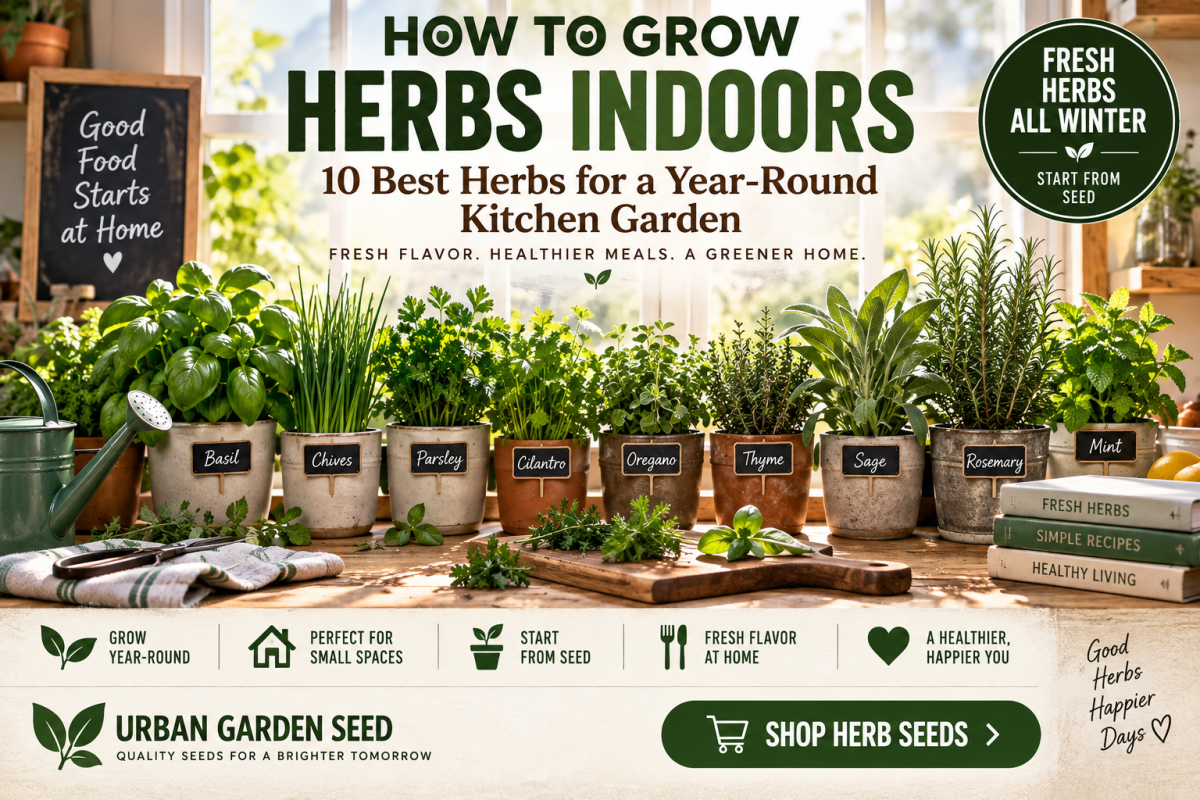
How to Grow Herbs Indoors: 10 Best Herbs for a Year-Round Kitchen Garden
Sep
The outdoor gardening season may be slowing down.
Your herb garden does not have to.
As colder nights arrive and frost begins ending summer crops, September is an excellent time to move part of your gardening indoors.
A sunny windowsill, several containers, quality seeds, and adequate light can give you fresh herbs for cooking through fall and winter.
Imagine being able to cut fresh:
- Basil for pasta
- Cilantro for tacos
- Parsley for soups
- Chives for eggs
- Oregano for pizza
- Thyme for roasted vegetables
without walking farther than your kitchen window.
Indoor herb gardening also works for people who do not have an outdoor garden at all.
You can grow herbs in:
- Apartments
- Condominiums
- Townhouses
- Dorm rooms where permitted
- Kitchens
- Sunrooms
- Greenhouses
- Indoor growing shelves
The key is understanding that herbs grown indoors need different management from plants growing outdoors.
The biggest challenge is usually not soil.
It is light.
This complete guide explains which herbs are easiest to grow indoors, how to start them from seed, how much light they need, how to water them, and how to keep harvesting fresh herbs throughout the colder months.
Quick Answer: What Are the Best Herbs to Grow Indoors?
Ten excellent herbs to consider are:
- Basil
- Chives
- Parsley
- Cilantro
- Oregano
- Thyme
- Sage
- Rosemary
- Mint
- Dill
They do not all grow exactly the same way.
Basil prefers warmth.
Cilantro prefers cooler conditions.
Rosemary needs excellent drainage.
Mint appreciates more consistent moisture.
Dill develops a taproot and prefers a deeper container.
Understanding those differences is what turns an indoor herb collection into a productive kitchen garden.
Why Start an Indoor Herb Garden in Fall?
Spring is not the only time to start seeds.
September and fall are ideal times to think about indoor gardening because the transition happens gradually.
Outdoor temperatures are beginning to decline, but houses are not yet in the darkest period of winter.
Starting now allows seedlings to become established before daylight becomes extremely short.
It also gives gardeners something productive to grow after:
- Tomatoes finish
- Cucumbers decline
- Basil outdoors is threatened by frost
- Flower beds become dormant
- Vegetable beds are prepared for winter
Instead of putting your seed-growing equipment away, move part of it indoors.
The Biggest Secret to Indoor Herbs: Light
Most indoor herb failures are really light problems.
The plant may have:
Good soil.
Enough water.
A beautiful container.
Quality seed.
But without adequate light, growth becomes weak.
Common symptoms of insufficient light include:
- Tall, thin stems
- Pale leaves
- Plants leaning toward the window
- Large spaces between leaves
- Weak aroma
- Slow growth
- Poor harvests
A window that looks bright to the human eye may still provide far less light than an outdoor garden.
How Much Light Do Indoor Herbs Need?
Most culinary herbs perform best with substantial light.
A bright south-facing window is usually one of the best natural-light locations in the Northern Hemisphere.
West-facing windows can also work.
As fall progresses into winter, natural light becomes weaker and shorter across much of the United States and Canada.
That is when a grow light becomes useful.
If your herbs stretch, lean heavily, or produce weak growth, do not immediately fertilize them.
Improve the light first.
Fertilizer cannot compensate for insufficient light.
Should You Use Grow Lights?
For reliable winter production, grow lights can make a major difference.
You do not necessarily need an elaborate greenhouse system.
A simple LED growing fixture above several pots can dramatically improve results.
Place lights according to the manufacturer’s recommendations.
Keep them close enough to provide useful intensity without overheating or damaging the foliage.
Use a timer.
Consistent light schedules are much easier to maintain automatically than manually switching lights on and off every day.
What Containers Should You Use?
Indoor herb containers must have one important feature:
Drainage holes.
Do not plant herbs permanently in decorative containers with nowhere for excess water to escape.
Waterlogged roots are one of the easiest ways to kill an indoor herb garden.
Possible containers include:
- Traditional flowerpots
- Terracotta pots
- Plastic nursery pots
- Fabric containers
- Window boxes
- Self-watering containers designed for herbs
Place a saucer underneath to protect indoor surfaces.
Do not allow pots to remain continuously sitting in water.
How Large Should Herb Pots Be?
Container size depends on the herb.
Compact herbs such as thyme and chives can grow in relatively modest containers.
Larger herbs need more root space.
Rosemary can eventually become a substantial plant.
Mint spreads rapidly.
Dill develops a taproot.
Parsley also develops a substantial root system.
When in doubt, give the plant more root space rather than squeezing five mature herbs into one tiny decorative pot.
Crowding may look attractive for two weeks.
It becomes difficult to manage later.
What Soil Should You Use?
Use a quality container-growing or potting mix.
Do not dig heavy soil from the backyard and pack it into small indoor containers.
Garden soil can:
- Compact
- Drain poorly
- Contain weed seeds
- Contain insects
- Behave poorly in pots
Container mixes are designed to balance air and moisture around roots.
That matters especially indoors, where evaporation is often slower than outside.
1. Basil
Basil is one of the most useful herbs to grow indoors from seed.
It grows relatively quickly and can provide repeated harvests.
Popular uses include:
- Pasta
- Pizza
- Pesto
- Soups
- Sandwiches
- Salads
- Thai dishes
Basil likes warmth
Basil is a warm-season herb.
Protect it from cold windows and drafts during winter.
A windowsill may receive good sunlight but become surprisingly cold after sunset.
If leaves begin suffering from cold exposure, move the pot slightly away from the glass.
Starting basil from seed
Use moist seed-starting mix.
Plant seeds according to the variety’s recommended depth.
Keep the medium warm and evenly moist while germination occurs.
Once seedlings appear, give them strong light immediately.
Harvesting basil
Do not simply pull individual leaves forever.
Harvesting stems just above leaf nodes encourages branching.
A well-pruned basil plant becomes bushier and produces more growing tips.
Avoid allowing the plant to flower continuously if your main objective is tender leaf production.
2. Chives
Chives are among the easiest kitchen herbs for indoor growing.
Their narrow leaves have a mild onion flavor.
Use them in:
- Eggs
- Potatoes
- Soups
- Dips
- Salads
- Sandwiches
Both regular chives and garlic chives can be useful culinary plants.
Why chives work well indoors
They remain relatively compact.
They tolerate repeated cutting.
They can be grown from seed.
Established plants can also be divided.
Harvesting
Cut leaves as needed.
Do not remove all growth from a weak young plant.
Allow seedlings to become established first.
As plants mature, repeated harvesting encourages fresh growth.
3. Parsley
Parsley is one of the most useful herbs to keep near the kitchen.
It works in:
- Soups
- Pasta
- Sauces
- Salads
- Potatoes
- Meat and vegetable dishes
Both curly and flat-leaf parsley can be grown indoors.
Be patient with parsley germination
Parsley can germinate more slowly than basil.
Do not assume the seed failed simply because nothing happened during the first several days.
Maintain appropriate moisture and temperature.
Avoid constantly digging through the soil looking for the seeds.
Give parsley root space
Parsley develops a substantial root system.
Use a reasonably deep container.
A tiny shallow pot may work for seedlings but becomes restrictive for mature plants.
4. Cilantro
Cilantro is particularly timely for fall growing because it prefers cooler conditions than basil.
Gardeners who struggle with cilantro bolting during summer may find indoor fall production much easier.
Use fresh cilantro in:
- Tacos
- Salsa
- Curries
- Soups
- Rice dishes
- Asian cooking
- Salads
Cilantro is naturally short-lived
Do not expect one cilantro plant to produce forever.
It naturally progresses toward flowering and seed production.
The better strategy is succession sowing.
Plant a small amount.
Then sow another container a couple of weeks later.
Continue as needed.
This creates a continuing supply.
5. Oregano
Oregano is well suited to container growing.
It prefers good drainage and strong light.
Use oregano in:
- Pizza
- Pasta sauce
- Tomato dishes
- Roasted vegetables
- Marinades
- Mediterranean recipes
Do not overwater oregano
Oregano generally prefers to dry slightly between waterings.
Constantly saturated soil can cause root problems.
Allow the growing medium to begin drying before watering again.
Harvest regularly to encourage branching.
6. Thyme
Thyme is an excellent compact herb for windowsills.
Its small leaves provide intense flavor.
Use thyme with:
- Chicken
- Fish
- Potatoes
- Vegetables
- Soups
- Stews
- Sauces
Light matters
Thyme performs best under strong light.
Give it one of your brightest indoor locations.
Water carefully
Thyme does not need constantly wet soil.
Good drainage is essential.
Allow the top portion of the potting mix to dry slightly before watering.
7. Sage
Sage brings strong flavor and attractive foliage to the indoor garden.
Use it in:
- Stuffing
- Poultry
- Squash
- Butter sauces
- Roasted vegetables
- Holiday dishes
This makes sage especially useful during fall and winter cooking.
Growing sage indoors
Provide strong light and good drainage.
Avoid keeping soil permanently wet.
Young seed-grown plants may take time to become substantial enough for regular harvesting.
Be patient.
A mature sage plant can become much larger than a small windowsill seedling.
8. Rosemary
Rosemary is one of the most desirable indoor herbs—and one of the easiest to mismanage.
It needs:
- Excellent light
- Good airflow
- Excellent drainage
- Careful watering
Rosemary dislikes waterlogged roots.
At the same time, completely drying the root ball repeatedly can also stress the plant.
Is rosemary easy from seed?
Rosemary can be started from seed, but germination can be slower and less uniform than herbs such as basil.
Gardeners who want faster production may also propagate rosemary from cuttings or purchase established plants.
If you enjoy growing plants from seed, rosemary is still a worthwhile long-term project.
Just do not expect a large harvest in two weeks.
9. Mint
Mint is highly productive and useful for:
- Tea
- Desserts
- Fruit
- Salads
- Sauces
- Drinks
Indoors, its aggressive spreading habit becomes an advantage because the container keeps it confined.
Outdoors, mint can spread far beyond where it was originally planted.
Give mint its own pot
Do not combine mature mint with slower-growing herbs in one small container.
It can dominate the available root space.
Mint generally appreciates more consistent moisture than Mediterranean herbs such as thyme and oregano.
This is another reason to grow it separately.
10. Dill
Dill adds fresh flavor to:
- Fish
- Pickles
- Potatoes
- Sauces
- Eggs
- Salads
It can also eventually produce seed for culinary use.
Use a deeper pot
Dill develops a taproot.
It generally prefers not to be transplanted repeatedly.
Consider starting seed directly in the container where the plant will grow.
Provide strong light.
If dill becomes tall and weak indoors, insufficient light is often the problem.
Which Herbs Are Easiest to Start From Seed?
For beginners, I would begin with:
- Basil
- Chives
- Parsley
- Cilantro
- Dill
These give you several different flavors without requiring a large indoor setup.
Then add:
- Oregano
- Thyme
- Sage
when you are comfortable managing moisture and lighting.
Rosemary can be treated as a longer-term project.
A Simple Five-Pot Kitchen Herb Garden
You do not need 20 containers.
Start with five.
Pot 1: Basil
For frequent warm-flavored cooking.
Pot 2: Cilantro
For salsa, tacos and Asian dishes.
Pot 3: Parsley
For general kitchen use.
Pot 4: Chives
For eggs, potatoes and soups.
Pot 5: Oregano
For pizza and tomato dishes.
Those five herbs cover an enormous range of everyday cooking.
Should You Put Several Herbs in One Container?
You can, but only when their growing requirements are compatible.
For example, herbs that prefer relatively dry conditions may coexist better than pairing them with moisture-loving plants.
Do not combine plants merely because they look attractive together.
Ask:
- Do they need the same amount of water?
- Do they require similar light?
- Will one grow much faster?
- Will their root systems compete?
- How large will they become?
Separate containers make watering much easier for beginners.
How to Water Indoor Herbs Correctly
The most common watering mistake is following a calendar.
Do not automatically water every Monday and Thursday.
Check the soil.
Insert a finger into the upper portion of the growing medium.
If it is still wet, wait.
If it has begun drying to the level appropriate for that herb, water thoroughly.
Allow excess water to drain.
Empty saucers if water accumulates.
Indoor conditions change according to:
- Temperature
- Humidity
- Pot size
- Plant size
- Light level
- Heating systems
Let the plant and soil determine the schedule.
Why Indoor Herbs Die From Overwatering
Roots need oxygen.
When every air space inside a pot is constantly filled with water, roots become stressed.
Symptoms may include:
- Yellowing leaves
- Wilting despite wet soil
- Root decline
- Fungus gnats
- Rot
People often see a wilted plant and add more water.
That can make the problem worse.
Check the soil first.
Indoor Herbs Need Airflow
A kitchen garden should not be sealed into a humid corner.
Good airflow helps reduce:
- Fungal problems
- Excessive humidity
- Weak growth
Do not aim a powerful fan directly at tiny seedlings.
Gentle circulation is enough.
Avoid placing herbs directly beside heating or cooling vents where constant drafts can rapidly dry foliage and soil.
How Warm Should Indoor Herbs Be?
Most common kitchen herbs are comfortable at normal household temperatures.
But individual herbs differ.
Basil particularly dislikes cold.
Cilantro prefers cooler conditions.
Rosemary and thyme can tolerate cooler indoor spaces better than tropical plants.
The important point is avoiding extremes.
Do not put tender basil directly against freezing winter glass.
Do not place herbs directly above a hot radiator.
Stable conditions are easier on the plants.
Should You Fertilize Indoor Herbs?
Yes, but lightly.
Indoor herbs usually grow more slowly than outdoor summer plants.
Heavy fertilization can lead to:
- Soft growth
- Salt accumulation
- Root damage
- Reduced flavor quality in some herbs
Use an appropriate fertilizer at a conservative rate.
Follow the product label.
More fertilizer does not mean more flavor.
How to Harvest Herbs So They Keep Growing
Harvesting is not simply taking food from the plant.
Done correctly, it also shapes growth.
For branching herbs such as basil:
Cut just above a node where leaves emerge.
This encourages additional branches.
For chives:
Cut established leaves and allow new growth to emerge.
For parsley:
Harvest outer stems while leaving the center growing.
For cilantro:
Harvest leaves while plants are young and continue succession sowing.
For oregano and thyme:
Cut small stems rather than stripping the entire plant bare.
Never remove so much foliage from a young plant that it cannot continue photosynthesizing.
Should You Let Indoor Herbs Flower?
It depends on your goal.
If your priority is leaf production, flowering can reduce tenderness or change flavor in some herbs.
Basil is a classic example.
Pinching flower buds can extend leafy growth.
But flowers can also be useful if you want:
- Seeds
- Ornament
- Pollinator resources when plants eventually move outdoors
Decide which harvest you want.
Leaves or seeds.
Can You Bring Outdoor Herbs Inside?
Yes, but inspect them carefully first.
Before moving an outdoor pot indoors:
- Check leaves.
- Check stems.
- Inspect underneath leaves.
- Examine the soil surface.
- Look for insects.
- Remove dead foliage.
Possible hitchhikers include:
- Aphids
- Whiteflies
- Spider mites
- Fungus gnats
- Slugs
It is much easier to control pests before the plant joins the rest of your indoor garden.
Should You Dig Outdoor Herbs Up and Bring Them Inside?
Some herbs transplant better than others.
If you have a valuable outdoor plant, you may be able to move it into a container.
However, digging can damage roots.
Another approach is taking cuttings from suitable herbs.
You can also simply start fresh seeds indoors.
Sometimes a young healthy seedling adapts more easily than an old outdoor plant being moved suddenly into a completely different environment.
Growing Herbs Indoors Without a Sunny Window
A poor window does not automatically prevent indoor herb growing.
Use artificial light.
A simple shelf system can hold:
- Seed trays
- Herb pots
- Microgreens
- Small leafy vegetables
Install appropriate LED grow lights above the plants.
This can turn:
- A basement
- Spare room
- Utility room
- Dark kitchen corner
into a productive growing area.
The light becomes your artificial sun.
Growing Herbs in an Apartment
Indoor herbs are particularly well suited to apartment gardening.
You do not need a balcony.
A bright window or small grow-light shelf is enough.
Compact herbs such as:
- Chives
- Parsley
- Thyme
- Basil
- Cilantro
can fit into limited spaces.
Use vertical shelving to increase production without sacrificing counter space.
Growing Herbs Indoors in Canada
Canadian gardeners face very short winter daylight hours, especially farther north.
A windowsill that works beautifully in September may become inadequate by December.
Supplemental lighting becomes increasingly useful.
Indoor growing is especially valuable because outdoor herb production may be impossible for months.
Use fall to establish the plants while natural daylight remains stronger.
Then transition them to supplemental light as winter develops.
Growing Herbs Indoors in the Northern United States
Northern U.S. gardeners face many of the same challenges.
By late fall:
- Days shorten
- Sun angles become lower
- Outdoor gardens freeze
- Indoor heating dries the air
Monitor both light and moisture carefully.
Plants may need less water because growth slows, even though indoor air feels dry.
Do not water automatically simply because the furnace is running.
Growing Herbs Indoors in the Southern United States
Southern gardeners may have excellent winter sunlight.
Indoor herbs can still be useful, especially for:
- Convenience
- Apartment gardening
- Protection from unusual cold
- Continuous kitchen access
But you may also be able to grow many herbs outdoors through fall and winter.
Choose the location—indoors or outdoors—that provides the best conditions.
Indoor Herb Garden vs. Microgreens
These are two different growing projects.
Microgreens
Harvested as very young seedlings.
Usually ready quickly.
Grown densely.
Herbs
Allowed to develop into mature plants.
Harvested repeatedly over a longer period.
Require more root space.
An indoor growing shelf can contain both.
Microgreens provide fast harvests while herb plants become established.
Common Indoor Herb Gardening Mistakes
Not enough light
The most common problem.
Overwatering
Indoor pots stay wet longer than outdoor garden beds.
No drainage
Every herb container needs drainage.
Crowding too many herbs together
Small seedlings become much larger plants.
Using heavy garden soil
Use appropriate container mix.
Putting every herb on the same watering schedule
Different species have different needs.
Starting too many plants
Five healthy pots are more useful than 30 struggling ones.
Ignoring pests
Check plants regularly.
Letting herbs become overgrown
Harvest and prune them.
Expecting one plant to live forever
Annual herbs such as basil and cilantro naturally have limited life cycles.
Keep seed available for replacement plantings.
Create a Continuous Indoor Herb Harvest
One of the best strategies is to stagger your sowing.
Do not start every basil or cilantro seed on the same day.
Instead:
Week 1: Sow basil.
Week 2: Sow cilantro.
Week 3: Sow chives.
Week 4: Sow another cilantro pot.
Week 5: Sow parsley.
This creates plants at different stages.
When one begins declining, another is already growing.
This is particularly useful for short-lived cilantro.
What Herbs Should You Buy First?
For a beginner indoor kitchen garden, I recommend this order:
Basil
Fast growth and frequent kitchen use.
Cilantro
Excellent cool-season indoor crop.
Chives
Compact and easy to harvest.
Parsley
Highly versatile.
Oregano
A useful long-term container herb.
After those are growing successfully, add:
- Thyme
- Sage
- Rosemary
- Mint
- Dill
Why Grow Herbs From Seed?
Buying supermarket herbs is convenient.
But starting from seed gives you access to much greater variety.
Instead of one generic basil, you may grow:
- Genovese basil
- Thai basil
- Purple basil
- Lemon basil
Instead of one type of parsley:
- Curly parsley
- Flat-leaf parsley
Seeds also let you plant repeatedly.
If one cilantro pot finishes, sow another.
If a basil plant flowers and declines, start a fresh generation.
The indoor garden becomes renewable.
Why Choose Urban Garden Seed?
Urban Garden Seed offers vegetable, flower, herb, fruit, tree, ground-cover, and specialty seeds for growers throughout the United States and Canada.
Indoor herb gardening is a practical way to continue growing even when outdoor conditions become unfavorable.
Build your kitchen garden with:
- Basil
- Cilantro
- Parsley
- Chives
- Dill
- Oregano
- Thyme
- Sage
- Rosemary
- Mint
Choose varieties according to their growing requirements and your available indoor light.
Urban Garden Seed focuses on Non-GMO and untreated seed selections and backs purchases with a 30-Day Satisfaction Guarantee.
Start with the herbs your household actually uses.
Then expand.
Your Garden Does Not Have to Stop at the Back Door
Cold weather changes where we garden.
It does not have to stop us from gardening.
Outside, leaves fall.
Tomatoes finish.
Frost arrives.
Beds are mulched.
But inside, a different garden can begin.
Basil seedlings emerge beneath a grow light.
Cilantro fills a kitchen pot.
Chives produce new leaves.
Parsley waits beside the window.
Rosemary adds fragrance.
And dinner is only a few steps away.
That is the advantage of an indoor herb garden.
It does not need acres.
It does not even need a backyard.
It needs seeds, light, water, drainage, and a little attention.
Ready to Grow Fresh Herbs Indoors?
Explore herb seeds at UrbanGardenSeed.com and build a kitchen garden for fall, winter, and year-round growing.
Start with five pots.
Give them strong light.
Water according to the plant.
Harvest regularly.
Then sow again.
Grow indoors. Harvest fresh. Keep gardening all year.
Frequently Asked Questions
What herbs grow best indoors?
Basil, chives, parsley, cilantro, oregano, thyme, sage, rosemary, mint, and dill can all be grown indoors when given appropriate light, water, and containers.
What is the easiest herb to grow indoors from seed?
Basil is one of the easiest because it germinates and grows relatively quickly under warm, bright conditions.
Can I grow herbs indoors all winter?
Yes. Many herbs can be grown indoors during winter, although supplemental lighting is often necessary in northern regions.
How much light do indoor herbs need?
Most culinary herbs need strong light. A bright window may work, but supplemental grow lights can provide more reliable winter production.
Do indoor herbs need direct sunlight?
Most herbs perform best with substantial direct light. Low-light conditions commonly produce thin, weak plants.
Can I grow herbs in a kitchen window?
Yes, particularly when the window receives strong sunlight. South-facing windows are often best in the Northern Hemisphere.
Do I need a grow light?
Not always. But a grow light becomes especially useful during fall and winter when natural daylight is weaker and shorter.
How often should indoor herbs be watered?
Water according to soil moisture rather than a fixed schedule. Allow the growing medium to dry to the appropriate level for the herb before watering again.
Why are my indoor herbs turning yellow?
Possible causes include overwatering, poor drainage, inadequate light, root problems, or nutrient issues. Check growing conditions before adding fertilizer.
Can basil grow indoors in winter?
Yes. Basil can grow indoors when kept warm and given strong light.
Can cilantro grow indoors?
Yes. Cilantro performs well under cool indoor conditions, although it naturally has a relatively short life cycle.
Can parsley grow indoors?
Yes. Parsley adapts well to containers but benefits from a reasonably deep pot and strong light.
Can rosemary grow from seed indoors?
Yes, but rosemary is slower and less predictable from seed than fast-growing herbs such as basil.
Can mint grow indoors?
Yes. Mint grows well in containers and should usually have its own pot because it spreads aggressively.
Can I use garden soil for indoor herbs?
Container potting mix is generally preferable because ordinary garden soil can compact and drain poorly in pots.
Do indoor herb pots need drainage holes?
Yes. Drainage is critical for healthy roots and reducing waterlogging.
Can I grow several herbs in one pot?
Yes when their light, moisture, mature size, and root requirements are compatible. Separate pots are often easier for beginners.
Where can I buy herb seeds online?
Visit UrbanGardenSeed.com to explore herb seeds and other varieties for indoor, outdoor, container, and year-round gardening.
