
Backyard Gardening, Cactus & Succulent, Family & Kids' Gardening, Flower Seeds, Garden Planning & Design, Herb Seeds, Homesteading & Self-Reliance, Sensory & Wellness Gardening, Sustainable & Regenerative Living, The Horticulturist’s Lab, Urban & Small-Space Gardening, Vegetables
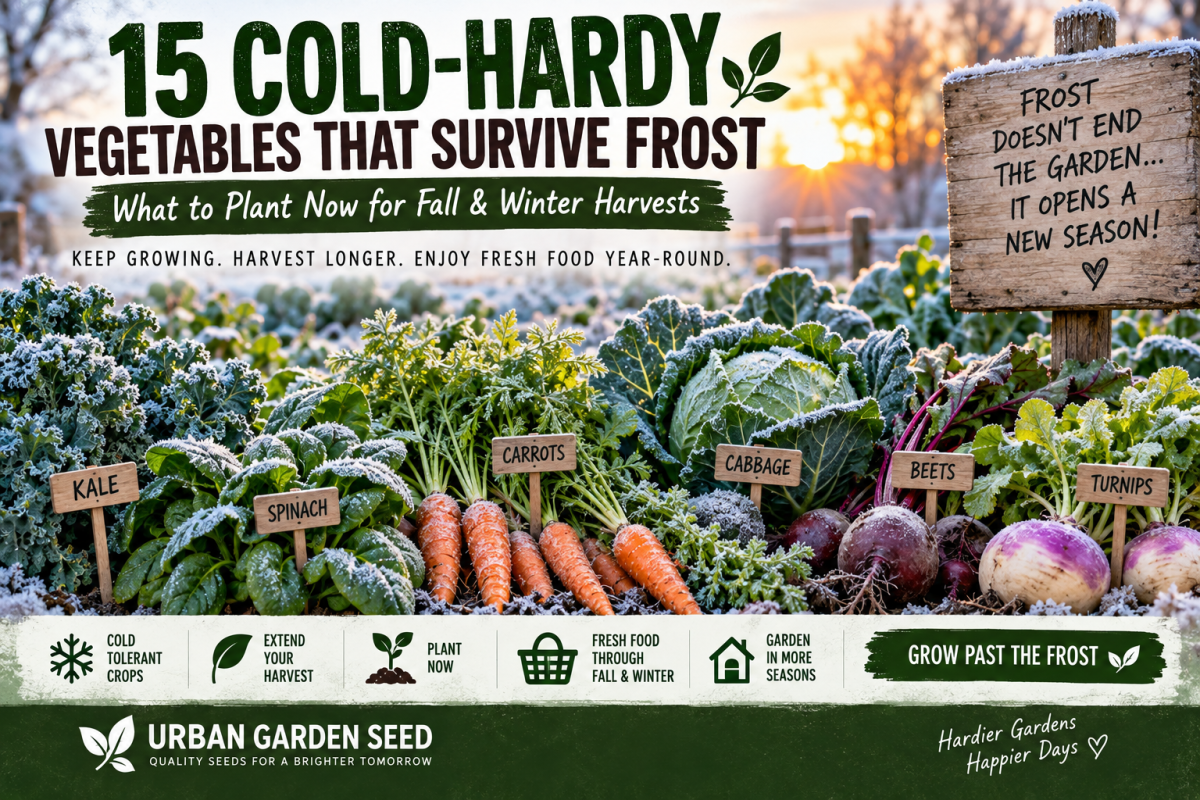
15 Cold-Hardy Vegetables That Survive Frost: What to Plant Now for Fall & Winter Harvests
Sep
The first frost does not have to end your vegetable garden.
Tomatoes may collapse.
Basil may turn black.
Cucumber vines may stop producing.
But underneath a light coating of frost, an entirely different group of vegetables can keep growing.
Kale.
Spinach.
Carrots.
Cabbage.
Turnips.
Collards.
Radishes.
And several other crops are far more comfortable in cold weather than the vegetables we associate with summer.
For gardeners throughout the United States and Canada, learning which vegetables tolerate frost can extend the harvest by weeks—or even months.
In mild climates, some crops can grow throughout winter.
In colder climates, they may remain harvestable beneath row covers, low tunnels, mulch, cold frames, or snow.
The secret is choosing the right plants before the garden gets cold.
This guide covers 15 of the best cold-hardy vegetables, when to plant them, which ones tolerate frost best, and how to keep harvesting as temperatures fall.
Quick Answer: Which Vegetables Survive Frost?
Some of the best cold-hardy vegetables include:
- Kale
- Spinach
- Collard greens
- Cabbage
- Brussels sprouts
- Turnips
- Radishes
- Carrots
- Parsnips
- Beets
- Swiss chard
- Kohlrabi
- Mustard greens
- Green onions
- Garlic
Cold tolerance varies according to:
- Variety
- Plant maturity
- Duration of freezing temperatures
- Wind
- Snow cover
- Soil moisture
- Whether plants have gradually acclimated to cold
- Protective structures
A mature kale plant hardened by several cool weeks can tolerate conditions that might severely damage a tender seedling.
Treat cold-hardiness numbers as guidelines rather than guarantees.
What Is a Cold-Hardy Vegetable?
Cold-hardy vegetables are crops capable of tolerating cool temperatures and at least some exposure to frost.
They are very different from warm-season vegetables such as:
- Tomatoes
- Peppers
- Eggplants
- Cucumbers
- Melons
- Beans
- Summer squash
- Basil
Those plants evolved for warm growing conditions and can suffer significant injury around freezing.
Cool-season crops are different.
Many grow best during:
- Spring
- Fall
- Mild winter
Some even improve in flavor after exposure to cold weather.
Frost-Tolerant vs. Freeze-Tolerant Vegetables
Not all cold-hardy plants tolerate the same temperatures.
A useful way to think about them is in three groups.
Light-frost tolerant
These can generally handle a brief frost better than tender summer crops.
Examples include:
- Lettuce
- Swiss chard
- Carrots
- Beets
- Broccoli
- Cauliflower
More strongly cold-hardy
These can tolerate colder conditions when established.
Examples include:
- Kale
- Collards
- Cabbage
- Spinach
- Turnips
- Kohlrabi
- Some onions
Overwintering crops
Certain crops can remain outdoors through winter in suitable climates.
Examples include:
- Garlic
- Spinach
- Kale
- Leeks
- Selected onions
- Certain cabbage-family vegetables
Whether they actually survive your winter depends heavily on location.
A crop overwintering easily in Oregon or North Carolina may not survive an exposed Manitoba winter without significant protection.
1. Kale
If you want one vegetable associated with cold-weather gardening, start with kale.
Kale is among the hardiest commonly grown leafy vegetables.
Established plants can tolerate frost and continue producing long after tomatoes have finished.
Why grow kale in fall?
Kale offers:
- Repeated leaf harvests
- Excellent cold tolerance
- High productivity
- Container compatibility
- Raised-bed compatibility
- Multiple colors and leaf textures
Harvest the oldest outside leaves while leaving the center intact.
This allows the plant to continue producing.
Does frost make kale sweeter?
Cold conditions can change carbohydrate metabolism in hardy vegetables, and many gardeners notice improved sweetness after frost.
That is one reason fall-grown kale can taste different from kale grown during warm weather.
Best strategy
Plant early enough that the plant reaches useful size before very short winter days arrive.
Cold weather may not kill established kale immediately, but growth slows dramatically when light levels and temperatures fall.
2. Spinach
Spinach is another champion of the cold-season garden.
Where summer heat causes spinach to bolt, cool fall temperatures create much better growing conditions.
In some climates, established spinach can overwinter and resume vigorous growth in spring.
Why grow spinach?
It can be harvested as:
- Baby spinach
- Mature leaves
- Cut-and-come-again greens
Spinach is also compact enough for:
- Raised beds
- Containers
- Low tunnels
- Cold frames
Planting tip
Spinach needs time to establish before severe winter conditions.
For winter harvests, sow earlier than you think.
For spring harvests, established plants may remain dormant or grow very slowly during the darkest part of winter before accelerating again as daylight returns.
3. Collard Greens
Collards are especially valuable for gardeners in the southern United States.
They tolerate cold far better than most summer vegetables and can produce large quantities of edible leaves.
Harvest method
Pick mature outside leaves.
Leave the central growing point intact.
The plant can continue producing over an extended period.
Best regions
Collards are particularly useful in:
- Southeast
- Mid-Atlantic
- Transition zones
- Mild winter climates
Northern gardeners can also grow them as fall crops, but severe winter conditions eventually require protection or end production.
4. Cabbage
Cabbage is one of the most cold-tolerant mainstream garden vegetables when established.
Its dense heads and broad leaves make it an excellent fall crop.
Why cabbage works well
It is useful for:
- Fresh cooking
- Slaw
- Fermentation
- Sauerkraut
- Storage
Storage varieties are especially valuable for gardeners interested in extending the usefulness of the harvest beyond the growing season.
Important timing issue
Cabbage takes considerably longer to mature than radishes or spinach.
By September, gardeners in colder regions usually need established transplants rather than beginning long-season varieties from seed outdoors.
Southern gardeners have a much longer planting window.
5. Brussels Sprouts
Brussels sprouts are made for cool weather.
They require a long growing season but develop their sprouts along tall stalks during fall.
Light frosts are not necessarily a problem.
Many gardeners intentionally allow the plants to experience cold conditions before finishing the harvest.
The challenge
Brussels sprouts take time.
They are not an emergency crop to plant four weeks before winter.
Plan months ahead.
For next year’s garden, schedule them as a long-season crop intended to mature during autumn rather than summer.
6. Turnips
Turnips are highly useful because they produce two edible crops.
The leaves can be eaten.
The roots can be eaten.
That makes them valuable when the growing season is becoming short.
Even if roots do not achieve maximum size, you may still harvest greens.
Why grow turnips?
They are:
- Fast
- Cold tolerant
- Easy to direct sow
- Suitable for succession planting
- Productive in relatively small spaces
Turnip greens can be harvested young while roots continue developing.
7. Radishes
Radishes are one of the smartest crops for September and early-fall planting.
Many varieties mature rapidly.
They also prefer cooler weather compared with intense summer heat.
Why radishes are ideal now
A fast variety may still have enough time to produce even when longer crops do not.
Use radishes to fill spaces vacated by:
- Tomatoes
- Beans
- Cucumbers
- Early potatoes
- Summer lettuce
Succession sow
Plant a short row.
Wait a week.
Plant another.
Continue while your remaining season allows.
This creates several harvests rather than one overwhelming batch.
8. Carrots
Carrots tolerate cold considerably better than warm-season fruiting vegetables.
The roots are protected by the soil, giving gardeners additional options as frost arrives.
Fall carrots can become sweeter
Cold weather can improve the sweetness of carrots.
Some gardeners leave mature carrots in the ground into late fall and harvest as needed.
Mulch helps
A deep layer of clean straw or leaves can delay freezing of the soil.
This can extend the harvest period.
However, once the ground freezes solid in extremely cold climates, harvesting becomes difficult.
Canadian Prairie and far-northern U.S. gardeners need substantially more insulation than gardeners in mild coastal regions.
9. Parsnips
Parsnips are among the classic vegetables for cold-weather harvesting.
Their roots remain underground and can tolerate substantial cold once mature.
Flavor can improve after exposure to low temperatures.
Why parsnips require planning
They are not fast.
Parsnips require a long growing period.
Think of them as a crop planted months earlier specifically for late fall, winter, or early spring harvest.
Where soil remains workable, mature roots may stay in the garden well after frost.
10. Beets
Beets provide both edible roots and greens.
They tolerate cool weather well, although they are generally not as freeze-resistant as the toughest kale or collard plants.
Harvest options
Young beet leaves can be used in salads.
Mature greens can be cooked.
Roots can be harvested at multiple sizes.
This flexibility makes beets useful when the season becomes unpredictable.
If very cold weather is approaching, harvest mature roots and store them rather than risking damage.
11. Swiss Chard
Swiss chard is often treated as a summer crop, but established plants can tolerate light frost.
Its colorful stems also make it one of the most ornamental vegetables.
Depending on variety, stalks may be:
- Red
- Pink
- Yellow
- Orange
- White
Best use
Continue harvesting outer leaves as fall advances.
In mild climates, chard may remain productive for a long period.
In colder climates, protection can extend the harvest before severe freezes end the season.
12. Kohlrabi
Kohlrabi belongs to the cabbage family and thrives in cool conditions.
Its swollen stem develops above the soil and is harvested while tender.
Why gardeners overlook it
Kohlrabi does not resemble the familiar vegetables most people see every week in supermarkets.
But it is:
- Compact
- Fast compared with many brassicas
- Cold tolerant
- Excellent for raised beds
It can be eaten:
- Raw
- Roasted
- Stir-fried
- Added to soups
For gardeners who want something beyond ordinary kale and cabbage, kohlrabi is worth trying.
13. Mustard Greens
Mustard greens grow rapidly in cool weather.
That makes them excellent for fall gardens.
Leaves range from mildly peppery to intensely spicy depending on variety.
Why plant mustard?
It offers:
- Fast growth
- Baby-leaf harvesting
- Mature cooking greens
- Good cool-weather performance
It is especially useful in southern fall gardens, where autumn can provide months of growing time after summer heat disappears.
14. Green Onions
Green onions require relatively little space and tolerate cooler weather better than tender vegetables.
They work particularly well in:
- Raised beds
- Containers
- Herb gardens
- Garden edges
You do not necessarily need to wait for large bulbs.
Harvest the green tops and developing white stems.
Their compact growth habit also makes them useful for filling narrow spaces between larger crops.
15. Garlic
Garlic belongs on this list even though its growing cycle is different.
Instead of planting it for an immediate fall harvest, gardeners plant garlic in autumn for next summer’s harvest.
One healthy clove becomes one entire bulb.
Why garlic handles winter
In suitable climates, garlic establishes roots during fall, survives winter underground, then begins vigorous growth again during spring.
Cold exposure contributes to proper bulb development in many varieties.
Important
Garlic is normally grown from cloves, sometimes called seed garlic, rather than ordinary botanical seeds.
Planting timing varies substantially across North America.
Best Cold-Hardy Vegetables by Difficulty
If this is your first fall or winter garden, do not begin with every crop.
Easiest choices
Start with:
- Radishes
- Spinach
- Kale
- Mustard greens
- Turnips
These provide a good combination of:
- Relatively quick growth
- Cold tolerance
- Straightforward seed sowing
Intermediate choices
Try:
- Carrots
- Beets
- Swiss chard
- Kohlrabi
- Green onions
Crops requiring more planning
These include:
- Cabbage
- Brussels sprouts
- Parsnips
- Garlic
They are excellent crops but require either longer growing periods or season-specific timing.
Cold-Hardy Vegetable Comparison Chart
| Vegetable | Cold tolerance | Speed | Best use |
|---|---|---|---|
| Kale | Very high | Medium | Long fall/winter leaf harvest |
| Spinach | High | Fast | Baby or mature greens |
| Collards | Very high | Medium | Repeated leaf harvest |
| Cabbage | High | Slow-medium | Heads and storage |
| Brussels sprouts | Very high | Slow | Late fall harvest |
| Turnips | High | Fast | Roots + greens |
| Radishes | High | Very fast | Quick fall harvest |
| Carrots | Moderate-high | Medium | Roots/storage |
| Parsnips | Very high when mature | Slow | Winter roots |
| Beets | Moderate | Medium | Roots + greens |
| Swiss chard | Moderate | Medium | Repeated leaves |
| Kohlrabi | High | Medium-fast | Crisp swollen stems |
| Mustard greens | High | Fast | Leaf harvest |
| Green onions | High | Medium | Fresh stems and greens |
| Garlic | Overwinters | Long season | Summer bulb harvest |
These ratings are general.
Actual performance varies with variety and climate.
When Should You Plant Vegetables for a Winter Harvest?
This is the most important winter-gardening lesson:
Plant before winter—not in the middle of winter.
Cold-hardy crops can survive low temperatures better than warm-season crops.
That does not mean they grow quickly during freezing weather.
As daylight drops below roughly ten hours in many northern areas, plant growth can become extremely slow.
The objective is to have plants approaching useful size before the darkest part of winter.
Then winter becomes a storage and slow-harvest period rather than a rapid-growth period.
Work Backward From Your First Frost
Use this planning formula:
Days to maturity + extra fall time = planting deadline
Suppose a spinach variety lists 40 days to maturity.
Do not assume you can plant exactly 40 days before frost.
Fall growth slows as:
- Days shorten
- Temperatures decline
- Sunlight weakens
Add additional time.
Fast-maturing varieties become particularly valuable late in the season.
What Can You Plant Right Now in September?
In many regions, September still offers opportunities for fast and cold-tolerant vegetables.
Depending on climate, gardeners may still consider:
- Spinach
- Radishes
- Leaf lettuce
- Arugula
- Mustard greens
- Turnips
- Baby kale
- Asian greens
A fresh September 2026 gardening guide likewise highlights spinach, kale, collards, winter radishes, mustard greens and Asian greens as crops to establish for later harvest. (Homes and Gardens)
In colder northern regions, the window is closing quickly.
In Zones 7 and warmer, opportunities can remain open much longer.
Cold-Hardy Vegetables for the Northern United States
Gardeners in:
- Minnesota
- Wisconsin
- Michigan
- Maine
- Vermont
- New Hampshire
- North Dakota
- Montana
should prioritize plants that are already established or mature quickly.
Useful crops include:
- Kale
- Spinach
- Radishes
- Turnips
- Mustard greens
For true winter production, use protection.
Without it, growth eventually becomes minimal.
University of Minnesota’s current crop guidance identifies kale and cabbage among its hardiest vegetable crops, while spinach, turnips, mustard, carrots and several other crops tolerate varying degrees of frost. (University of Minnesota Extension)
Cold-Hardy Vegetables for Canada
Canada needs even more regional thinking.
Alberta, Saskatchewan and Manitoba
The growing season is short.
By September, concentrate on:
- Established kale
- Spinach
- Turnips
- Carrots
- Root crops
- Frost protection
- Garlic preparation
A greenhouse, cold frame, or tunnel significantly increases your options.
Ontario and Quebec
Fall production can continue longer, especially in southern locations.
Grow:
- Kale
- Spinach
- Carrots
- Turnips
- Radishes
- Swiss chard
Use protection as temperatures fall.
Coastal British Columbia
Mild winters create some of Canada’s best winter-gardening opportunities.
Gardeners may overwinter:
- Spinach
- Kale
- Hardy greens
- Garlic
- Selected cabbage-family crops
Rain and saturated soil may become a bigger challenge than extreme cold.
Cold-Hardy Vegetables for the Southern United States
Southern gardeners have almost the opposite problem.
September and October may mark the beginning of the best vegetable-growing season.
In:
- Texas
- Georgia
- Alabama
- Mississippi
- Louisiana
- Florida
- South Carolina
consider crops such as:
- Collards
- Kale
- Mustard greens
- Spinach
- Lettuce
- Broccoli
- Cabbage
- Radishes
- Turnips
- Carrots
In many southern locations, these vegetables perform much better during fall and winter than during midsummer.
How to Protect Cold-Hardy Vegetables From a Hard Freeze
Even cold-hardy vegetables benefit from protection.
Cold tolerance is not unlimited.
Floating row cover
Frost cloth or floating row cover can provide useful protection while still allowing some light and moisture through.
Low tunnels
Place hoops over beds and cover them with suitable protective fabric.
Low tunnels can protect entire vegetable rows.
Cold frames
A cold frame gives plants additional shelter while allowing sunlight to enter.
They work particularly well for:
- Spinach
- Lettuce
- Kale
- Asian greens
Greenhouses
A greenhouse provides significantly more control, although an unheated greenhouse can still become very cold at night.
Do not assume an unheated structure will remain frost-free automatically.
Protect Plants Before Sunset
Do not wait until frost is already covering the leaves.
Cover plants before temperatures fall sharply.
The objective is partly to trap heat stored in the soil.
Extend the covering toward the ground.
Secure it against wind.
Then remove or ventilate covers when warm sunshine returns.
Plants can overheat surprisingly quickly beneath clear coverings.
Can Snow Protect Vegetables?
Surprisingly, yes.
Snow can function as insulation.
A layer of snow may protect low-growing plants from colder air temperatures above it.
The problem comes when:
- Snow becomes extremely deep
- Plants are physically damaged
- Ground remains inaccessible
- Freeze-thaw cycles occur
In genuinely cold climates, gardeners often harvest hardy vegetables before deep winter and leave only specially managed overwintering crops.
Mulch Root Vegetables
Root crops have an advantage:
The edible portion is underground.
For carrots, parsnips, turnips and other roots, mulch can slow soil freezing.
Use materials such as:
- Clean straw
- Shredded leaves
Apply enough insulation to protect the soil.
Then harvest when needed.
This works best where winter conditions still allow physical access to the garden.
Cold Weather Doesn’t Mean No Water
Fall and winter crops still require moisture.
It is easy to stop thinking about irrigation after summer.
But dry autumn weather can stress young crops.
Before freezing weather:
Keep soil reasonably moist.
Avoid constantly saturated conditions.
Reduce irrigation as plant growth slows.
Raised beds and containers may dry faster than in-ground beds.
Why Winter Vegetables Sometimes Taste Sweeter
Gardeners often claim carrots, kale and other hardy vegetables taste better after frost.
There is a physiological reason.
Some plants increase soluble sugars and other compounds as part of their adaptation to cold temperatures.
That can change flavor.
Cold weather does not magically improve every vegetable, but several hardy crops are genuinely prized for cool-season quality.
Don’t Fertilize Just Because Growth Slows
Cold-weather growth naturally slows.
Do not respond by pouring fertilizer onto the garden.
Low temperature and limited daylight—not necessarily nutrient deficiency—may be responsible.
Excess fertilizer can accumulate in the soil or create unwanted growth.
Use soil-test information and crop-specific recommendations.
Grow Several Crops Instead of One
A resilient winter garden uses diversity.
Instead of planting only kale, combine:
- Kale
- Spinach
- Radishes
- Carrots
- Turnips
- Mustard greens
- Green onions
Different weather affects each crop differently.
If one struggles, another may thrive.
Diversity also provides a much more interesting harvest.
Build a Simple Winter Salad Bed
One raised bed can become a cold-season salad garden.
Plant:
- Spinach
- Lettuce
- Arugula
- Radishes
- Green onions
Protect the bed with hoops and row cover.
Harvest leaves progressively.
In mild climates, this bed may provide food for months.
Build a Cold-Hardy Cooking-Greens Bed
For larger harvests, grow:
- Kale
- Collards
- Mustard greens
- Swiss chard
These crops work well for:
- Soups
- Stir-fries
- Stews
- Sautés
- Side dishes
Harvest outer leaves instead of cutting every plant at once.
Build a Winter Root-Crop Bed
Grow:
- Carrots
- Turnips
- Beets
- Parsnips
- Radishes
Each occupies a different amount of time and space.
Fast radishes can be harvested while slower roots continue growing.
This is an efficient use of valuable garden area.
Cold-Hardy Vegetables in Containers
Cold-season gardening is possible in containers.
Excellent candidates include:
- Spinach
- Kale
- Lettuce
- Radishes
- Green onions
- Swiss chard
But container roots become colder than roots in the ground.
A pot is exposed to cold air from every side.
That means a plant hardy in the garden may need additional protection in a container.
Move pots into a sheltered location during severe weather when possible.
Raised Beds and Winter Vegetables
Raised beds are excellent for fall gardening because:
- Soil drainage is usually good
- Covers are easy to install
- Crops remain organized
- Harvesting is convenient
However, raised beds can cool more quickly because more soil surface is exposed to cold air.
Use:
- Mulch
- Hoops
- Row covers
- Cold frames
to increase protection.
Common Cold-Weather Gardening Mistakes
Planting too late
Hardy vegetables still need time to grow.
Assuming frost tolerance means unlimited freeze tolerance
Every crop has limits.
Planting warm-season vegetables in fall
Tomatoes and peppers are not winter vegetables.
Forgetting daylight
Winter crops may survive without producing much new growth.
Overwatering
Cold wet soil can create root problems.
Ignoring wind
Wind can dramatically increase plant stress.
Using unsupported plastic directly on foliage
Cold plastic touching leaves can cause damage.
Forgetting to ventilate on sunny days
Covered gardens can overheat.
Choosing the wrong variety
Cold tolerance varies even within the same vegetable species.
What Should You Buy for a Winter Garden?
Start with seed varieties suited to cool conditions.
A useful seed collection might contain:
Leafy greens
- Kale
- Spinach
- Mustard
- Swiss chard
Roots
- Radishes
- Turnips
- Carrots
- Beets
Brassicas
- Cabbage
- Kohlrabi
- Collards
Alliums
- Green onions
- Garlic planting stock
Then add:
- Row cover
- Garden hoops
- Labels
- Mulch
The combination of good seed and simple protection can dramatically extend what your garden produces.
Why Choose Urban Garden Seed?
Urban Garden Seed offers vegetable, herb, flower, fruit, tree and specialty seed varieties for growers throughout the United States and Canada.
Fall and winter gardening gives you a different reason to explore seed varieties.
Instead of focusing only on summer crops such as tomatoes and cucumbers, build a cold-season garden around:
- Kale
- Spinach
- Radishes
- Turnips
- Carrots
- Beets
- Greens
- Onions
Urban Garden Seed focuses on Non-GMO and untreated seeds and backs purchases with a 30-Day Satisfaction Guarantee.
Always review each variety’s:
- Days to maturity
- Cold tolerance
- Growing requirements
- Regional suitability
before planting.
The Garden Doesn’t End at the First Frost
Summer teaches gardeners to fear frost.
But fall gardeners learn something different.
Frost is not always the end.
It is a filter.
Tomatoes leave.
Peppers finish.
Cucumbers disappear.
And underneath them, the cold-hardy garden takes over.
Kale keeps producing.
Spinach waits beneath a row cover.
Carrots remain underground.
Turnips grow.
Garlic establishes roots for next summer.
Once you learn which vegetables belong in each season, the vegetable garden becomes more than a summer activity.
It becomes something you can plan almost year-round.
Ready to Grow Through the Cold?
Explore cold-season vegetable seeds at UrbanGardenSeed.com and build a garden designed for fall, winter and early spring.
Choose cold-hardy crops.
Plant before winter arrives.
Protect them when necessary.
Then keep harvesting after everyone else thinks the season is finished.
Grow past the frost. Extend the harvest. Keep your garden producing.
Frequently Asked Questions
What vegetables can survive frost?
Kale, spinach, collards, cabbage, turnips, radishes, carrots, kohlrabi, mustard greens and several other cool-season crops tolerate frost better than warm-season vegetables.
What is the most cold-hardy vegetable?
Kale, collards, cabbage and certain spinach varieties are among the hardiest common garden crops, but performance varies by variety and conditions.
Can kale survive frost?
Yes. Established kale tolerates frost very well and can continue producing during cold weather.
Can spinach survive frost?
Yes. Spinach is cold tolerant, and established plants can even overwinter in some climates.
Can carrots survive frost?
Yes. The roots are protected by soil and can remain harvestable after frost. Mulch can extend the harvest further.
Can lettuce survive frost?
Many lettuces tolerate light frost, but they are generally less freeze tolerant than crops such as mature kale.
Can radishes survive frost?
Yes. Radishes are cool-season crops and tolerate frost better than warm-season vegetables.
Can cabbage survive freezing weather?
Established cabbage is relatively cold hardy, although severe or prolonged freezes can still cause damage.
Does frost make vegetables sweeter?
Cold conditions can increase soluble sugars in several hardy vegetables, which can improve perceived sweetness.
What vegetables can I grow through winter?
Depending on climate and protection, possibilities include kale, spinach, collards, carrots, turnips, green onions, garlic and other cold-tolerant crops.
Can vegetables grow under snow?
Some established cold-hardy crops can survive beneath insulating snow, although active growth is extremely limited under cold, dark conditions.
Do winter vegetables need row covers?
Not always, but row covers can increase protection and extend harvests during freezing weather.
When should I plant a winter vegetable garden?
Plant early enough for crops to become established before the combination of severe cold and short daylight dramatically slows growth.
Can I grow winter vegetables in Canada?
Yes, but technique depends heavily on region. Coastal British Columbia offers a much longer winter-growing season than Alberta, Saskatchewan or Manitoba.
Can I grow winter vegetables in the southern United States?
Yes. In many southern areas, fall and winter are among the best seasons for spinach, kale, collards, carrots, radishes, cabbage and other cool-season vegetables.
Where can I buy cold-hardy vegetable seeds?
Visit UrbanGardenSeed.com to explore vegetable and herb seed varieties for fall, winter, spring and year-round garden planning.
