
Adenium, Backyard Gardening, Cactus & Succulent, Family & Kids' Gardening, Flower Seeds, Garden Planning & Design, Herb Seeds, Homesteading & Self-Reliance, Sensory & Wellness Gardening, Sustainable & Regenerative Living, The Horticulturist’s Lab, Urban & Small-Space Gardening, Vegetables
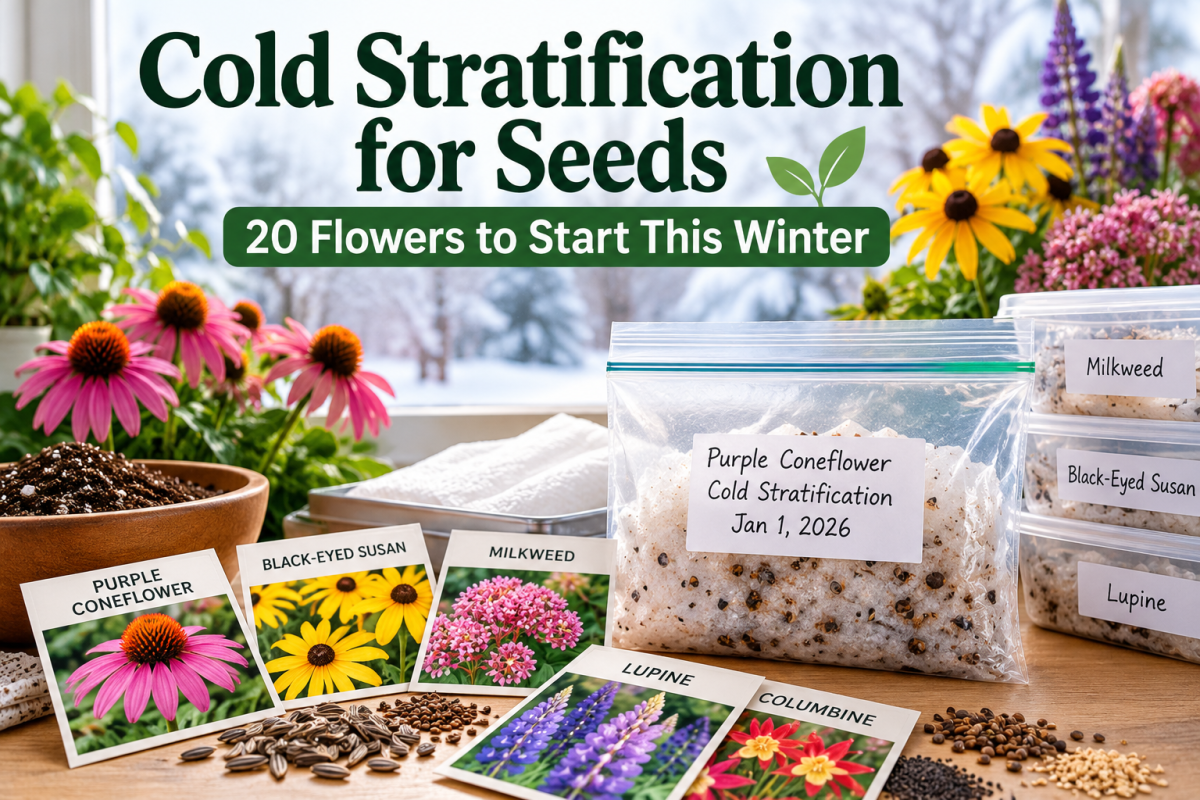
Cold Stratification for Seeds: 20 Flowers to Start This Winter
Oct
Have you ever planted perennial flower seeds, waited patiently, and wondered why almost nothing germinated?
The seeds may not have been bad.
They may simply have been waiting for winter.
Many perennial flowers, native wildflowers, shrubs, and trees produce seeds with built-in dormancy mechanisms. In nature, this prevents seeds from germinating immediately in fall only to have tender seedlings killed by freezing weather.
Instead, the seeds experience weeks or months of cold, moist winter conditions. When warmer temperatures return, dormancy is broken and germination can begin.
Gardeners call this process cold stratification.
For gardeners planning next spring’s flowers, late fall and winter are therefore not downtime. They can be one of the most important stages of the growing season.
This guide explains how cold stratification works, how to do it in your refrigerator or outdoors, and which flower seeds commonly benefit from winter chilling.
What Is Cold Stratification?
Cold stratification is a seed-treatment process that exposes dormant seeds to cold, usually moist conditions for a specific period of time.
In nature, the process happens automatically.
A perennial plant drops seeds during late summer or fall. The seeds lie in or near the soil through rain, snow, freezing temperatures, and winter moisture.
As winter progresses, physiological changes take place inside the seed.
When temperatures rise again in spring, the seed receives the environmental signal that winter has passed and growing conditions may now be safe.
University of Illinois Extension describes stratification as a natural survival mechanism that prevents seeds from germinating prematurely. Many herbaceous perennials and woody plants require this cold period before dormancy is broken.
Does Every Seed Need Cold Stratification?
No.
Most common vegetable seeds do not need it.
Tomatoes, peppers, cucumbers, beans, squash, lettuce, basil, and many annual flowers are normally planted without a cold treatment.
Cold stratification is much more common among plants originating from temperate climates where winter is part of their natural life cycle.
Native perennial wildflowers are particularly likely to have dormancy requirements.
However, even plants within the same genus can have different germination requirements.
Always check the instructions for the specific species and variety you are growing.
The phrase “cold stratify for 30 days” should never automatically be applied to every perennial flower.
Cold Stratification vs. Scarification
These terms are sometimes confused.
Stratification deals primarily with physiological dormancy by exposing seeds to temperature and moisture conditions.
Scarification involves weakening or damaging a hard seed coat so that moisture can penetrate.
Some seeds need only cold stratification.
Some need scarification.
Others may need both.
For example, certain legumes have especially hard seed coats and may benefit from scarification before other treatments.
Do not scarify seeds unless the specific species requires it.
How Long Does Cold Stratification Take?
There is no universal period.
University of Illinois Extension notes that cold-treatment requirements commonly vary from roughly one to three months depending on the plant.
Some species may require approximately 30 days.
Others may require 60 days, 90 days, or a more complex sequence of warm and cold conditions.
This is why planning ahead matters.
If a seed needs 60 days of cold treatment and you want to begin growing it indoors in February, you cannot wait until February to begin stratification.
Work backward from your intended sowing date.
Two Easy Ways to Cold Stratify Seeds
Gardeners generally have two practical choices.
Method 1: Let Winter Do It Naturally
This is often the easiest method.
Plant suitable seeds outside in late fall or winter and allow natural weather to provide the required cold period.
University of Maine Extension specifically notes that fall sowing can allow nature to provide the chilling period for seeds such as black-eyed Susan and coneflower.
Depending on the species, seeds may be direct-sown into a prepared bed or planted into protected winter-sowing containers.
The advantage is simplicity.
The disadvantage is that outdoor conditions are less controlled. Seeds may be eaten by wildlife, washed away, dry out, rot, or be disturbed.
Method 2: Stratify Seeds in the Refrigerator
A refrigerator allows you to create more controlled cold conditions.
University of Illinois Extension recommends placing seeds in a moist medium such as a paper towel, sand, peat, or vermiculite inside a closed container or sealed bag and refrigerating them at approximately 33°F to 40°F.
The medium should be moist, not soaking wet.
Check the seeds periodically.
Too much moisture can encourage mold, while allowing the medium to dry completely can compromise the treatment.
If seeds begin germinating while still in the refrigerator, plant them promptly.
How to Cold Stratify Seeds in the Refrigerator
A simple method works well for many species.
Moisten a paper towel, sterile seed-starting medium, vermiculite, or clean sand.
Mix or place the seeds in the moist material.
Put everything inside a labeled resealable plastic bag or container.
Write the plant name and the date the treatment started on the container.
Place it in the refrigerator—not the freezer.
Check it periodically for moisture, mold, or early germination.
When the species-specific chilling period has been completed, remove the seeds and sow them according to their normal planting requirements.
University of Minnesota Extension likewise recommends a moist—not wet—substrate and emphasizes accounting for the required stratification period when planning your indoor seed-starting schedule.
What Temperature Should You Use?
For many cold-stratified seeds, refrigerator temperatures slightly above freezing work well.
University of Illinois Extension gives approximately 33°F to 40°F as a cold-stratification range.
Do not assume freezing seeds solid in a household freezer accomplishes the same thing.
Cold and moisture are often both important.
The goal is to imitate winter soil conditions, not simply expose dry seeds to extremely low temperatures.
20 Flower Seeds That Commonly Benefit From Winter Chilling
The exact treatment varies by species, so use this section as a starting point rather than as a substitute for species-specific germination instructions.
- Purple Coneflower — Echinacea species
Coneflowers are among the most popular perennial flowers grown from seed. Cold treatment is commonly used for many species, and they are excellent candidates for winter sowing. - Common Milkweed — Asclepias syriaca
Milkweed is especially valuable in pollinator gardens because monarch caterpillars depend on milkweed plants. Many milkweed species benefit from cold, moist stratification. - Swamp Milkweed — Asclepias incarnata
Another excellent pollinator species, swamp milkweed is well suited to moist locations and is frequently winter-sown. - Butterfly Weed — Asclepias tuberosa
This orange-flowering milkweed is popular in sunny pollinator gardens. Check the seed instructions carefully because treatment requirements can differ among Asclepias species. - Black-Eyed Susan — Rudbeckia species
Black-eyed Susan is a classic native-style garden flower. Some Rudbeckia species and seed lots benefit from cold treatment, particularly when grown as perennials. - False Indigo — Baptisia species
Baptisia is a long-lived perennial that can have both dormancy and hard-seed-coat considerations. Depending on species, additional pretreatment may be recommended. - Wild Columbine — Aquilegia species
Columbines naturally grow in cooler climates and many species benefit from cold stratification before germination. - Wild Bergamot / Bee Balm — Monarda species
These aromatic flowers are excellent additions to pollinator gardens and are popular winter-sowing candidates. - Blazing Star — Liatris species
Known for its vertical flower spikes, Liatris is valuable to butterflies and other pollinators. Several species benefit from exposure to cold, moist conditions. - Penstemon / Beardtongue — Penstemon species
Many Penstemon species come from climates with cold winters and commonly benefit from stratification. - Joe-Pye Weed — Eutrochium species
This tall perennial produces large flower clusters that attract numerous pollinators. Its very small seeds should be handled carefully and may require both cold treatment and appropriate surface sowing. - Cardinal Flower — Lobelia cardinalis
Cardinal flower produces brilliant red blooms and is particularly attractive to hummingbirds. The seeds are tiny, so planting depth matters as much as pretreatment. - Great Blue Lobelia — Lobelia siphilitica
A woodland and moisture-loving perennial, great blue lobelia is another strong candidate for natural winter treatment. - Goldenrod — Solidago species
Goldenrods provide valuable late-season pollen and nectar. Many native Solidago species can be started using cold, moist stratification or winter sowing. - Native Asters — Symphyotrichum species
Native asters provide crucial late-season color and pollinator resources. Species differ, so follow the germination requirements for the exact aster you purchase. - Ironweed — Vernonia species
Ironweed’s rich purple flowers can become an important late-summer pollinator resource. Many native Vernonia seeds benefit from a winter-like treatment. - Rattlesnake Master — Eryngium yuccifolium
This distinctive native perennial is specifically cited by Illinois Extension as an example of a plant whose seeds use winter cold to delay germination until appropriate spring conditions return. - Prairie Smoke — Geum triflorum
Prairie smoke is valued for both its flowers and unusual feathery seed heads. Cold treatment is commonly used when propagating it from seed. - Gentian — Gentiana species
Many gentians have substantial dormancy requirements. Depending on the species, germination can be slow and may require an extended cold period. - Blue Vervain — Verbena hastata
Blue vervain is an attractive native perennial for moist landscapes and pollinator gardens. Cold stratification is commonly used when starting it from seed.
Why the Species Name Matters
This point is extremely important.
“Coneflower,” “milkweed,” “aster,” and “goldenrod” describe groups containing multiple species.
Those species may have different dormancy requirements.
Even when two plants look similar, one may need 30 days of cold stratification while another requires considerably longer—or no stratification at all.
Whenever possible, identify plants by their botanical name.
Good seed labels should provide enough information for you to determine the correct germination treatment.
Winter Sowing: An Easier Alternative
If refrigerator stratification sounds complicated, winter sowing may be an excellent alternative.
Winter sowing involves planting seeds in containers—commonly recycled translucent milk jugs—and placing them outdoors through winter.
The containers function like miniature greenhouses while still exposing the seeds to natural temperature cycles.
University of Minnesota Extension recommends winter sowing for pollinator plants and notes that recycled containers can provide seeds with the cold stratification needed to break dormancy.
Penn State Extension similarly describes winter sowing as particularly appropriate for some annuals, perennials, and wildflowers, generally during the colder months depending on local conditions.
This method can reduce the amount of indoor space and equipment required.
Basic Winter-Sowing Method
Use a translucent plastic container with adequate depth.
Milk jugs work well.
Create drainage holes in the bottom.
Cut the container horizontally while leaving a small hinge.
Add several inches of moist potting mix.
Sow seeds according to their recommended planting depth.
Label the container clearly.
Close the container and secure it.
Leave the cap off or provide ventilation.
Place the container outdoors where it can experience winter temperatures, rain, and snow.
As spring approaches, monitor moisture and ventilation carefully.
Once seedlings emerge and temperatures warm, gradually increase ventilation before transplanting.
University of Minnesota Extension recommends roughly three inches of potting soil in winter-sowing containers and emphasizes drainage and ventilation.
When Should You Start Cold Stratification?
The answer depends on how long the seed needs to remain cold.
Late fall is an excellent time to begin planning because seeds that require 60 to 90 days of chilling must be started well before spring planting.
For natural outdoor stratification, many gardeners sow after autumn temperatures become consistently cold but before the soil becomes completely inaccessible.
For container winter sowing, the ideal timing can extend later into winter.
Penn State Extension notes that December through March is generally useful for winter sowing perennials and hardy annuals, depending on local weather.
In northern regions, January is particularly useful for perennial seeds requiring stratification, according to University of Minnesota Extension.
Common Cold-Stratification Mistakes
Using too much water is one of the most common problems.
The seed medium should be damp rather than dripping wet.
Another mistake is forgetting to label the bags. After several weeks in a refrigerator, small brown seeds can become nearly impossible to identify.
Do not place stratification bags in the freezer unless the germination instructions specifically call for freezing.
Do not assume every perennial requires the same treatment.
And do not forget to inspect seeds periodically. If they begin germinating earlier than expected, they need to be planted.
What If Mold Appears?
A small amount of mold does not automatically mean all seeds are lost, but excessive moisture creates favorable conditions for fungal growth.
Use clean containers and clean materials.
Keep the stratification medium damp rather than saturated.
Inspect bags periodically.
If the medium becomes excessively wet, carefully correct the moisture level.
Avoid repeatedly opening containers unnecessarily, since contamination can be introduced each time they are handled.
What Happens After Stratification?
Once the required treatment is complete, plant the seeds according to their normal germination requirements.
Some species need light to germinate and should remain near the soil surface.
Others need shallow covering.
Temperature requirements after stratification also vary.
Penn State Extension emphasizes that successful seed germination depends not only on dormancy treatment but also on proper moisture, temperature, oxygen, and sometimes light.
Cold stratification is therefore only one part of successful seed starting.
Can You Cold Stratify Seeds Too Long?
Potentially.
Seeds should not simply be forgotten in the refrigerator indefinitely.
Some may begin germinating while still in storage.
Others can deteriorate if conditions remain excessively wet or if the seeds are kept beyond their useful storage life.
Use the recommended duration for your particular species and check the seeds regularly.
Can You Stratify Seeds Without a Refrigerator?
Yes.
That is exactly what nature does.
Fall sowing, dormant sowing, and winter sowing can all provide natural cold treatment in climates with appropriately cold winters.
For gardeners living in warm climates without a sufficiently long cold season, refrigerator stratification provides much more control.
Why Cold Stratification Matters for Native Gardens
Native plants have evolved alongside local weather cycles.
For many temperate-climate native perennials, winter is not an obstacle to germination—it is part of the germination process.
That is why gardeners sometimes report excellent results after simply sowing certain native seeds outdoors in fall.
Understanding dormancy can also prevent gardeners from unnecessarily throwing away seed that appears to have “failed.”
The seed may simply not have received the environmental signal required to germinate.
Start Planning Your Spring Garden During Winter
Growing flowers from seed does not have to begin when spring arrives.
For many perennial and native flowers, preparation begins months earlier.
Cold stratification lets gardeners imitate the natural winter conditions that certain seeds need before germination.
You can provide those conditions naturally through fall planting and winter sowing, or recreate them in a refrigerator where temperature and moisture are easier to control.
The most important rule is simple:
Know the germination requirements of the exact species you are growing.
Once you understand whether a seed requires cold stratification, scarification, light, surface sowing, or another treatment, germination becomes much less mysterious.
Winter may look quiet in the garden, but inside many seeds, the next growing season has already begun.
Explore Urban Garden Seed’s selection of flower, perennial, wildflower, tree, and specialty seeds and start preparing your spring garden this winter.