
Backyard Gardening, Family & Kids' Gardening, Flower Seeds, Garden Planning & Design, Herb Seeds, Homesteading & Self-Reliance, Sensory & Wellness Gardening, Sustainable & Regenerative Living, Urban & Small-Space Gardening, Vegetables
How to Start a Food Forest: 7 Layers & Best Edible Plants for Your Backyard
Aug
What if your yard could produce fruit, berries, herbs, vegetables, flowers, and perennial food year after year?
That is the basic idea behind a food forest.
Instead of separating every crop into individual rows, a food forest uses different heights and types of plants together to create an edible landscape inspired by the layered structure of a natural woodland.
You might have:
- Fruit or nut trees overhead
- Smaller fruit trees below them
- Berry bushes underneath
- Herbs and perennial vegetables at ground level
- Strawberries covering exposed soil
- Root crops below the surface
- Grapes or other vines growing vertically
The result can be a productive landscape that combines food production, beauty, pollinator habitat, shade, and long-term plantings in the same space.
And you do not need an entire farm.
Food forests can be created on:
- Suburban properties
- Homesteads
- Farms
- Rural acreage
- Large backyards
- Front yards
- Existing orchards
- Side yards
- Community properties
- Small residential lots
A food forest can contain three layers.
Or five.
Or all seven.
The objective is not to follow a rigid formula.
The objective is to make your land produce more useful plants at multiple levels.
What Is a Food Forest?
A food forest—sometimes called a forest garden—is a designed edible landscape that combines trees, shrubs, perennial plants, annual crops, roots, ground covers, and vines.
Instead of looking like a conventional vegetable garden composed primarily of annual rows, a mature food forest may look more like an ornamental landscape or young woodland.
But much of what grows there has a purpose.
Plants may provide:
- Fruit
- Nuts
- Vegetables
- Herbs
- Culinary flowers
- Pollinator resources
- Mulch
- Shade
- Soil cover
- Wildlife habitat
Some food forests emphasize perennial crops.
Others combine permanent trees and shrubs with annual vegetables such as tomatoes, peppers, beans, squash, lettuce, and cucumbers.
You can adapt the concept to your property.
Why Are Food Forests Becoming So Popular?
Many homeowners are reconsidering what they want their land to do.
A conventional landscape might contain:
- Lawn
- Shade trees
- Foundation shrubs
- Ornamental flowers
A food forest asks:
Can some of those plants also produce food?
Instead of planting only an ornamental shrub, could you plant a berry bush?
Instead of an ordinary ground cover, could strawberries work?
Instead of a decorative vine, could grapes occupy the trellis?
Instead of an empty sunny area, could perennial herbs or vegetables grow there?
This approach is often called edible landscaping.
It allows food production to become part of the overall landscape instead of being hidden in one rectangular vegetable garden.
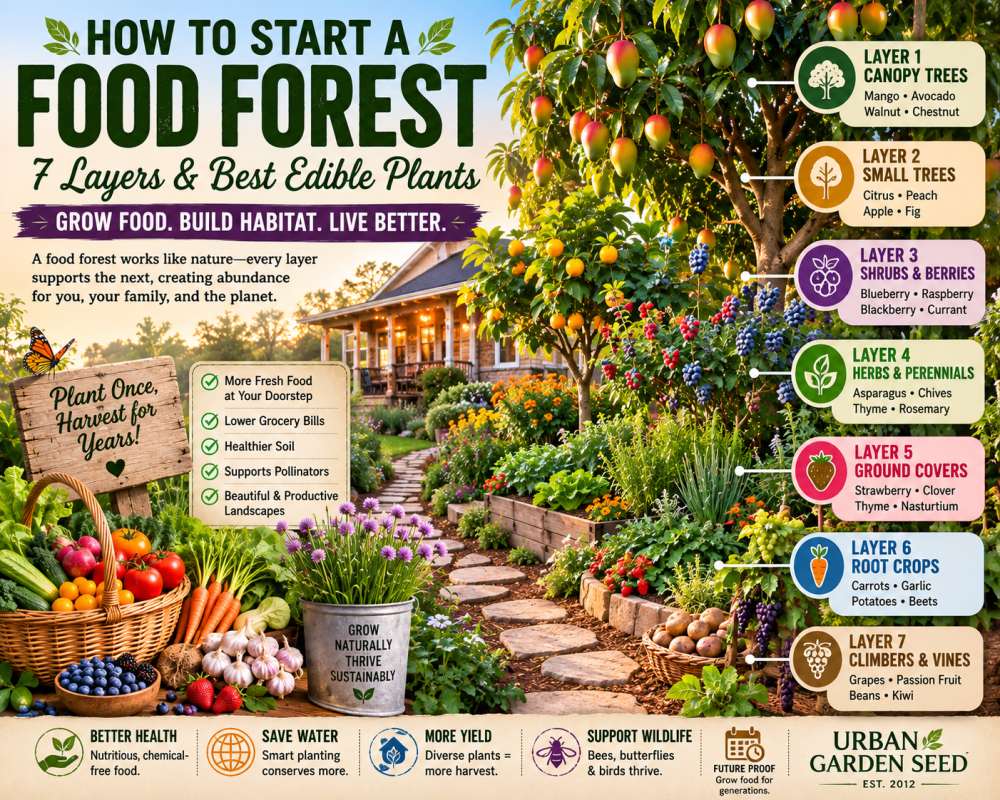
The 7 Layers of a Food Forest
A common food-forest design uses seven growing layers.
You do not need all seven.
But understanding them helps you see how much growing space exists on the same piece of land.
Layer 1: The Canopy
The canopy contains your largest trees.
Depending on climate and property size, these might include large fruit- or nut-producing trees.
Possible examples include:
- Chestnut
- Walnut
- Mulberry
- Pecan
- Persimmon
- Standard-size apple
- Pear
Important:
Consider mature size before planting.
A tree that looks small today can dominate the landscape decades later.
Ask:
- How tall will it become?
- How wide will the canopy spread?
- Will it shade the house?
- Will it shade your vegetable area?
- Are overhead utility lines nearby?
- How close is the property line?
- Will roots interfere with structures?
For an average residential property, you may not need a large canopy layer at all.
Smaller fruit trees may make better use of the available space.
Layer 2: Small Trees and Understory Fruit Trees
The second layer contains smaller trees growing underneath or between larger canopy trees.
This can be one of the most productive layers of a residential food forest.
Possible plants include:
- Dwarf apples
- Semi-dwarf apples
- Peaches
- Plums
- Cherries
- Figs
- Pawpaws
- Smaller citrus in appropriate climates
Always select fruit trees according to your climate.
A fruit tree that thrives in Georgia may not survive a Minnesota winter.
Likewise, a tree requiring significant winter chilling may perform poorly in the warmest parts of Florida.
A note about growing fruit trees from seed
Fruit trees grown from seed may not produce fruit identical to the fruit the seed came from.
Apples are a classic example.
If you need a predictable named fruit cultivar, a grafted nursery tree is generally the appropriate choice.
Growing fruit trees from seed can still be rewarding for:
- Plant breeding
- Experimentation
- Rootstock
- Bonsai
- Species trees
- Long-term gardening projects
Know your objective before planting.
Layer 3: Berry and Fruit Shrubs
Shrubs form one of the easiest food-forest layers to add to an existing landscape.
Possible choices include:
- Blueberries
- Raspberries
- Blackberries
- Currants
- Gooseberries
- Elderberries
- Honeyberries
- Aronia
- Bush cherries
This layer can produce significant food without occupying the same vertical space as trees.
Berry shrubs are useful along:
- Fences
- Property boundaries
- Orchard edges
- Garden paths
- Sunny walls
But do not plant solely by appearance.
Check:
- Soil pH
- Winter hardiness
- Summer heat tolerance
- Moisture requirements
- Pollination requirements
- Mature spread
Blueberries, for example, generally prefer acidic soil.
Layer 4: Herbs and Perennial Vegetables
The herbaceous layer occupies the area beneath trees and shrubs.
This may be one of the most diverse parts of your food forest.
Possible edible plants include:
- Asparagus
- Rhubarb
- Chives
- Parsley
- Sage
- Oregano
- Thyme
- Mint
- Lemon balm
- Sorrel
- Kale in suitable climates
You can also integrate annual vegetables into open sunny areas.
Examples include:
- Tomatoes
- Peppers
- Lettuce
- Beans
- Cucumbers
- Eggplant
- Radishes
- Swiss chard
Food forests do not have to be entirely perennial.
Annual vegetables can make excellent use of sunny spaces while trees are young.
Layer 5: Ground Covers
Ground-cover plants occupy the soil surface.
They can help reduce the amount of exposed soil while making the landscape more productive.
Possible edible or useful ground covers include:
- Strawberries
- Creeping thyme
- Low-growing herbs
- Selected clovers
- Nasturtiums in suitable locations
Ground covers may help:
- Shade the soil
- Reduce evaporation
- Compete with some weeds
- Provide flowers
- Create habitat
- Add another harvest layer
But ground covers must still be managed.
An aggressive species can become difficult to control.
Choose carefully.
Layer 6: Root Crops
The soil itself is another growing layer.
Possible root crops include:
- Carrots
- Beets
- Radishes
- Turnips
- Garlic
- Onions
- Potatoes
- Sweet potatoes
Root crops are especially useful between young trees before canopy shade becomes dense.
They also allow the food forest to produce below ground while other plants occupy the surface.
Avoid excessive digging around mature trees because disturbing major roots can damage them.
Locate heavily cultivated annual root crops away from sensitive tree-root zones.
Layer 7: Vines and Climbers
Vertical structures create another productive layer.
Possible edible vines include:
- Grapes
- Peas
- Pole beans
- Cucumbers
- Selected squash
- Hardy kiwi in suitable climates
Use:
- Trellises
- Pergolas
- Fences
- Arbors
- Dedicated support structures
Do not automatically allow aggressive vines to climb fruit trees.
Heavy vines can shade branches, interfere with pruning, and make harvesting difficult.
Dedicated supports are often easier to manage.
How to Start a Food Forest Step by Step
A successful food forest begins with planning.
Do not buy fifty plants and decide where they belong afterward.
Step 1: Map Your Property
Draw a simple map.
Mark:
- House
- Driveway
- Existing trees
- Fences
- Utility lines
- Water sources
- Septic systems
- Walkways
- Slopes
- Shaded areas
- Sunny areas
You do not need professional landscape-design software.
A pencil and paper are enough.
Step 2: Study Your Sunlight
Fruit production generally requires good sunlight.
Observe your property throughout the day.
Identify:
- Full-sun areas
- Morning sun
- Afternoon sun
- Partial shade
- Deep shade
Remember that sunlight changes seasonally.
Also remember that the small fruit tree you plant this year will cast much more shade when mature.
Plan for its future canopy.
Step 3: Check Drainage
Walk your property after a heavy rain.
Where does water collect?
Where does it run?
Where does soil dry quickly?
Food-forest plants have different moisture requirements.
Do not put a moisture-loving plant on the driest hilltop or a drainage-sensitive plant in a constantly wet depression.
Work with the site whenever possible.
Step 4: Test Your Soil
Before investing heavily in perennial plants, consider a soil test.
A useful soil test may provide information about:
- Soil pH
- Phosphorus
- Potassium
- Organic matter
- Other nutrient characteristics
Different plants have different soil requirements.
Blueberries are a good example: they generally require more acidic conditions than many common vegetables.
Correcting a major soil problem before planting permanent trees is much easier than correcting it afterward.
Step 5: Start With Trees and Permanent Structures
Plan the longest-lived components first.
These include:
- Canopy trees
- Fruit trees
- Major shrubs
- Paths
- Fences
- Trellises
- Irrigation
- Water collection systems
Then fill the spaces between them with smaller plants.
Think from largest and longest-lived to smallest and most temporary.
Step 6: Give Mature Trees Enough Space
One of the easiest mistakes is planting a young food forest too densely.
Everything looks tiny during year one.
Then everything grows.
Do not base spacing on the size of a plant in its nursery pot.
Use its expected mature width.
Crowded fruit trees can become:
- Difficult to prune
- Difficult to harvest
- Poorly ventilated
- Heavily shaded
- More susceptible to certain disease problems
Give the permanent structure of the food forest room to mature.
Step 7: Add Shrubs
Once tree locations are established, position berry and fruit shrubs.
Use them:
- Between widely spaced trees
- Along edges
- Beside paths
- Near fences
- In dedicated berry rows
Keep enough access for harvesting and pruning.
A productive plant you cannot reach becomes a maintenance problem.
Step 8: Fill Gaps With Herbs and Vegetables
The early years of a food forest often contain large amounts of sunlight because the trees are still small.
Take advantage of it.
Grow annual crops such as:
- Tomatoes
- Peppers
- Beans
- Cucumbers
- Lettuce
- Kale
- Radishes
- Herbs
- Flowers
As trees mature and shade increases, gradually transition those spaces toward crops that tolerate lower light.
Your food forest should evolve.
Step 9: Add Ground Covers
Bare soil is rarely the final goal.
Ground-cover plants can fill appropriate spaces between larger plantings.
Strawberries are one classic edible option.
Creeping thyme may be useful in sunny, dry, lightly traveled areas.
Choose ground covers that match the water and sunlight requirements of nearby plants.
Step 10: Add Pollinator Flowers
Fruit production often depends on pollinating insects.
Adding flowers can improve the ecological diversity of the landscape and make the garden more beautiful.
Possible flowers include:
- Coneflowers
- Sunflowers
- Zinnias
- Cosmos
- Marigolds
- Calendula
- Nasturtiums
- Regionally appropriate wildflowers
Aim for flowers across different seasons rather than one short burst of bloom.
Best Food Forest Plants for Beginners
If you are starting your first edible landscape, do not begin with fifty unfamiliar plants.
Start with crops you already eat.
A manageable beginner collection might include:
Trees
- Apple suited to your climate
- Peach where appropriate
- Fig in suitable regions
Shrubs
- Blueberries
- Raspberries
- Blackberries
Perennial crops
- Asparagus
- Chives
- Thyme
- Oregano
Ground covers
- Strawberries
- Creeping thyme in appropriate dry areas
Annual vegetables
- Tomatoes
- Peppers
- Lettuce
- Beans
- Cucumbers
- Radishes
Flowers
- Zinnias
- Marigolds
- Sunflowers
- Nasturtiums
This is enough diversity to learn how the different layers interact without creating an unmanageable property.
Food Forest Ideas by Property Size
Small Backyard
Use:
- One dwarf fruit tree
- Two or three berry shrubs
- Strawberries beneath
- Herbs around edges
- One trellis
- Annual vegetables in sunny gaps
You do not need seven separate layers.
Typical Suburban Yard
Consider:
- Several dwarf or semi-dwarf fruit trees
- A berry hedge
- Perennial herbs
- Strawberry ground cover
- Vegetable beds
- Grapes on a pergola
- Pollinator borders
This creates a combination of orchard, kitchen garden, and landscape.
Quarter-Acre Homestead
You can expand into:
- Small orchard
- Berry rows
- Grapes
- Perennial vegetables
- Annual food-production beds
- Storage crops
- Culinary herbs
- Pollinator habitat
- Composting area
- Rainwater systems
One Acre or More
Large properties may incorporate:
- Fruit and nut trees
- Berry production
- Vegetable plots
- Perennial food plants
- Cover crops
- Pollinator meadows
- Poultry systems where legally appropriate
- Windbreaks
- Agroforestry techniques
- Larger storage-crop production
At this scale, pathways and efficient irrigation become especially important.
Build a Food Forest for All Four Seasons
A good design considers more than summer.
Spring
Possible harvests and benefits:
- Asparagus
- Herbs
- Early greens
- Fruit-tree blossoms
- Pollinator activity
Summer
Potential harvests:
- Berries
- Tomatoes
- Cucumbers
- Peppers
- Herbs
- Summer fruit
Fall
Potential harvests:
- Apples
- Pears
- Grapes
- Root vegetables
- Winter squash
- Beans
- Storage crops
Winter
A food forest may still provide:
- Stored squash
- Stored onions and garlic
- Preserved fruit
- Dried beans
- Frozen berries
- Dried herbs
Designing for storage and preservation extends the value of the garden beyond the fresh harvest season.
Food Forest vs. Vegetable Garden
You do not have to choose between them.
They serve different purposes.
A traditional vegetable garden is excellent for intensive annual production.
A food forest is useful for combining longer-lived plants and multiple growing layers.
The strongest property may contain both.
For example:
Food forest
- Fruit trees
- Berry bushes
- Grapes
- Herbs
- Perennial vegetables
- Strawberries
Annual garden
- Tomatoes
- Peppers
- Beans
- Lettuce
- Carrots
- Cucumbers
- Squash
Together they create a more diversified food system.
Food Forest vs. Traditional Landscaping
Traditional landscaping might contain:
- Ornamental tree
- Evergreen shrubs
- Decorative ground cover
- Flower border
An edible landscape could substitute:
- Fruit tree
- Berry shrubs
- Strawberries
- Culinary herbs
- Edible flowers
The landscape can still look intentional and attractive.
Edible does not have to mean messy.
Use:
- Defined paths
- Edging
- Repeated plant groups
- Thoughtful spacing
- Pruned trees
- Attractive trellises
- Mulched beds
A planned food forest can look like a professional landscape while also producing food.
Should You Remove Your Entire Lawn?
Not necessarily.
Keep lawn where it serves a function.
Useful lawn areas include:
- Children’s play areas
- Outdoor games
- Pet areas
- Entertaining spaces
- Walking routes
Convert areas that provide little value first.
A gradual conversion might look like:
Year 1
Create one fruit-tree guild.
Year 2
Add berry shrubs.
Year 3
Expand ground covers and perennial herbs.
Year 4
Add another fruit-tree section.
There is no requirement to transform everything at once.
Gradual development is often easier to manage.
Watering a Food Forest
Newly planted food forests still need irrigation.
Perennial does not mean drought-proof.
New trees and shrubs need time to establish large root systems.
Watering requirements depend on:
- Climate
- Rainfall
- Soil type
- Plant species
- Plant age
- Mulch
- Temperature
Drip irrigation can be useful because it delivers water directly to planting areas.
Mulch can also reduce evaporation.
Keep mulch away from direct contact with tree trunks.
Mulching a Food Forest
Organic mulch can help:
- Reduce evaporation
- Moderate soil temperature
- Suppress weeds
- Protect soil
- Add organic matter over time
Possible materials include:
- Wood chips
- Shredded leaves
- Straw where appropriate
- Other locally available organic materials
Do not pile mulch against tree trunks.
A wide mulch ring is useful.
A mulch volcano around the trunk is not.
Do Food Forests Require Maintenance?
Yes.
Food forests are sometimes marketed as if they eventually require no work.
That is unrealistic.
Maintenance may include:
- Pruning
- Harvesting
- Weed control
- Mulching
- Irrigation
- Pest monitoring
- Replacing unsuccessful plants
- Controlling aggressive species
- Managing vines
- Thinning crowded plants
The maintenance pattern may differ from a conventional annual garden, but the landscape still requires management.
Designing intelligently from the beginning can reduce unnecessary work later.
Common Food Forest Mistakes
Mistake 1: Planting too densely
Think about mature plant size.
Mistake 2: Buying plants before making a plan
Map first.
Purchase second.
Mistake 3: Ignoring regional climate
Choose plants suited to your winters and summers.
Mistake 4: Forgetting pollination requirements
Some fruit trees need compatible pollinizers nearby.
Check each variety.
Mistake 5: Expecting seed-grown fruit trees to reproduce a named cultivar exactly
Seedling fruit trees can be genetically variable.
Mistake 6: Letting vines climb everything
Vines need intentional support.
Mistake 7: Ignoring water access
Design irrigation before the garden becomes crowded.
Mistake 8: Planting invasive species
Check regional invasive-plant recommendations.
Mistake 9: Growing food your family does not eat
Productivity is meaningless if nobody wants the harvest.
Mistake 10: Trying to build the entire forest in one weekend
A food forest can develop over years.
That is part of its value.
Starting a Food Forest From Seed
Seeds are particularly useful for filling the lower and temporary layers of a young food forest.
You can grow:
- Vegetables
- Herbs
- Flowers
- Ground-cover plants
- Vines
- Selected perennials
- Specialty plants
Starting from seed also lets you experiment with more varieties than are typically available as local transplants.
For tree and fruit seeds, remember that seedlings may vary genetically and may require years before producing.
Use seed-grown fruit plants when that fits your goals.
Use grafted named cultivars when predictable fruit characteristics are important.
What Seeds Should You Buy First?
A good starting order might contain four groups.
1. High-value vegetables
Consider:
- Tomatoes
- Peppers
- Cucumbers
- Lettuce
- Beans
- Radishes
2. Culinary herbs
Consider:
- Basil
- Parsley
- Chives
- Thyme
- Oregano
3. Flowers
Consider:
- Sunflowers
- Zinnias
- Marigolds
- Pollinator flowers
4. Long-term edible and landscape plants
Explore:
- Fruit seeds
- Ground covers
- Specialty plants
- Perennial edibles
Do not purchase based only on what looks unusual.
Start with plants that match your climate and your food preferences.
Why Choose Urban Garden Seed?
Urban Garden Seed supplies seeds for much more than small-space gardening.
Our collections include:
- Vegetable seeds
- Fruit seeds
- Flower seeds
- Plant seeds
- Herbs
- Ground-cover plants
- Specialty and unusual varieties
Our focus is helping growers—from backyard gardeners to homesteaders and larger-property owners—find more varieties to grow.
Urban Garden Seed offers:
- Non-GMO seed options
- Untreated seeds
- Seeds selected for strong germination
- Varieties sourced from around the world
- A broad range of edible and ornamental plants
- A 30-Day Satisfaction Guarantee
Whether you are planting your first tomato row or designing an entire edible landscape, everything begins with choosing what you want your land to produce.
Turn Your Property Into Something Productive
You do not have to choose between a beautiful yard and a productive garden.
You can have both.
A fruit tree can provide shade and food.
A berry hedge can create privacy and produce a harvest.
Strawberries can cover soil.
Grapes can grow over an arbor.
Herbs can border a pathway.
Flowers can support pollinators.
Vegetables can fill sunny spaces.
That is the real power of a food forest:
one property serving many purposes at the same time.
Start with one tree.
Add a few shrubs.
Plant some herbs.
Sow vegetables and flowers in the open spaces.
Then allow the landscape to develop season after season.
Ready to Start Your Food Forest?
Explore vegetable, fruit, herb, flower, ground-cover, and specialty seeds at UrbanGardenSeed.com.
Plant for this season. Design for the future. Grow food for years to come.
Frequently Asked Questions About Food Forests
What is a food forest?
A food forest is an edible landscape that combines multiple types and heights of plants such as trees, shrubs, herbs, vegetables, roots, ground covers, and vines.
How many layers does a food forest have?
Food forests are commonly described as having three to seven layers. Not every property needs all seven.
How much land do I need for a food forest?
There is no minimum acreage. A residential food forest may begin with one fruit tree, a few shrubs, herbs, ground covers, and annual vegetables.
What are the seven layers of a food forest?
The common layers are canopy trees, smaller trees, shrubs, herbaceous plants, ground covers, root crops, and vines.
What are the easiest food forest plants?
Beginner-friendly possibilities include strawberries, raspberries, blackberries, culinary herbs, asparagus, tomatoes, beans, lettuce, and regionally appropriate fruit trees.
Can I turn my lawn into a food forest?
Yes. Many homeowners gradually convert unused sections of lawn into fruit, berry, herb, vegetable, or pollinator plantings.
How long does a food forest take to establish?
Annual vegetables and herbs may produce during the first season. Berry shrubs often need more time, while fruit and nut trees can take several years to reach meaningful production.
Is a food forest maintenance-free?
No. Food forests still require pruning, harvesting, weed management, watering, pest monitoring, and other maintenance.
Can fruit trees be grown from seed?
Yes, but seedlings can differ genetically from their parent fruit. Named commercial fruit cultivars are typically propagated vegetatively, often by grafting.
Can vegetables grow inside a food forest?
Yes. Annual vegetables can be grown in sunny gaps, especially while fruit trees are young.
What should I plant under fruit trees?
Options depend on climate, tree age, sunlight, irrigation, and soil. Herbs, flowers, selected ground covers, and some perennial edibles may work well if they do not aggressively compete with young trees.
Where can I buy seeds for a food forest?
UrbanGardenSeed.com offers vegetable, fruit, flower, ground-cover, and specialty seeds that can be used in many parts of an edible landscape.
