
Backyard Gardening, Cactus & Succulent, Family & Kids' Gardening, Flower Seeds, Garden Planning & Design, Herb Seeds, Homesteading & Self-Reliance, Sensory & Wellness Gardening, Sustainable & Regenerative Living, The Horticulturist’s Lab, Urban & Small-Space Gardening, Vegetables
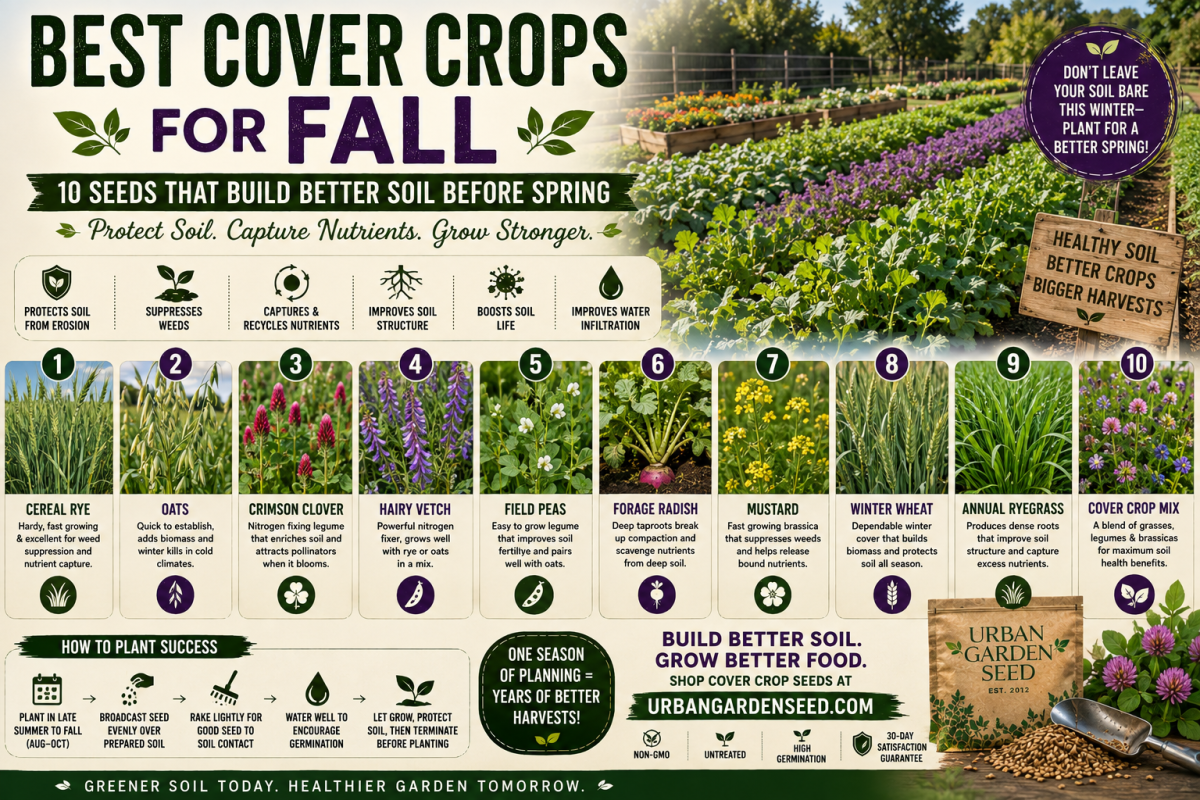
Best Cover Crops for Fall: 10 Seeds That Build Better Soil Before Spring
Aug
When the tomatoes are finished, the beans stop producing, and your summer garden begins opening up, you have two choices.
You can leave the soil bare all winter.
Or you can grow something that protects and improves it.
That is where cover crops come in.
Cover crops are planted primarily to benefit the soil rather than to produce a harvest for the kitchen. Farmers have used them for generations, but they are equally useful in backyard gardens, raised beds, homesteads, market gardens, and larger growing operations.
A well-chosen fall cover crop can help:
- Protect bare soil
- Reduce erosion
- Suppress weeds
- Capture leftover nutrients
- Add organic matter
- Improve soil structure
- Encourage biological activity
- Improve water infiltration
- Prepare beds for spring planting
And August through fall is exactly when many growers should begin thinking about them.
Here are 10 cover crops worth considering, how they differ, and how to choose the right one for your garden.
What Is a Cover Crop?
A cover crop is a plant grown mainly to protect or improve soil between primary crops.
Instead of leaving a harvested vegetable bed empty for months, you sow plants that keep roots growing and the soil covered.
Depending on the species, a cover crop may help with:
Soil protection
Leaves and stems shield the soil from heavy rain and wind.
Weed suppression
A dense stand can occupy space and intercept sunlight that weeds would otherwise use.
Nutrient capture
Some grasses and brassicas absorb nutrients remaining in the soil after summer crops.
Those nutrients remain in plant material rather than being lost as easily during the off-season.
Nitrogen fixation
Legumes such as clovers, peas, and vetch can form associations with nitrogen-fixing bacteria.
Organic matter
Roots and above-ground plant material eventually decompose and contribute organic matter.
Soil structure
Different root systems can help create channels through compacted soil and support soil aggregation.
The best cover crop depends on which of these benefits matters most to you.
Quick Guide: Best Fall Cover Crops
Consider these 10 options:
- Cereal rye
- Oats
- Crimson clover
- Hairy vetch
- Field peas
- Forage radish
- Mustard
- Winter wheat
- Annual ryegrass
- Mixed cover crops
You do not need to plant all ten.
In fact, beginners often get better results by choosing one crop—or one simple two-species mixture—and learning how it behaves.
1. Cereal Rye
Cereal rye is one of the most useful cold-season cover crops.
Do not confuse cereal rye with perennial ryegrass or annual ryegrass. They are different plants with different management characteristics.
Why grow cereal rye?
Cereal rye can:
- Establish during cool weather
- Produce substantial roots and biomass
- Protect soil
- Capture nutrients
- Compete strongly with weeds
- Survive winters in many colder regions
This makes it useful when your garden becomes available relatively late in fall.
Best for:
- Vegetable gardens
- Homesteads
- Larger plots
- Late-season planting
- Weed suppression
- Building biomass
The important catch
Cereal rye normally survives winter in many climates.
That means you must plan to terminate it in spring.
Do not simply plant it and forget about it.
Cut, mow, crimp, or otherwise manage it before it becomes mature and produces seed.
Also allow enough time between termination and planting sensitive spring crops.
Best choice if:
You want dependable winter soil cover and are willing to manage living growth in spring.
2. Oats
Oats are among the easiest cover crops for beginners in cold-winter regions.
They establish quickly during late summer and fall.
Why grow oats?
Oats can:
- Cover soil rapidly
- Compete with fall weeds
- Capture leftover nutrients
- Produce useful biomass
- Develop a fibrous root system
In colder climates, oats frequently die naturally during winter.
That can be a major advantage.
Instead of facing a living crop in spring, you may find a layer of dead plant residue covering your garden.
This can make spring preparation easier.
Best for:
- Beginners
- Raised beds
- Vegetable gardens
- Early fall planting
- Gardens where easy spring cleanup matters
Important:
Do not assume oats will winterkill everywhere.
In mild-winter regions, they may remain alive.
Always check local recommendations.
Best choice if:
You want an uncomplicated first cover-crop experiment in a climate with sufficiently cold winters.
3. Crimson Clover
Crimson clover is a legume often grown where nitrogen contribution and soil coverage are priorities.
It also produces attractive flowers when allowed to mature.
Why grow crimson clover?
Potential benefits include:
- Nitrogen fixation
- Ground coverage
- Pollinator resources when flowering
- Organic matter
- Increased plant diversity
Best for:
- Soil-building rotations
- Homesteads
- Garden beds
- Pollinator-conscious growers
- Cover-crop mixtures
Crimson clover often works particularly well in mixtures with grasses.
The grass can contribute substantial biomass and nutrient capture while the clover contributes legume diversity and nitrogen fixation.
Important:
Winter survival varies by climate.
A planting that survives beautifully in one state may be damaged by winter temperatures somewhere else.
Best choice if:
Nitrogen contribution is one of your main objectives.
4. Hairy Vetch
Hairy vetch is another nitrogen-fixing legume used extensively as a cover crop.
It can produce significant growth when given enough time to establish.
Potential benefits:
- Nitrogen fixation
- Soil coverage
- Organic matter
- Strong spring growth
- Useful partnership with cereal grains
Best for:
- Vegetable rotations
- Homesteads
- Larger gardens
- Growers planning heavy-feeding spring crops
Hairy vetch is frequently paired with cereal rye.
The plants offer complementary growth habits.
The management issue
Hairy vetch can continue growing in spring.
Plan its termination carefully.
Do not let a vigorous cover crop interfere with the vegetable crop you actually intend to grow.
Best choice if:
You want a nitrogen-focused cover crop and are comfortable managing spring growth.
5. Field Peas
Field peas are another useful legume for cool-season cover cropping.
For home gardeners, a mixture of peas and oats can be particularly approachable.
Why combine peas and oats?
The oats provide:
- Fast growth
- Ground coverage
- Fibrous roots
- Weed competition
The peas contribute:
- A legume component
- Nitrogen fixation
- Additional plant diversity
In climates where both winterkill, the mixture can leave behind manageable residue for spring.
Best for:
- First-time cover croppers
- Vegetable beds
- Raised beds
- Early fall planting
- Gardeners wanting a simple mixture
Best choice if:
You want to try a two-species cover crop without creating an overly complicated system.
6. Forage Radish
Forage radish—sometimes called tillage radish—is grown for a very different reason from salad radishes.
It develops a large taproot that penetrates into the soil.
Potential benefits:
- Deep rooting
- Nutrient scavenging
- Soil channels
- Rapid fall growth
- Ground coverage
When large roots die and decompose, they can leave channels in the soil.
These channels may improve water movement and create pathways that later crop roots can follow.
Best for:
- Compacted areas
- Larger garden plots
- Farms
- Soil-building mixtures
- Early fall planting
Important:
Forage radish needs enough fall growing time to develop substantial roots.
Planting extremely late reduces the benefit.
It also winterkills in many cold climates but may behave differently in milder regions.
Best choice if:
Compaction and deep soil structure are major concerns.
7. Mustard
Mustards and related brassicas can establish rapidly under suitable fall conditions.
Their fast growth makes them useful when weed suppression and soil coverage are priorities.
Potential benefits:
- Rapid establishment
- Dense cover
- Nutrient scavenging
- Root development
- Weed competition
Best for:
- Vegetable gardens
- Larger beds
- Early fall planting
- Crop rotations
Rotation warning
Mustard is in the brassica family.
If you regularly grow:
- Broccoli
- Cabbage
- Kale
- Cauliflower
- Radishes
- Turnips
think carefully about crop rotation.
Repeatedly growing closely related plants in the same area can complicate disease and pest management.
Best choice if:
You want fast fall growth and brassicas fit your crop-rotation plan.
8. Winter Wheat
Winter wheat can serve as a dependable cereal cover crop.
Like cereal rye, it can:
- Protect soil
- Produce biomass
- Capture nutrients
- Develop extensive roots
Winter wheat may be appropriate where growers want a winter-hardy grass but prefer it within a planned rotation or mixture.
Best for:
- Farms
- Homesteads
- Larger vegetable plots
- Winter soil coverage
It usually needs spring management.
Plan the next crop before deciding to use it.
Best choice if:
You want a winter cereal and have adequate time to establish it in your region.
9. Annual Ryegrass
Annual ryegrass can produce an extensive root system and dense soil cover.
It can be useful for:
- Holding soil
- Improving root-zone structure
- Capturing nutrients
- Competing with weeds
However, it must be managed properly.
Do not confuse it with cereal rye.
Best for:
- Experienced gardeners
- Farms
- Soil-building rotations
- Areas where fibrous rooting is desired
Important:
Termination is a major part of planning.
Any cover crop that survives winter should be selected only if you understand how you will remove or suppress it before planting your next crop.
Best choice if:
Root density and soil coverage are high priorities and you are comfortable with management.
10. Cover Crop Mixtures
A mixture can provide benefits that a single species cannot.
A common strategy combines different plant families.
For example:
Grass + legume
The grass contributes biomass and nutrient capture.
The legume contributes nitrogen fixation.
Or:
Grass + legume + brassica
This adds a taproot component to the fibrous roots and nitrogen-fixing plant.
Examples could include:
- Oats + field peas
- Rye + hairy vetch
- Oats + clover
- Rye + clover
- Oats + peas + radish
More diversity is not automatically better.
A two- or three-species mixture is often easier for home gardeners than a complicated ten- or fifteen-species blend.
Best choice if:
You have several soil-health objectives and understand the needs of each species in the mix.
Which Cover Crop Should You Choose?
Start with the problem you want to solve.
If weeds are your biggest problem
Consider:
- Cereal rye
- Oats
- Mustard
- Dense mixtures containing a fast-growing grass
If you want more nitrogen
Consider legumes such as:
- Crimson clover
- Hairy vetch
- Field peas
If compaction is the problem
Consider:
- Forage radish
- Deep-rooted mixtures
If you want easy spring management
In cold climates, consider crops that reliably winterkill locally, such as:
- Oats
- Field peas
- Radish
Always confirm winterkill behavior in your location.
If erosion is your primary concern
Choose a crop capable of establishing a dense root and shoot system before winter.
If you want maximum diversity
Use a carefully chosen grass-legume-brassica mixture.
Best Cover Crop for Beginners
For many cold-climate backyard gardeners, a simple oats and field pea mixture is an excellent starting experiment.
Why?
Both establish relatively quickly.
The oats provide dense fibrous roots and soil coverage.
The peas add a legume component.
In sufficiently cold climates, they may die during winter, reducing spring termination work.
If your winters are mild, choose based on local recommendations instead.
When Should You Plant Fall Cover Crops?
Timing depends on:
- Your location
- First frost timing
- Species
- Soil moisture
- Temperature
- Whether the crop must survive winter
There is no single nationwide planting date.
In many northern areas, planting may begin during August or September as vegetable beds become available.
Some very winter-hardy cereals can be planted considerably later.
Legumes and brassicas generally need more time to establish before cold weather than highly cold-tolerant cereal rye.
A useful principle is:
The earlier a fall cover crop is planted within its suitable window, the more growth it can usually produce before winter.
Do not wait until every vegetable in your garden is finished.
Plant cover crops bed by bed.
Use the Patchwork Method
Your whole garden does not become empty on the same day.
Maybe:
- Peas finish in June
- Garlic is harvested in July
- Beans finish in August
- Tomatoes continue into September
- Peppers remain until frost
There is no reason to wait until October to plant every cover crop simultaneously.
Instead, sow a cover crop whenever a section becomes available.
By fall, your vegetable garden may look like a patchwork of:
- Active vegetables
- Newly seeded cover crop
- Established cover crop
- Beds waiting for later harvest
This maximizes the amount of time living roots occupy the soil.
Can You Grow Cover Crops in Raised Beds?
Absolutely.
Raised beds are ideal places to experiment because each bed can receive a different treatment.
For example:
Bed 1: Oats + peas
Bed 2: Cereal rye
Bed 3: Clover mixture
Bed 4: Mulch only
Then compare the soil and weed pressure next spring.
Keep notes.
Cover cropping becomes much more useful when you learn what works on your own property.
Can You Use Cover Crops on a Homestead?
Yes.
Homesteads are particularly well suited to cover cropping because different areas may become available throughout the season.
Possible applications include:
- Vegetable plots
- Storage-crop fields
- Corn patches
- Orchard alleys
- Future garden expansion areas
- Pumpkin patches
- Market-garden beds
Larger areas also make erosion control and soil-building increasingly important.
Are Cover Crops Only for Farms?
No.
A cover crop can make sense in a 4-by-8-foot raised bed or a hundred-acre field.
The scale changes.
The principle does not:
Keep the soil protected and biologically active when possible.
Large farms may seed mechanically.
A backyard gardener can broadcast seed by hand.
How to Plant a Cover Crop
Step 1: Remove the previous crop
Harvest finished vegetables and remove material that needs to leave the garden.
Healthy residues may sometimes remain as part of the soil-cover system, depending on your management approach.
Step 2: Control mature weeds
Do not seed a cover crop into an area filled with large established weeds and expect it to solve everything.
Remove weeds that are already producing seeds.
Step 3: Prepare the surface
A finely tilled seedbed is not always necessary.
But seeds do need reliable contact with the soil.
Lightly rake the surface where appropriate.
Step 4: Broadcast or drill the seed
Small garden areas can be hand seeded.
Divide seed into two portions.
Spread half while walking in one direction.
Spread the second half while walking perpendicular to the first pass.
This improves distribution.
Step 5: Create seed-to-soil contact
Lightly rake or press seed into the surface according to its required planting depth.
Large seeds generally tolerate deeper planting than tiny ones.
Step 6: Water
Keep the seedbed sufficiently moist for germination.
Late-summer soil can dry surprisingly fast.
Once plants develop stronger roots, watering needs may decrease.
Do You Fertilize Cover Crops?
It depends on the crop and soil.
Remember that one purpose of many cover crops is to capture nutrients already remaining after the main crop.
Applying unnecessary fertilizer may defeat part of that objective.
A soil test is the best foundation for nutrient decisions.
Legumes also behave differently from grasses.
For farms and larger commercial plantings, use region-specific Extension or NRCS recommendations.
What Happens to Cover Crops in Spring?
This is the step beginners often forget.
Before planting a living cover crop, decide how it will end.
Cover crops may be:
- Killed naturally by winter
- Mowed
- Cut
- Crimped
- Incorporated shallowly
- Left on the surface as mulch
- Terminated using an appropriate farm-management method
Your approach depends on the species and production system.
Winter-killed crops are often easiest for beginners.
Winter-hardy crops require deliberate spring management.
Do Not Let Cover Crops Become Weeds
A useful cover crop can become inconvenient if allowed to produce mature seed.
Monitor the crop in spring.
If your goal is soil improvement rather than seed production, terminate it before mature seed develops.
This is especially important for vigorous cereal grasses.
How Long Before Planting Vegetables Should You Terminate?
The ideal interval varies by:
- Cover crop
- Amount of plant residue
- Spring crop
- Soil temperature
- Moisture
- Termination method
Do not terminate a large living cover crop in the morning and plant delicate vegetable seeds directly into a heavy mass that afternoon unless your system is designed for it.
Give residue time to settle when necessary.
For precise local timing, consult your Cooperative Extension service.
Cover Crops vs. Mulch
Both protect soil.
But they work differently.
Mulch
Examples include:
- Straw
- Leaves
- Wood chips
- Compost
- Crop residue
Mulch protects the surface but does not provide living roots.
Cover crops
Cover crops protect the surface and put active roots into the soil.
Those roots interact with soil organisms, create channels, capture nutrients, and contribute organic matter.
The two methods can complement each other.
You do not need to choose one forever.
Cover Crops vs. Compost
Compost adds decomposed organic material.
Cover crops grow organic material directly in the bed.
A productive soil-building strategy may use both:
- Compost to add mature organic matter
- Cover crops to keep living roots in the soil
- Mulch to maintain surface protection
- Reduced disturbance to preserve soil structure
No single input solves every soil problem.
Think in systems.
Common Cover Crop Mistakes
Mistake 1: Planting too late
Some species need weeks of fall growth before freezing weather.
Mistake 2: Choosing a crop without planning termination
Know what will happen in spring before you plant.
Mistake 3: Assuming every crop winterkills
Winter survival varies by species and climate.
Mistake 4: Letting a cover crop produce seed unintentionally
Terminate at the appropriate growth stage.
Mistake 5: Ignoring crop rotation
Mustards, radishes, and other brassicas are related to common vegetable crops.
Mistake 6: Creating an unnecessarily complicated mixture
Beginners do not need fifteen species.
Start with one to three.
Mistake 7: Ignoring moisture during germination
A dry seedbed can produce poor stands.
Mistake 8: Treating cover crops as instant fertilizer
Soil health improves through repeated management over time.
A Simple Fall Cover Crop Plan
If you are new to cover crops, use this process.
August
Identify beds that have already finished producing.
Consider fast-establishing cover crops suitable for your climate.
September
Continue planting beds as summer crops finish.
This is an important planting period for many cover crop species in large parts of the United States.
October
Options begin narrowing in colder regions.
Concentrate on species that tolerate later establishment where locally recommended.
November
In many cold areas, the planting window has largely closed.
Certain hardy cereals may still be options in some climates.
In warm regions, however, the season may still be suitable for several cool-season cover crops.
Local guidance matters.
Regional Planning Matters
A fall cover crop in Minnesota should not automatically be managed like one in Georgia.
Cold-winter regions
Winter-killed crops may simplify spring management.
Winter-hardy cereals remain options where continuous winter protection is required.
Transition regions
Both winterkill and winter survival can vary considerably depending on weather.
Choose cautiously.
Mild-winter regions
Many plants that die in northern winters may continue growing.
Spring termination becomes more important.
Hot southern climates
Wait for appropriate cool-season conditions, but do not assume the first frost controls every planting decision.
Your local Extension service can provide more useful dates than a nationwide calendar.
How Cover Crops Fit Into a Food-Producing Garden
Cover crops do not replace food crops.
They support them.
Think of your garden as a yearly cycle:
Spring: vegetables begin growing
Summer: crops produce heavily
Late summer: finished beds become available
Fall: cover crops occupy unused soil
Winter: soil remains protected
Spring: cover crops are terminated
Next crop: vegetables return to improved beds
Instead of treating winter as a dead period, you make it part of the soil-building season.
Why Seed Quality Matters
Cover cropping is time-sensitive.
If germination is poor, you may lose valuable weeks before winter.
Choose seed appropriate for:
- Your intended use
- Your region
- Planting date
- Climate
- Management method
Always confirm that the seed you purchase is suitable for cover-crop use and calculate the correct seeding rate for the area being planted.
Grow More by Improving the Soil First
Gardeners naturally focus on what they can see:
Tomatoes.
Peppers.
Flowers.
Corn.
Squash.
Beans.
But every one of those plants depends on what is below them.
Healthy soil supports:
- Root growth
- Water movement
- Nutrient cycling
- Biological activity
- Resilient plants
A cover crop is not wasted space.
It is an investment in the crops that come next.
Why Choose Urban Garden Seed?
Urban Garden Seed supplies seeds for gardeners, homeowners, homesteaders, plant collectors, and growers across the United States.
Our selection includes:
- Vegetable seeds
- Flower seeds
- Fruit seeds
- Plant seeds
- Ground-cover plants
- Herbs
- Specialty varieties
Urban Garden Seed focuses on Non-GMO, untreated seed options and offers a 30-Day Satisfaction Guarantee.
Whether you are growing food, improving a homestead, creating a regenerative garden, or preparing soil for next season, better planning begins with the right seed.
Don’t Leave Your Best Soil Bare All Winter
You spent an entire growing season building your garden.
Do not abandon the soil after harvest.
When a bed becomes empty:
Plant something useful.
Grow roots.
Protect the surface.
Capture nutrients.
Suppress weeds.
Build organic matter.
Then prepare for another productive season.
Ready to Plan Your Next Crop?
Explore seed varieties at UrbanGardenSeed.com and start preparing your garden, homestead, or growing area for the seasons ahead.
Grow the harvest. Build the soil. Improve the garden year after year.
Frequently Asked Questions
What is the best cover crop for fall?
There is no single best species. Cereal rye is useful for cold-weather soil cover and weed competition, oats are beginner-friendly in many cold climates, legumes such as clover and vetch can contribute nitrogen, and forage radish can provide deep rooting.
When should I plant fall cover crops?
Many fall cover crops are planted from late summer through fall. The exact date depends on species and region. Crops that need significant fall growth must be planted earlier than very winter-hardy cereals.
What is the easiest cover crop for beginners?
In sufficiently cold climates, oats or an oats-and-field-pea mixture can be relatively easy because they often winterkill, reducing spring termination work.
What cover crop is best for weeds?
Dense, fast-growing grasses such as cereal rye and oats are commonly used where weed competition is important.
What cover crop adds nitrogen?
Legumes such as crimson clover, hairy vetch, and field peas can fix atmospheric nitrogen through associations with soil bacteria.
What cover crop helps compacted soil?
Forage radish develops a large taproot and is commonly selected when deep rooting and soil channels are desired.
Can I plant cover crops in raised beds?
Yes. Raised beds are excellent for experimenting with cover crops, particularly beds that would otherwise remain bare through fall and winter.
Do cover crops need to be tilled into the soil?
No. Depending on the system, they may be cut, mowed, crimped, winter-killed, incorporated, or left on the soil surface as residue.
Will cover crops come back next year?
Some winter-hardy species survive into spring. Others die during winter in cold climates. Prevent unwanted reseeding by managing living crops before they produce mature seed.
Can cover crops replace fertilizer?
Not entirely. Cover crops can improve nutrient cycling and legumes may contribute nitrogen, but nutrient needs depend on soil conditions and the crop you plan to grow.
Are cover crops useful for home gardens?
Yes. They can benefit backyard vegetable gardens, raised beds, homesteads, market gardens, and farms.
Where can I buy seeds for improving my garden?
Visit UrbanGardenSeed.com to explore vegetable, plant, flower, fruit, ground-cover, and specialty seed varieties for your next growing season.
