Adenium, Backyard Gardening, Cactus & Succulent, Flower Seeds, Garden Planning & Design, Herb Seeds, Homesteading & Self-Reliance, Sensory & Wellness Gardening, Sustainable & Regenerative Living, The Horticulturist’s Lab, Urban & Small-Space Gardening, Vegetables
How to Grow a Native Garden: Complete U.S. Guide for a Beautiful, Low-Maintenance Yard
Aug
American yards are changing.
More homeowners are looking beyond the traditional formula of lawn, foundation shrubs, and a few annual flowers.
They want landscapes that are:
- Beautiful
- Resilient
- Better adapted to local weather
- Useful to bees and butterflies
- Less dependent on constant irrigation
- More interesting throughout the year
- Filled with plants that actually belong in their region
That is why interest in native gardening is growing.
A native garden uses plants that occur naturally within a particular region rather than treating the entire United States as one gardening zone.
That distinction is important.
A flower native to Florida may not be native to Oregon.
A grass native to Texas may not belong in a New England landscape.
And a plant described simply as “North American native” may naturally occur hundreds or thousands of miles from your property.
Successful native gardening therefore begins with one simple idea:
Grow plants adapted to where you actually live.
This guide will show you how.
What Is a Native Garden?
A native garden is a landscape built primarily with plants that originated in your local region or ecosystem.
Depending on where you live, that could include:
- Wildflowers
- Perennial flowers
- Native grasses
- Sedges
- Ground covers
- Shrubs
- Vines
- Small trees
- Large shade trees
A native garden does not have to resemble an unmanaged field.
It can be designed as:
- A formal front yard
- A cottage garden
- A pollinator border
- A meadow
- A woodland garden
- A drought-tolerant landscape
- A backyard wildlife garden
- A mixed edible and native landscape
The design can be neat or naturalistic.
The important part is plant selection.
Why Grow Native Plants?
Native plants developed under the environmental conditions of their region.
That makes appropriately selected native species valuable components of resilient landscapes.
Regional native plants can provide food and habitat for pollinators and other wildlife, and many are well adapted to local soils and climate.
But “native” does not automatically mean “maintenance-free.”
A native wetland plant will struggle in a dry hillside.
A sun-loving prairie flower will struggle under dense tree shade.
You still need to match the plant to the site.
That principle is sometimes summarized as:
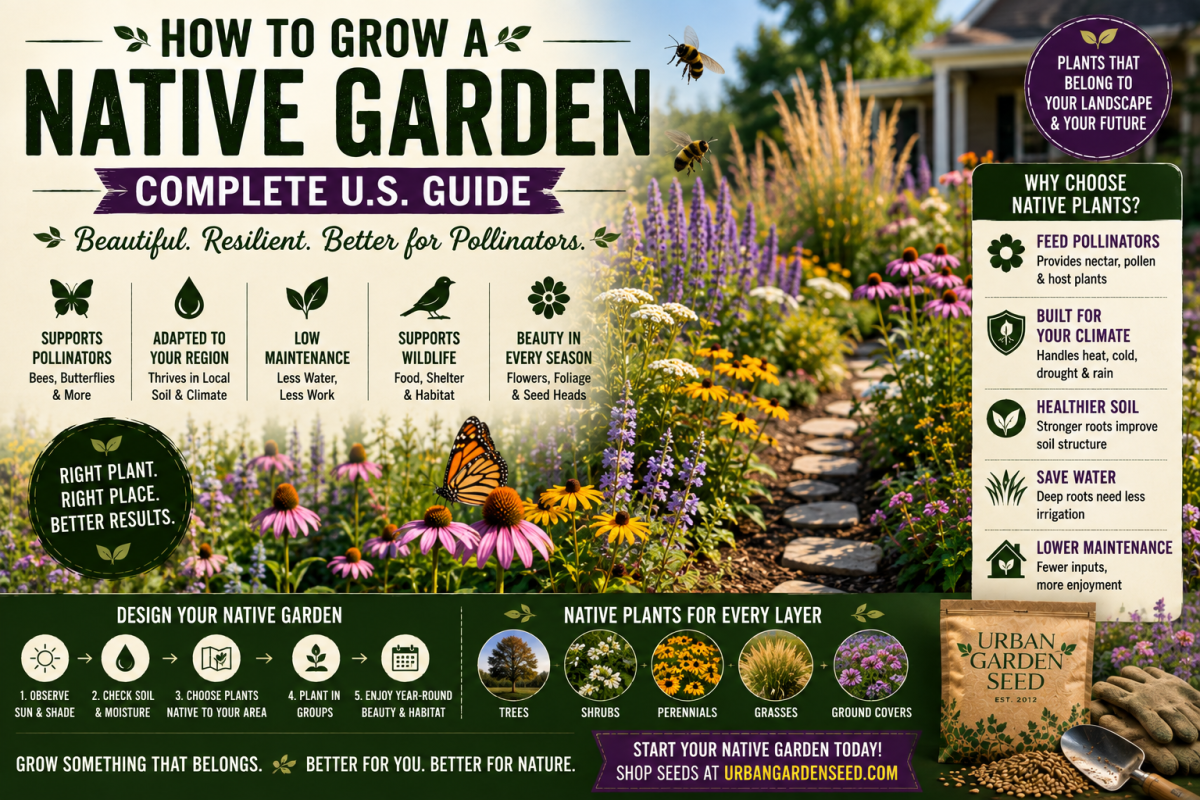
Right plant. Right place.
1. Native Gardens Can Support Pollinators
Flowers provide nectar and pollen.
But native plants can provide much more.
Depending on the species, they may support:
- Native bees
- Butterflies
- Moths
- Caterpillars
- Hummingbirds
- Beetles
- Beneficial predatory insects
Some insects are generalists and use many different plants.
Others have much more specialized relationships with particular plant families or species.
That means a diverse native landscape can contribute more than color.
It can become habitat.
2. Native Plants Can Make Landscapes More Resilient
A plant adapted to your regional rainfall, temperatures, seasonal patterns, and soils may require fewer interventions once properly established than a poorly adapted ornamental plant.
That can mean less dependence on:
- Frequent irrigation
- Soil modification
- Intensive fertilization
- Constant replacement
But always remember:
New plants need establishment care.
Even drought-adapted native plants generally need appropriate moisture while developing their root systems.
Drought tolerant does not mean “never water.”
3. Native Gardens Can Reduce Lawn Area
One of the biggest opportunities in native landscaping is not necessarily removing every square foot of grass.
It is questioning where lawn is actually useful.
Keep durable lawn where you need:
- Children’s play space
- Pet areas
- Outdoor games
- Entertaining areas
- Regular foot traffic
Then consider transforming unused lawn into:
- Native flower beds
- Prairie-style plantings
- Shrub borders
- Wildlife habitat
- Meadow areas
- Ground-cover plantings
You can convert gradually.
There is no requirement to remove the entire lawn in one weekend.
4. Native Gardens Can Look Beautiful All Year
A strong native garden is designed for more than spring flowers.
Think in four seasons.
Spring
Look for:
- Early flowers
- Emerging grasses
- Flowering shrubs
- Native trees with blossoms
Summer
Create strong color with:
- Long-blooming perennials
- Meadow flowers
- Native grasses
- Pollinator plants
Fall
Use:
- Seed heads
- Berries
- Changing foliage
- Late-blooming flowers
- Ornamental grasses
Winter
Do not assume everything needs to be cut to the ground immediately.
Standing stems, grasses, seed heads, bark, and plant structure can contribute winter interest while also serving ecological functions.
Native Does Not Mean Native Everywhere
This is probably the most important point in this entire guide.
The United States is enormous.
It contains:
- Deserts
- Prairies
- Temperate forests
- Subtropical regions
- Mountains
- Wetlands
- Mediterranean climates
- Coastal environments
- Great Lakes ecosystems
There is no single group of plants that belongs everywhere.
Before buying a plant or seed, determine whether that specific species is native to your region.
Scientific names are extremely helpful.
Common names can sometimes refer to several different plants.
How to Find Native Plants for Your State
Use reliable regional resources.
Good places to research include:
- State Cooperative Extension services
- Native plant societies
- Regional botanical gardens
- USDA plant-distribution resources
- Pollinator-conservation organizations
- University horticulture programs
When researching a species, check:
- Native range
- Sun requirements
- Soil requirements
- Moisture preference
- Mature height
- Mature width
- Blooming season
- Cold hardiness
- Heat tolerance
- Growth habit
Do this before ordering large quantities.
Start With Your Property, Not a Plant List
One of the biggest native-gardening mistakes is finding a beautiful plant online and forcing it into the wrong location.
Instead, analyze your property first.
Step 1: Measure the Sun
Observe the planting area throughout the day.
Classify areas as:
Full sun
Usually the strongest choice for prairie and meadow-style flowers.
Partial sun or partial shade
Useful for woodland-edge plants and many shrubs.
Deep shade
Requires plants adapted to woodland conditions.
Do not assume a plant will adapt simply because it is native somewhere in your state.
Step 2: Understand Your Soil Moisture
Look at the garden after rain.
Does water:
- Drain quickly?
- Remain for several hours?
- Pool for days?
- Run downhill immediately?
Identify:
- Dry areas
- Average-moisture areas
- Wet areas
Different native plants occupy all of these environments.
Your goal is to match them.
Step 3: Check Your Soil
You do not necessarily need perfect soil.
In fact, many native species are adapted to conditions that would frustrate traditional garden plants.
But it helps to know:
- Soil texture
- Drainage
- pH
- Organic matter
- Compaction
A soil test can provide useful information before a major landscape transformation.
Step 4: Determine the Function of the Area
What do you want this part of the yard to do?
Maybe you want:
- Pollinator habitat
- Privacy
- Flowers for cutting
- Bird habitat
- Erosion control
- A low-water garden
- A meadow
- A replacement for unused turf
- Four-season beauty
- A butterfly garden
The goal determines the plants.
How to Design a Native Garden That Looks Intentional
Some homeowners like naturalistic gardens but worry that neighbors will think the yard looks neglected.
Design solves this.
Use visual signals that tell people:
This landscape is intentional.
Use Defined Edges
A strong edge makes even a naturalistic planting look organized.
Consider:
- Stone borders
- Steel edging
- Brick
- Timber
- Mowed strips
- Defined paths
A wild center with a clean perimeter often looks deliberate.
Plant in Groups
Avoid placing one specimen of twenty-five different species randomly throughout a small bed.
Instead, repeat plants.
For example:
- 5 of one flower
- 7 ornamental grasses
- 5 of another perennial
- 3 shrubs
Repeated groups create visual rhythm.
They can also make flowers easier for pollinators to locate.
Use Different Plant Heights
A garden usually looks more complete when it contains several levels.
Back layer
Use:
- Tall grasses
- Tall perennials
- Shrubs
Middle layer
Use:
- Medium-height flowering plants
- Compact grasses
- Smaller shrubs
Front layer
Use:
- Ground covers
- Low flowers
- Short sedges
This creates the same kind of dimensional planting found in natural ecosystems while maintaining a designed appearance.
Include Native Grasses
Flowers get most of the attention.
But grasses can be one of the most important visual components of a native garden.
Native grasses can provide:
- Texture
- Movement
- Winter structure
- Ground coverage
- Habitat
- Contrast with flowers
Depending on your region, native-grass options may range from short prairie grasses to tall architectural species.
Choose according to local range and site conditions.
Include Shrubs
A landscape composed only of flowers can look empty during winter.
Native shrubs add permanent structure.
Depending on species, they may also provide:
- Flowers
- Berries
- Nesting cover
- Fall color
- Screening
- Privacy
Use shrubs to create the backbone of the planting.
Then fill around them with flowers and grasses.
Include Native Trees Where Space Allows
Trees can provide enormous long-term value.
A mature native tree may offer:
- Shade
- Nesting sites
- Seeds
- Nuts
- Fruit
- Caterpillar habitat
- Wind protection
- Landscape structure
But mature size matters.
Never plant a large tree without considering:
- Power lines
- Roofs
- Foundations
- Driveways
- Property boundaries
- Underground utilities
- Future shade
Plant for the tree it will become—not the seedling you see today.
Native Flowers to Research
The correct species depends on location, but several native-plant groups are worth researching for your particular region.
Milkweeds
Milkweeds are especially well known because monarch caterpillars depend on plants in the milkweed genus.
But do not treat all milkweeds as interchangeable.
Choose a species native to your region.
Different milkweeds are adapted to:
- Dry soils
- Average garden soils
- Wet areas
- Prairies
- Western climates
- Eastern climates
The right species matters.
Coneflowers
Coneflowers are popular in naturalistic and pollinator gardens.
Different species occur in different native ranges.
They can provide:
- Summer flowers
- Pollinator resources
- Attractive seed heads
Research the exact species rather than relying only on the word “coneflower.”
Black-Eyed Susans
Black-eyed Susan-type flowers provide the classic yellow-and-dark-center prairie appearance many gardeners associate with native landscapes.
They work especially well when planted in groups.
Again, check the exact species and native range.
Native Asters
Asters are especially valuable when designing for late-season color.
Late flowers can extend garden interest after many summer species finish blooming.
They also help create a continuous sequence of flowering plants through the season.
Goldenrods
Goldenrods can be outstanding late-season plants.
They are available in many different heights and growth habits.
Some are suitable for large naturalized spaces.
Others are better suited to designed residential beds.
Choose carefully because mature size and spreading behavior vary.
Native Sunflowers
The sunflower family contains many North American native species beyond the familiar giant annual sunflower.
Native perennial sunflower relatives can add:
- Late color
- Wildlife value
- Height
- Naturalistic character
They may be best suited to larger spaces because some spread vigorously.
Butterfly Weed
Butterfly weed is a milkweed species known for vivid orange flowers.
It is particularly associated with sunny, well-drained conditions within its native range.
Do not confuse it with every other plant carrying the word “butterfly” in its common name.
Native Iris
Several iris species are native to different parts of North America.
Some prefer moist environments.
Others occupy different habitats.
Identify the species before assuming an iris is native where you live.
Native Grasses
Depending on region, gardeners may research species within groups such as:
- Switchgrass
- Little bluestem
- Big bluestem
- Blue grama
- Side-oats grama
These are not universal recommendations.
Their natural ranges and suitable garden conditions vary.
Use regional sources before planting.
How to Replace Lawn With Native Plants
Lawn conversion is one of the most searched native-gardening projects.
There are several ways to approach it.
Method 1: Convert Small Sections Gradually
This is the easiest strategy for many homeowners.
Start with:
- A mailbox bed
- A sunny corner
- A strip along a fence
- An area around an existing tree
- A section beside a driveway
Learn what performs well.
Expand later.
Method 2: Smother the Existing Grass
For some areas, gardeners use sheet materials and mulch to suppress turf before planting.
The process takes time.
Do not rush directly from living lawn to sowing tiny native seeds without controlling competition.
Method 3: Remove the Turf
Small beds can sometimes be stripped manually.
This gives you immediate access to the soil but requires more labor.
Avoid disturbing soil more deeply than necessary because cultivation may expose dormant weed seeds.
Method 4: Establish a Meadow
Large sunny areas can be converted to native-style meadow plantings.
But meadow establishment is not simply:
Scatter seed + stop mowing = native meadow.
Successful establishment usually requires:
- Existing vegetation control
- Appropriate seed selection
- Correct sowing timing
- Seed-to-soil contact
- Weed management
- Patience
A meadow can take several growing seasons to mature.
Should You Plant Native Seeds in Fall or Spring?
Both can work depending on the species and region.
Some native seeds need or benefit from exposure to cold and moist conditions before germinating.
Fall or dormant sowing can provide that treatment naturally.
Other plants can be spring sown.
Always check the germination requirements for the exact species.
Do not use one planting method for every native seed.
Why Some Native Seeds Take Longer to Germinate
Many popular vegetable seeds are bred for rapid, predictable germination.
Wild and native species may behave differently.
Some seeds contain natural dormancy mechanisms that delay germination until conditions become suitable.
Depending on the plant, successful germination may involve:
- Cold stratification
- Warm stratification
- Scarification
- Light exposure
- Darkness
- Alternating temperatures
This does not necessarily mean the seed is bad.
It may simply be behaving according to its natural life cycle.
Read species-specific instructions.
How to Build a Native Pollinator Garden
A pollinator garden should provide flowers over as much of the growing season as possible.
Avoid creating a bed in which every flower blooms during the same three weeks.
Instead, choose:
Early-season bloomers
Provide resources when the season begins.
Summer bloomers
Create peak-season color and nectar.
Late-season bloomers
Continue flowering into late summer and fall.
Then combine multiple flower structures.
Different pollinators use different flowers.
Diversity matters.
Native Garden for Birds
Flowers are only part of bird habitat.
Consider incorporating:
- Seed-producing flowers
- Berry shrubs
- Native trees
- Dense cover
- Grasses
- Water
- Nesting habitat
Leave some seed heads standing after flowering.
A garden does not have to be completely cleaned and cut down immediately after frost.
Native Garden for Butterflies
Butterflies need more than nectar.
They also need plants that their caterpillars can eat.
These are called host plants.
A good butterfly garden therefore contains:
- Nectar plants for adult butterflies
- Appropriate host plants for caterpillars
- Shelter
- Suitable maintenance practices
Expect some leaves to be eaten.
That can mean the habitat is functioning.
Native Garden for Bees
Include flowers with different:
- Shapes
- Colors
- Bloom periods
- Heights
Avoid unnecessarily applying broad-spectrum insecticides around flowering plants.
Also remember that some native bees nest in the ground while others use hollow stems or cavities.
Habitat is more than flowers.
Can Native Plants Grow in Formal Landscaping?
Absolutely.
Native gardening does not require giving up traditional landscape design.
Try:
- Native shrubs as foundation plants
- Native grasses in repeated groups
- One flowering species planted in masses
- Defined stone edging
- A native shade tree as a focal point
- Low native plants around pathways
You can achieve a clean architectural landscape using native plants.
Can You Mix Native and Non-Native Plants?
Yes.
A garden does not need to be 100 percent native to become more ecologically useful.
Many homeowners transition gradually.
Keep:
- Favorite vegetables
- Fruit trees
- Culinary herbs
- Treasured ornamentals
Then increase the amount of locally appropriate native vegetation over time.
The goal can be improvement rather than perfection.
Native Gardens and Vegetable Gardens Work Well Together
Native flowers and grasses can be excellent neighbors for food-producing gardens.
Plant native habitat:
- Along vegetable-bed edges
- Near orchards
- Around property boundaries
- Along farm lanes
- Beside raised beds
Flowering habitat may attract pollinators and beneficial insects into the broader property.
This is especially useful for crops that rely on insect pollination.
Common Native Gardening Mistakes
Mistake 1: Assuming “American native” means locally native
Always check the species’ actual range.
Mistake 2: Buying by flower color alone
Match soil, sun, and moisture.
Mistake 3: Planting too densely around young shrubs and trees
Plan for mature size.
Mistake 4: Expecting zero maintenance
Young native gardens require weed management and establishment care.
Mistake 5: Watering drought-adapted plants excessively
Match irrigation to the species and soil.
Mistake 6: Leaving aggressive invasive plants nearby
They can outcompete newly established natives.
Mistake 7: Cutting everything down immediately in fall
Seed heads and stems can provide winter structure and habitat.
Mistake 8: Expecting instant results from seed
Some native perennials develop slowly during their first season.
Mistake 9: Planting only one species
Diversity generally creates a more useful and visually interesting landscape.
Mistake 10: Ignoring scientific names
Common names can create confusion.
A Simple Native Garden Plan for Beginners
Start with one manageable bed.
For example:
Back layer
Choose one or two regionally appropriate:
- Native shrubs
- Taller grasses
- Tall perennials
Middle layer
Add several groups of:
- Medium flowering perennials
- Compact grasses
Front layer
Use:
- Low flowers
- Sedges
- Ground covers
Then aim for flowering at different points in the season.
Do not try to recreate an entire ecosystem during your first weekend.
Start small.
Observe.
Expand.
Native Garden Maintenance
During the first year, focus on:
- Weed identification
- Watering while plants establish
- Maintaining mulch where suitable
- Keeping invasive plants out
- Learning what seedlings look like
During later years:
- Divide overcrowded plants when needed
- Thin aggressive spreaders
- Add missing seasonal blooms
- Leave appropriate winter structure
- Replace plants that clearly dislike the site
The garden should become increasingly adapted to your property over time.
Why Grow Native Plants From Seed?
Growing from seed can make it possible to:
- Establish larger plantings economically
- Grow more individual plants
- Create meadow areas
- Experiment with different species
- Produce flowers for larger landscapes
- Participate in the entire life cycle of the plant
But native species can have more specialized germination requirements than common annual flowers.
Research before sowing.
Patience is part of native gardening.
Buying Native Plant Seeds Online: What to Check
Before buying, ask:
What is the scientific name?
This helps you confirm exactly what you are purchasing.
Is it native to my region?
Do not assume.
What germination treatment does it need?
Some species require stratification or scarification.
What conditions does the mature plant prefer?
Check:
- Sun
- Soil
- Moisture
- Mature size
Is the plant invasive outside its native range?
A species can behave differently when moved far beyond its natural ecosystem.
Is the seller clearly describing the product?
Good gardening starts with knowing what you are planting.
Why Choose Urban Garden Seed?
Urban Garden Seed offers a broad collection of flower, vegetable, herb, fruit, tree, grass, ground-cover, and specialty seeds for growers throughout the United States.
Our focus is helping gardeners discover more plants and grow with greater confidence.
Urban Garden Seed offers:
- Non-GMO seed options
- Untreated seeds
- Seeds selected and tested for strong germination
- Varieties sourced from around the world
- Flower and landscape selections
- A 30-Day Satisfaction Guarantee
When shopping specifically for a native garden, always verify that the individual species you choose is native and appropriate for your region.
A beautiful plant is only the right plant when it belongs in the conditions you can provide.
Start With One Native Bed
You do not need to transform your entire property at once.
Choose one area.
Remove unwanted competition.
Study the sunlight.
Understand the soil.
Select several regionally appropriate species.
Plant them in intentional groups.
Then watch what happens.
You may begin to notice:
- More bees
- More butterflies
- More birds
- New flowers throughout the seasons
- Less unused lawn
- A landscape that feels more connected to where you live
That is the power of native gardening.
Not simply planting something beautiful.
But planting something that makes sense for your place.
Ready to Grow?
Explore flower, grass, tree, ground-cover, and specialty seeds at UrbanGardenSeed.com and begin building a more diverse landscape.
Grow for your climate. Grow for your landscape. Grow something that belongs.
Frequently Asked Questions About Native Gardens
What is a native garden?
A native garden primarily uses plants that naturally occur within the gardener’s geographic region or ecosystem.
Why should I plant native plants?
Appropriately selected native plants can provide habitat and food for local wildlife and may be well adapted to regional soil and weather conditions.
Are native plants low maintenance?
They can require less intervention once established when correctly matched to the site, but new plantings still require watering, weed management, and other establishment care.
Do native plants need fertilizer?
Many established native species perform well without heavy fertilization when grown in suitable soil. Follow species-specific and soil-test recommendations.
Can I replace my lawn with native plants?
Yes. Homeowners can replace part or all of unused lawn with native flower beds, grasses, shrubs, ground covers, or meadow-style plantings.
What are the best native flowers?
There is no universal list. The best native flowers depend on your geographic region, soil, moisture, light, and garden goals.
Are coneflowers native?
Some coneflower species are native to portions of North America, but native range differs by species. Check the scientific name and local distribution.
Is milkweed good for butterflies?
Milkweed species serve as host plants for monarch caterpillars. Select milkweed species native to your region.
Can native plants grow from seed?
Yes. Many can, although some require special germination treatments such as cold stratification.
When should native seeds be planted?
It depends on the species. Some are well suited to fall or dormant sowing, while others can be spring sown.
Can native plants grow with vegetables?
Yes. Native flowers and grasses can be incorporated around vegetable gardens, orchards, and other food-producing landscapes.
Do native gardens attract bees?
Many flowering native plants provide pollen and nectar for native bees and other pollinating insects.
Where should I find plants native to my state?
Use your state Cooperative Extension program, regional native plant societies, USDA plant-distribution information, and reputable regional conservation resources.
Where can I buy seeds for a naturalistic garden?
Visit UrbanGardenSeed.com to browse flower, grass, tree, ground-cover, and other plant seeds. For native-garden projects, confirm that each selected species is native to your particular region before planting.
