
Backyard Gardening, Cactus & Succulent, Flower Seeds, Garden Planning & Design, Herb Seeds, Homesteading & Self-Reliance, Sensory & Wellness Gardening, Sustainable & Regenerative Living, The Horticulturist’s Lab, Urban & Small-Space Gardening, Vegetables
10 Perennial Vegetables You Plant Once and Harvest for Years
Aug
Most vegetable gardens start over every spring.
Tomatoes are replanted.
Beans are resown.
Cucumbers go back into the ground.
Lettuce starts again from seed.
But not every edible plant follows that cycle.
Perennial vegetables can remain in the garden for several years, returning season after season without requiring complete replanting every spring. Some produce for decades when properly established.
That makes them particularly useful for:
- Backyard gardens
- Homesteads
- Farms
- Food forests
- Edible landscapes
- Long-term food-security gardens
- Low-maintenance vegetable gardens
- Families trying to produce more food from their property
Instead of rebuilding your entire food garden every year, perennial crops create a permanent edible foundation.
Plant them carefully.
Let them establish.
Then harvest for years.
What Is a Perennial Vegetable?
A perennial vegetable is an edible plant capable of surviving for multiple growing seasons and producing again after dormancy or seasonal dieback.
This is different from annual vegetables such as tomatoes, beans, cucumbers, and lettuce, which normally complete their life cycle within one season.
Examples of well-known perennial vegetables include:
- Asparagus
- Rhubarb
- Artichokes in suitable climates
- Horseradish
- Sorrel
Several perennial herbs and onions can also become permanent parts of a productive edible garden.
The important qualification is climate.
A plant that behaves as a perennial in California may grow only as an annual in Minnesota.
Always check the cold hardiness and heat tolerance of the specific species before planting.
Why Grow Perennial Vegetables?
Less replanting
Once established, perennial crops do not require complete annual reseeding.
You still have maintenance work, but much of the planting has already been done.
Earlier harvests
Some perennial vegetables begin growing as soon as weather becomes favorable in spring.
That can provide food before newly planted annual crops become productive.
Long-term root systems
Perennial crops develop established root systems instead of beginning from tiny seedlings every year.
More diversity
A permanent edible garden can produce foods beyond the standard tomatoes, peppers, squash, and beans found in many annual gardens.
Useful for food forests and edible landscaping
Perennial vegetables fit naturally around:
- Fruit trees
- Berry shrubs
- Herb gardens
- Orchard edges
- Permanent raised beds
They allow more of the property to produce food.
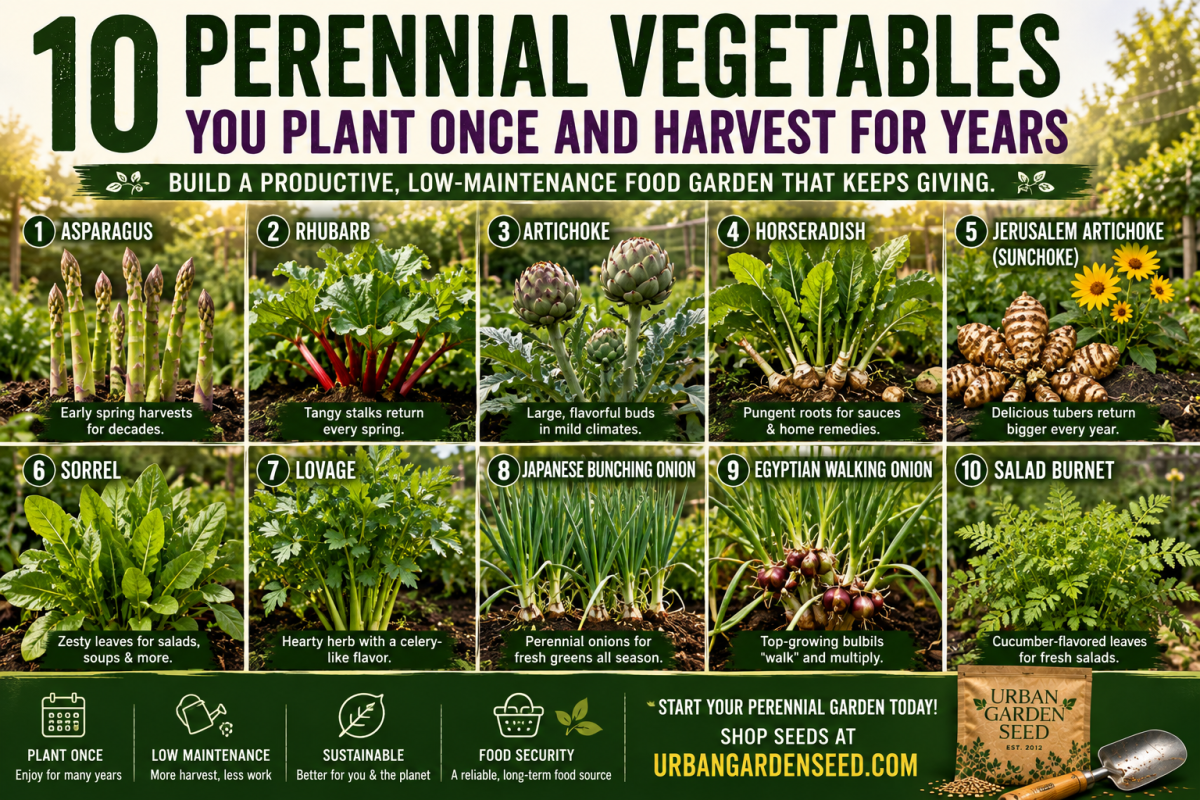
1. Asparagus
If there is one crop that represents perennial vegetable gardening, it is asparagus.
A properly maintained asparagus planting can remain productive for many years. University of Minnesota Extension notes that an asparagus planting can last around 15 years.
Why asparagus is worth growing
Once established, asparagus produces fresh spears every spring.
Instead of sowing a new crop every year, established crowns emerge when conditions become favorable.
Can asparagus be grown from seed?
Yes.
Gardeners can start asparagus from seed or purchase established crowns.
Growing from seed requires more patience, but it can be an economical way to establish a larger asparagus bed.
University of Minnesota recommends waiting until approximately the third year before harvesting asparagus started from seed so plants can establish strong crowns.
Where should you plant asparagus?
Choose the location carefully.
An asparagus bed is a long-term commitment.
Give it:
- Good drainage
- Adequate sunlight
- Reliable moisture during establishment
- Room for mature fern growth
Avoid planting asparagus somewhere you expect to redesign next year.
Urban Garden Seed opportunity
Shop Asparagus Seeds at UrbanGardenSeed.com
Start today and build a perennial harvest for future springs.
2. Rhubarb
Rhubarb is another classic perennial vegetable.
The edible portion is the thick leaf stalk, which is commonly used in:
- Pies
- Sauces
- Preserves
- Desserts
- Compotes
Rhubarb establishes a permanent crown and can return for many seasons in climates where it grows well. UC and Minnesota Extension both recognize rhubarb among common perennial vegetables.
Important safety note
Only the stalks are normally eaten.
Rhubarb leaves should not be eaten.
Give rhubarb room
Mature rhubarb plants can become large.
Do not squeeze them tightly between annual vegetables.
A dedicated perennial bed or landscape edge may work better.
3. Globe Artichoke
Globe artichokes demonstrate why regional planning matters.
In suitable mild climates, they can behave as long-lived perennial plants.
In colder locations, winter conditions may kill the plants, and gardeners may instead grow artichokes more like annual crops.
UC Master Gardener guidance notes that artichokes may persist for several years but can freeze in colder areas.
Why grow artichokes?
An artichoke plant provides both food and strong ornamental value.
Its large foliage creates a dramatic landscape plant, while immature flower buds become the familiar edible artichokes.
This makes artichoke useful for foodscaping—integrating edible crops into ornamental landscapes.
Best placement
Artichokes need significant room.
Place them where their mature size will complement rather than overwhelm neighboring plants.
4. Horseradish
Horseradish is one of the toughest perennial edibles you can establish.
The edible root provides the strong flavor used in:
- Sauces
- Condiments
- Meat dishes
- Pickles
It is recognized alongside asparagus and rhubarb as a perennial vegetable suitable for long-term garden space.
The biggest warning: it spreads
Horseradish can become difficult to remove once established.
Even sections of root left in the soil may regrow.
For gardeners who want strict control, a contained planting area may be easier to manage.
This is one perennial you should plant only where you actually want it to remain.
5. Jerusalem Artichoke — Sunchoke
Despite the name, Jerusalem artichokes are not the same plants as globe artichokes.
Sunchokes (Helianthus tuberosus) are relatives of sunflowers that produce edible underground tubers.
UC Master Gardeners describe them as tough perennial plants producing edible tubers in fall.
Why grow sunchokes?
They can provide:
- Edible tubers
- Tall sunflower-like growth
- A substantial perennial harvest
Plant them carefully
Sunchokes can spread aggressively.
Harvesting every tuber can be difficult, and tubers left behind may produce new plants.
That can be useful in a dedicated food-production area.
It can be frustrating in a highly controlled ornamental bed.
Give sunchokes their own zone.
6. Sorrel
Garden sorrel is an excellent example of a perennial vegetable that many American gardeners overlook.
Its leaves have a distinctive tart, lemony flavor.
They can be used in:
- Salads
- Soups
- Sauces
- Egg dishes
- Cooked greens
UC Master Gardener guidance identifies garden sorrel (Rumex acetosa) as a perennial green producing edible leaves from spring into fall.
Why sorrel deserves more attention
While annual lettuce must continually be resown, an established sorrel plant can return and provide greens over multiple seasons.
That makes it useful for gardeners interested in a more permanent salad garden.
7. Lovage
Lovage is a tall perennial herb with a flavor commonly compared with celery.
Young leaves and stalks can be used to flavor:
- Soups
- Stews
- Stocks
- Sauces
- Savory dishes
UC Master Gardeners include lovage among useful perennial edible plants.
Why grow it?
One mature lovage plant can produce considerably more foliage than a small annual herb.
It can also become a substantial architectural plant in the edible landscape.
Because lovage grows large, place it toward the back of beds where it will not shade smaller crops unnecessarily.
8. Salad Burnet
Salad burnet is another lesser-known perennial edible.
Its young foliage has a fresh flavor often described as cucumber-like and can be used in salads and other dishes.
Good for adventurous gardeners
If your garden already contains:
- Tomatoes
- Lettuce
- Beans
- Cucumbers
- Peppers
adding uncommon perennial greens can make the harvest more interesting.
Growing from seed also gives gardeners access to edible plants that may be difficult to find as mature transplants at local garden centers.
9. Japanese Bunching Onions
Japanese bunching onions (Allium fistulosum) are perennial alliums that can provide onion-flavored leaves and stems over multiple seasons.
UC Master Gardener guidance specifically identifies Japanese bunching onions among perennial onion types.
Why perennial onions are useful
Onions are among the most frequently used ingredients in home kitchens.
A permanent onion patch can provide fresh flavor without requiring a completely new crop every year.
They are particularly useful near:
- Herb gardens
- Kitchen gardens
- Perennial vegetable beds
10. Egyptian Walking Onions
Egyptian walking onions are among the most unusual perennial vegetables.
Instead of producing only underground bulbs, mature plants develop clusters of small bulbils on top of their stems.
Those bulbils can bend toward the soil and establish new plants—giving rise to the name walking onion.
UC Extension includes walking onions among perennial alliums used in long-term edible gardens.
Important propagation note
Walking onions are generally propagated from bulbils rather than ordinary seed.
This distinction matters when shopping online.
Always verify whether you are purchasing:
- True botanical seed
- Bulbs
- Bulbils
- Crowns
- Root divisions
Not every perennial vegetable is most effectively propagated from seed.
What About Chives?
Chives also deserve a permanent spot in many edible gardens.
Although technically considered an herb, they function much like a perennial vegetable.
They return each year in suitable climates and provide:
- Onion-flavored leaves
- Edible flowers
- Early-season growth
Perennial herbs such as chives, thyme, oregano, sage, and rosemary in suitable climates can complement permanent vegetable beds. UC Master Gardener examples include several of these plants in perennial edible gardens.
Perennial vs. Annual Vegetables
The strongest food garden usually contains both.
Annual vegetables
Examples:
- Tomatoes
- Cucumbers
- Lettuce
- Beans
- Peppers
- Radishes
Advantages:
- Fast production
- Huge variety
- Easy crop rotation
- Flexible garden design
Perennial vegetables
Examples:
- Asparagus
- Rhubarb
- Sorrel
- Horseradish
- Sunchokes
Advantages:
- Return for multiple seasons
- Permanent root systems
- Reduced yearly replanting
- Earlier seasonal harvest potential
Do not replace your entire annual vegetable garden.
Build a perennial foundation, then use annual crops for the rest.
Where Should Perennial Vegetables Go?
Because these plants remain in place for years, avoid mixing them randomly into areas that require annual digging.
Better locations include:
- Dedicated perennial beds
- Garden borders
- Food forests
- Orchard edges
- Permanent raised beds
- Edible landscapes
- Homestead food-production zones
UC garden-planning guidance specifically recommends locating long-term perennial edibles such as asparagus, artichokes, berries, herbs, sunchokes and perennial collards in dedicated beds or containers when space allows.
How to Design a Perennial Food Bed
A simple layout might include:
Back row
Large plants such as:
- Artichokes
- Lovage
Middle
Medium perennial crops such as:
- Rhubarb
- Sorrel
Permanent section
Long-lived asparagus.
Edges
Use smaller perennial herbs such as:
- Chives
- Thyme
- Oregano
Keep spreading plants such as sunchokes and horseradish in controlled areas.
This gives each crop room while making harvesting easier.
Prepare the Soil Before Planting
Annual beds can be corrected next year.
Perennial beds are harder to redesign once established.
Before planting:
- Remove perennial weeds.
- Check drainage.
- Test soil if appropriate.
- Add amendments based on actual soil needs.
- Decide where paths will go.
- Plan mature plant spacing.
- Install irrigation before plants become large.
Think long term.
You may be working around these plants for a decade or more.
Be Patient With Perennial Crops
One major difference between annual and perennial vegetables is how you think about time.
Annual vegetables are designed to produce quickly.
Perennial crops often devote their early years to establishing roots.
Asparagus is the clearest example.
University of Minnesota recommends waiting about three years before harvesting plants grown from seed.
That may feel slow.
But afterward, the same planting can continue producing for many years.
Perennial gardening rewards patience.
Do Perennial Vegetables Require No Maintenance?
No.
“Plant once” does not mean “never work again.”
Permanent crops may still require:
- Watering
- Mulching
- Fertility management
- Weed control
- Division
- Pruning
- Pest monitoring
- Harvest management
Some also spread aggressively.
The advantage is reduced yearly establishment—not zero maintenance.
Can Perennial Vegetables Improve a Food-Security Garden?
They can be one component of one.
A resilient food garden benefits from diversity.
Consider combining:
Perennial vegetables
For recurring harvests.
Annual vegetables
For intensive seasonal production.
Storage crops
Such as squash, onions, dry beans, and potatoes.
Fruit and berries
For long-term perennial production.
Herbs
For high-value culinary use.
A property containing several types of food crops is less dependent on one growing strategy.
Best Perennial Vegetable for Beginners
If you want one crop to start with, consider asparagus.
Why?
It is:
- Widely recognized
- Grown in many U.S. climates
- Available from seed
- Long lived
- Productive after establishment
- Easy to incorporate into a dedicated perennial bed
Its main requirement is patience.
An asparagus bed is something you plant for your future garden.
Starting Perennial Vegetables From Seed
Not every perennial edible is best propagated from seed.
Some are usually started from:
- Crowns
- Roots
- Tubers
- Bulbils
- Divisions
But several can be grown from true seed.
The biggest advantage of seed is the ability to establish more plants economically and explore varieties that may not be sold locally as mature plants.
Always follow the instructions for the specific species rather than treating every perennial seed like a tomato seed.
Some perennial plants may require:
- Cold stratification
- Longer germination periods
- Specific temperature ranges
- Additional patience
Why Buy Seeds From Urban Garden Seed?
Urban Garden Seed offers vegetable, flower, fruit, plant, tree, herb, and specialty seeds for gardeners ranging from beginners to homesteaders and larger-property growers.
Our goal is to give gardeners access to a broad range of plants so they can create gardens that are more productive, diverse, and interesting.
Our collections include:
- Vegetable seeds
- Fruit seeds
- Flower seeds
- Plant seeds
- Specialty varieties
- Unusual edible and ornamental plants
Urban Garden Seed also offers Asparagus Seeds, making it easy to begin one of the most proven long-term perennial vegetable projects.
Start Building a Garden That Gets Better With Time
A productive vegetable garden does not need to begin from zero every spring.
Imagine walking outside several years from now and finding:
- Asparagus emerging without replanting
- Rhubarb returning in spring
- Sorrel ready for harvesting
- Chives pushing fresh green leaves
- Lovage growing taller
- Perennial onions multiplying
- Sunchokes developing underground
Then plant tomatoes, beans, lettuce, cucumbers, peppers, and other annual crops around that permanent foundation.
That is how a garden becomes more than a seasonal project.
It becomes a long-term food system.
Ready to Plant for the Future?
Explore Vegetable Seeds and perennial edible selections at UrbanGardenSeed.com.
Start with asparagus.
Add herbs.
Experiment with unusual perennial vegetables.
Plant once. Establish carefully. Harvest for years.
Frequently Asked Questions
What vegetables grow back every year?
Common perennial vegetables include asparagus, rhubarb, horseradish, sorrel and, in suitable climates, globe artichokes. Several perennial onions and edible herbs also return for multiple seasons.
What is the easiest perennial vegetable to grow?
Asparagus is one of the best-known perennial vegetables, although gardeners must allow plants time to establish before heavy harvesting.
How long does asparagus live?
A well-maintained asparagus planting can remain productive for many years; University of Minnesota notes that an asparagus plant can last around 15 years.
Can asparagus grow from seed?
Yes. Asparagus can be started from seed or crowns. Plants started from seed generally need more time before the first substantial harvest.
Is rhubarb perennial?
Yes. Rhubarb is a long-lived perennial vegetable in climates suitable for its growth.
Are artichokes perennial?
Globe artichokes can grow as perennials in mild climates but may be damaged or killed by severe winter cold.
Are onions perennial?
Some onion species are perennial, including Japanese bunching onions and Egyptian walking onions.
Are perennial vegetables maintenance-free?
No. They still require proper watering, weed management, soil care and harvesting, but they reduce the need to start the entire crop again every year.
Should perennial vegetables be planted in raised beds?
They can be, especially if the raised bed will remain permanently dedicated to them. Do not place long-lived crops in a bed you need to completely rework every season.
What perennial vegetable can I grow from seed?
Asparagus is an excellent example and can be grown from seed. Several perennial herbs and greens can also be seed-grown.
Where can I buy asparagus seeds?
UrbanGardenSeed.com currently offers asparagus seed products in its Vegetable Seeds collection.
