
Adenium, Backyard Gardening, Cactus & Succulent, Family & Kids' Gardening, Flower Seeds, Garden Planning & Design, Herb Seeds, Homesteading & Self-Reliance, Sensory & Wellness Gardening, Sustainable & Regenerative Living, The Horticulturist’s Lab, Urban & Small-Space Gardening, Vegetables
How to Plant Garlic in Fall: Complete U.S. Guide for Bigger Bulbs Next Summer
Aug
Some of next summer’s best harvests begin when most gardeners are putting their gardens to bed.
Garlic is one of them.
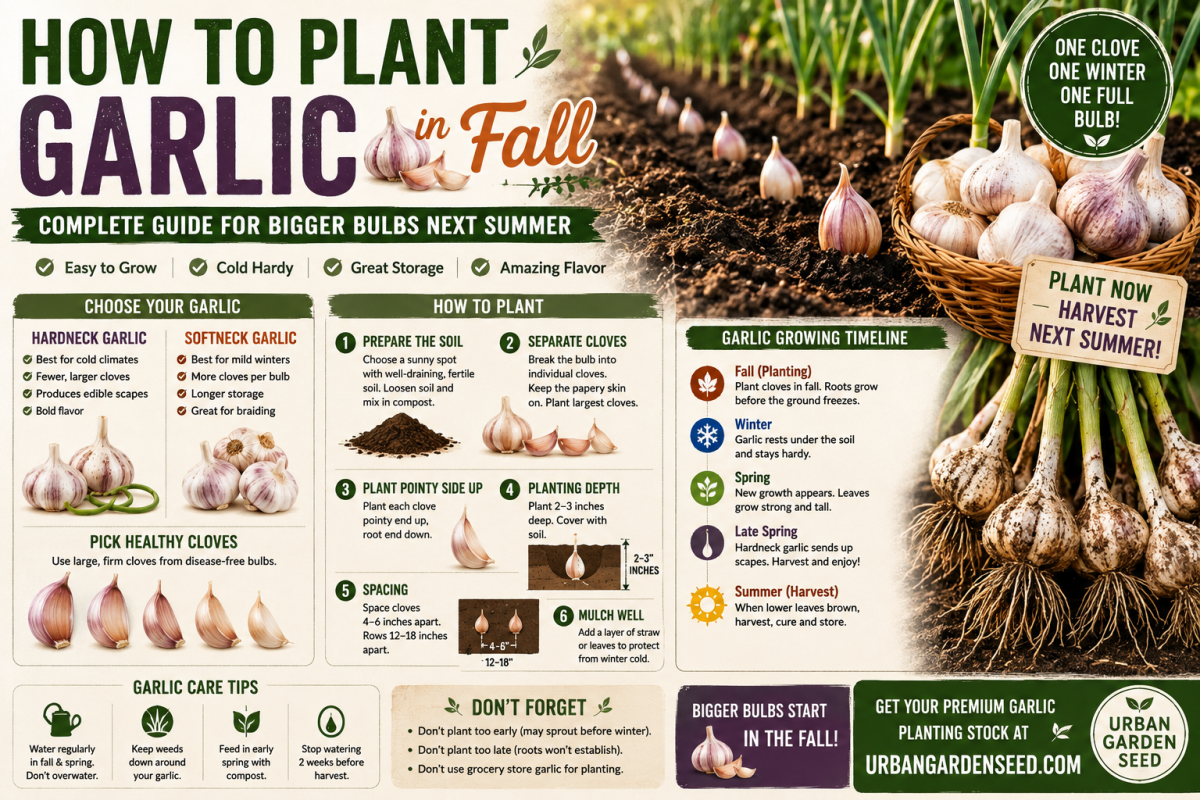
Plant individual garlic cloves in fall, allow them to establish roots before winter, and the plants resume vigorous growth when spring returns.
By early to midsummer, one clove can become an entire bulb.
That makes garlic one of the most rewarding crops for gardeners who are willing to think several seasons ahead.
And late summer is the ideal time to begin planning.
You need to choose the right garlic, prepare the soil, determine your local planting window, and get the cloves into the ground before winter.
This complete guide explains how to plant garlic in fall for backyard gardens, raised beds, homesteads, and larger growing areas throughout the United States.
Quick Answer: When Should You Plant Garlic?
For much of the United States, garlic is planted in fall, commonly from September through November depending on climate.
The goal is to plant late enough that the cloves do not produce excessive tender top growth before winter, but early enough for roots to establish before the ground freezes hard.
A useful rule is to plant several weeks before the soil becomes permanently frozen.
In regions with mild winters, garlic may be planted considerably later.
Do not rely on one nationwide calendar date.
Use:
- Your local frost pattern
- Soil temperature
- Regional Extension guidance
- Current weather
- Garlic type
Fall-planted garlic generally produces larger, better-developed bulbs than garlic planted too late in spring.
Why Is Garlic Planted in Fall?
Garlic has a growing cycle that works differently from tomatoes, peppers, beans, and many other familiar vegetables.
After fall planting, the clove begins developing roots.
Cold winter conditions provide the chilling many garlic varieties need for proper bulb formation.
When temperatures warm and days lengthen during spring, leaves grow rapidly.
Then the underground bulb begins expanding.
By summer, the plant has transformed one planted clove into a bulb containing multiple cloves.
Fall planting gives the plant months to prepare for that process.
Garlic “Seed” Usually Means Planting Cloves
This is an important distinction.
Most home gardeners do not grow ordinary garlic from botanical seed.
Garlic is normally propagated by planting individual cloves separated from a mature bulb.
The term seed garlic commonly refers to healthy garlic bulbs or cloves produced specifically for planting.
This is different from true botanical seed.
When shopping, determine exactly what the product contains.
For conventional garlic production, you normally plant cloves rather than the tiny seeds associated with ordinary seed-grown vegetables.
Do Not Automatically Plant Grocery-Store Garlic
A supermarket bulb may look perfectly healthy.
But grocery garlic is sold for eating, not necessarily for planting.
It may:
- Be poorly adapted to your climate
- Have been treated to reduce sprouting
- Carry diseases or pests
- Have unknown growing characteristics
For a long-term garlic bed, planting stock intended for cultivation is generally the better choice.
Healthy planting material is particularly important because certain garlic diseases can persist in garden soil.
Hardneck vs. Softneck Garlic
Before planting, understand the two major garlic groups.
Hardneck Garlic
Hardneck garlic develops a firm central stalk.
Many hardneck varieties are particularly well suited to colder winter climates.
They also produce one of garlic gardening’s best secondary harvests:
garlic scapes.
Scapes are curling flower stalks that emerge in late spring or early summer.
When harvested while tender, they can be used in:
- Stir-fries
- Pesto
- Soups
- Sauces
- Eggs
- Pasta
- Grilled dishes
Removing scapes can also redirect plant energy toward bulb development.
Hardneck bulbs generally contain fewer but larger cloves arranged around the central stalk.
Softneck Garlic
Softneck garlic does not normally form the same rigid central stalk.
It often produces more cloves per bulb.
Softneck garlic is particularly common in milder climates and is the type most often used for traditional garlic braids.
It also tends to store well.
Many commercial garlic bulbs sold in supermarkets are softneck types.
Which Garlic Should You Grow?
Choose based primarily on climate.
Cold-winter regions
Hardneck garlic is often an excellent choice.
Gardeners in northern states commonly grow varieties adapted to freezing winters.
Mild-winter regions
Softneck varieties may perform particularly well.
In warm climates where winter chilling is limited, variety selection becomes even more important.
Transition climates
Gardeners may be able to experiment with both groups.
The best approach is to select varieties known to perform in your region rather than choosing only by photograph or bulb color.
When to Order Garlic for Fall Planting
Do not wait until the exact week you want to plant.
Popular garlic varieties can sell out.
Late summer is a smart time to:
- Select varieties
- Order planting stock
- Test your soil
- Choose a planting location
- Prepare beds
- Collect mulch
You can store planting garlic appropriately until your local planting window arrives.
Planning early provides better variety selection.
How Much Garlic Should You Plant?
Each clove generally develops into one bulb.
That makes planning relatively straightforward.
If your household uses two bulbs of garlic every week, that equals more than 100 bulbs per year.
You do not need to grow your entire annual supply immediately.
Beginners might start with:
- 20 cloves
- 30 cloves
- 50 cloves
Then evaluate:
- Yield
- Storage quality
- Flavor
- Variety performance
- How much garlic the household actually consumes
Increase production the following year if desired.
Choose a Sunny Location
Garlic performs best with abundant sunlight.
Choose a location receiving approximately six or more hours of direct sun when possible.
Avoid deep shade.
Garlic needs enough energy during spring to produce substantial leaves.
Those leaves support the development of the underground bulb.
Weak top growth usually means reduced potential for large bulbs.
Garlic Needs Good Drainage
This is critical.
Garlic does not perform well in soil that remains waterlogged.
Cloves sitting in saturated soil can rot.
Choose soil that drains adequately after rain or snowmelt.
Raised beds can work particularly well for garlic because they often provide improved drainage.
If your garden has heavy clay, work on soil structure before planting.
Do not simply bury cloves in a wet compacted area and hope winter solves the problem.
Test the Soil Before Planting
Garlic occupies the garden for many months.
Preparing the soil correctly before planting is easier than trying to repair major fertility problems during spring growth.
A soil test can help determine:
- Soil pH
- Nutrient levels
- Amendment requirements
Garlic generally performs best in fertile soil containing adequate organic matter.
But do not assume adding enormous amounts of fertilizer or compost is always better.
Use soil-test recommendations where available.
Prepare the Bed
Before planting:
- Remove major weeds.
- Remove old crop debris where necessary.
- Address compaction.
- Correct serious drainage problems.
- Add required amendments.
- Smooth the planting area.
Garlic will occupy the space until summer.
You do not want perennial weeds becoming established between rows during that period.
Prepare thoroughly now.
How to Separate Garlic Cloves
Keep bulbs intact until relatively close to planting time.
When ready:
Gently separate the bulb into individual cloves.
Do not remove the papery skin surrounding each clove.
Choose the largest, healthiest cloves for planting.
Large cloves generally have more stored energy available for early development.
Set aside damaged, diseased, or extremely small cloves.
Those can be used in the kitchen if they are otherwise safe and healthy.
Which End Goes Up?
Every garlic clove has two distinct ends.
The broad, flatter base is where the roots develop.
The pointed end is where the shoot emerges.
Plant:
Point up.
Flat root end down.
Do not plant cloves sideways if you can avoid it.
They may still grow, but proper orientation allows the plant to develop more efficiently.
How Deep Should Garlic Be Planted?
A common planting depth is approximately 2 to 3 inches, measured from the top of the clove to the soil surface, although exact depth can vary with climate and soil.
Colder regions may use deeper planting combined with mulch for winter protection.
Milder climates may not require the same depth or insulation.
Follow regional recommendations.
The most important principles are:
- Completely cover the clove
- Maintain the correct orientation
- Avoid planting extremely shallowly
- Do not bury it excessively deep without reason
How Far Apart Should Garlic Cloves Be?
A practical spacing for many home gardens is approximately 4 to 6 inches between cloves.
Rows may be spaced farther apart depending on:
- Cultivation method
- Variety
- Equipment
- Garden size
Raised-bed gardeners can often use a grid pattern rather than conventional agricultural rows.
For example, cloves spaced approximately six inches apart in several directions can make efficient use of a rectangular bed.
Do not overcrowd garlic if your goal is large bulbs.
Every plant needs access to:
- Sunlight
- Moisture
- Nutrients
- Root space
A Simple 4 × 8-Foot Garlic Bed
A four-by-eight-foot raised bed can hold a substantial garlic crop.
At approximately six-inch spacing, you can create several rows containing dozens of plants.
That may be enough garlic for:
- Fresh summer cooking
- Fall and winter storage
- Seed garlic for next year
Keep the bed dedicated to garlic until harvest.
After harvest in summer, the same bed can be replanted with a suitable fall crop.
Mulch Garlic After Planting
Mulching is particularly valuable in regions with cold winters.
Possible mulch materials include:
- Clean straw
- Shredded leaves
- Other appropriate organic materials
Mulch can help:
- Moderate soil temperatures
- Reduce frost heaving
- Retain moisture
- Suppress weeds
- Protect the soil surface
The amount needed varies by climate.
Cold northern gardens may require considerably more winter protection than mild southern gardens.
What Happens During Winter?
After planting, garlic is not completely inactive.
Roots can begin developing before severe cold arrives.
Depending on climate and planting time, small green shoots may also appear.
Do not panic if some foliage emerges before winter.
The plant can often continue once spring returns.
The important activity is occurring underground.
The clove is establishing the foundation for next year’s plant.
What to Do in Early Spring
When spring arrives, inspect the bed.
Garlic shoots are often among the first green growth to appear.
If you used heavy winter mulch, you may need to adjust it depending on local climate and soil conditions.
Make sure emerging plants are not being excessively smothered.
Begin managing:
- Weeds
- Moisture
- Fertility
Spring is when garlic enters its most vigorous growth stage.
Healthy leaves are essential for producing large bulbs later.
Weed Garlic Carefully
Garlic does not compete particularly well with heavy weeds.
Keep the bed reasonably clean.
Mulch helps.
Hand weeding is often easiest in small gardens.
Avoid aggressive cultivation that damages garlic’s relatively shallow roots.
The objective is to remove competition without injuring the crop.
How to Water Garlic
Garlic benefits from consistent moisture during active spring growth.
Do not keep the bed saturated.
Instead, water deeply when necessary and allow drainage.
The most important period for adequate moisture is during leaf and bulb development.
As harvest approaches, watering is gradually reduced and eventually stopped.
This helps bulbs mature and cure properly.
Stop Watering Before Harvest
As the crop reaches maturity in early or midsummer, reduce irrigation.
A common practice is to stop watering roughly two weeks before harvest.
This allows bulb skins to begin drying and reduces excessively wet conditions around mature bulbs.
Local rainfall may make this harder to control.
The general goal is to avoid keeping mature garlic constantly wet immediately before harvest.
What Are Garlic Scapes?
Hardneck garlic sends up a curling stalk known as a scape.
The scape eventually becomes straighter and can form bulbils if allowed to mature.
For larger bulb production, many gardeners cut scapes while they are still young and curled.
Do not throw them away.
Scapes are edible.
Use them similarly to garlic-flavored vegetables.
They can be:
- Grilled
- Sautéed
- Pickled
- Blended into pesto
- Added to soups
- Chopped into eggs
That gives hardneck garlic two harvests:
Scapes first.
Bulbs later.
When Should You Harvest Garlic?
Do not wait until every leaf is completely brown.
Garlic is commonly ready when several lower leaves have browned but upper leaves remain partly green.
The exact timing depends on:
- Variety
- Climate
- Planting date
- Spring weather
Harvest often occurs from June through July in many U.S. regions.
If you wait too long, bulb wrappers may deteriorate and cloves can begin separating.
That reduces storage quality.
Test One Bulb First
Before harvesting the entire bed, dig one plant.
Do not simply pull it by the leaves.
Loosen the soil carefully with a garden fork or shovel placed far enough away to avoid cutting the bulb.
Inspect it.
A mature garlic bulb should have well-developed cloves beneath intact wrappers.
If the bulb still appears poorly segmented, give the remaining crop additional time.
Testing one plant is better than harvesting fifty too early.
Do Not Wash Garlic for Storage
After harvest, brush away large amounts of loose soil.
Avoid washing bulbs intended for long storage unless you have a specific reason and curing system.
The objective is to dry the plant.
Additional surface moisture works against that goal.
Handle fresh bulbs carefully.
Fresh garlic can bruise more easily than cured garlic.
How to Cure Garlic
Curing allows garlic to dry for storage.
After harvesting:
Keep bulbs with their stems and roots attached.
Arrange them in a dry, shaded, well-ventilated location.
Protect them from:
- Rain
- Strong direct sun
- Excessive humidity
Allow several weeks for curing.
Good airflow is essential.
Do not pile wet garlic into a sealed container.
How Do You Know Garlic Is Cured?
The outer wrappers should feel dry and papery.
The neck should become dry.
Roots should also dry.
Once cured:
Trim the roots.
Cut hardneck stems to an appropriate length.
Leave softneck tops longer if you intend to braid them.
Remove only the dirtiest loose outer wrappers.
Do not peel away all protective layers.
How to Store Garlic
Cured garlic stores best under conditions that are:
- Dry
- Well ventilated
- Appropriately cool
- Protected from direct sunlight
Storage life varies by variety.
Softneck garlic generally stores longer than many hardneck types.
Check bulbs periodically.
Remove any showing:
- Mold
- Softness
- Rot
- Severe sprouting
Use shorter-storing varieties first.
Save Your Best Bulbs for Replanting
One of the best parts of growing garlic is creating your own planting cycle.
At harvest time, set aside several of your:
- Largest
- Healthiest
- Best-formed
bulbs.
Store them appropriately.
In fall, separate those bulbs into cloves and plant them again.
Over time, you can continue growing garlic from your own harvest.
You can even select planting stock from plants that performed particularly well in your local conditions.
Do Not Replant Diseased Garlic
Only save planting material from healthy plants.
If a bulb shows suspicious rot, abnormal growth, or other disease symptoms, do not intentionally propagate it.
Garlic and onions can suffer from soilborne diseases that are difficult to eliminate once introduced.
Healthy planting material is worth protecting.
Can Garlic Grow in Containers?
Yes, provided the container is large and deep enough.
Use:
- Good drainage
- Quality growing medium
- Appropriate spacing
- Full sun
One tiny pot may not be practical for growing a meaningful garlic harvest.
Larger containers and grow bags provide more useful root volume.
Remember that containers experience colder winter temperatures around the roots than in-ground garden soil.
In very cold climates, extra protection may be necessary.
Can Garlic Grow in Raised Beds?
Absolutely.
Raised beds are excellent for garlic because they offer:
- Good drainage
- Loose soil
- Organized spacing
- Easy weed management
- Convenient harvesting
They also make it easy to dedicate one entire bed to a long-season crop.
After summer harvest, use the bed for:
- Fall lettuce
- Radishes
- Spinach
- Cover crops
- Another suitable succession crop
What Can You Plant With Garlic?
Garlic occupies its bed from fall into summer.
The simplest approach is often to give it dedicated space rather than trying to interplant aggressively.
Low-growing, shallow-rooted plants may sometimes share bed edges.
But avoid crowding garlic with vigorous crops that compete heavily for:
- Water
- Nutrients
- Sunlight
Your objective is to grow large bulbs.
Give garlic room.
What Should You Plant After Garlic?
Garlic harvest opens up valuable garden space during summer.
Depending on region, you may follow it with:
- Bush beans
- Cucumbers
- Zucchini
- Lettuce
- Radishes
- Beets
- Kale
- Fall carrots
- Cover crops
Choose based on remaining growing season.
This is one of the easiest ways to increase annual garden production.
One bed.
Two crops.
Common Garlic Growing Mistakes
Planting too early
Excessive top growth can develop before winter.
Planting too late
Roots may not establish adequately before the ground freezes.
Planting the clove upside down
The pointed end belongs up.
Using unhealthy planting stock
Diseases can follow the garlic into the soil.
Growing in deep shade
Weak foliage means less energy for bulb production.
Planting in waterlogged soil
Cloves and roots can rot.
Overcrowding
Bulbs need space.
Ignoring weeds
Garlic competes poorly with heavy weed growth.
Watering heavily near harvest
Mature bulbs need to begin drying.
Harvesting too late
Wrappers can deteriorate and bulbs may split.
Skipping curing
Freshly dug garlic does not have the same storage ability as properly cured bulbs.
Garlic Growing Timeline
August
Research varieties.
Order planting stock.
Choose the garden location.
Test soil if necessary.
September–November
Plant according to your regional conditions.
Mulch where needed.
Winter
Roots establish.
Growth slows or becomes dormant.
Early Spring
Shoots grow rapidly.
Manage weeds, moisture, and fertility.
Late Spring
Hardneck garlic produces scapes.
Harvest scapes while tender.
Early to Midsummer
Watch lower leaves.
Reduce watering.
Test a bulb.
Harvest when mature.
After Harvest
Cure garlic.
Store bulbs.
Select the best bulbs for fall replanting.
Then the cycle begins again.
Why Garlic Belongs in a Food Garden
Garlic gives gardeners an unusually high amount of usefulness from relatively little growing space.
It is used in cuisines around the world.
One bulb can flavor many meals.
Properly cured garlic can store for months.
Hardneck varieties can also provide edible scapes.
And because the crop grows primarily from fall through early summer, it fits neatly into crop rotations that leave the bed available for another planting after harvest.
For gardeners interested in:
- Food production
- Homesteading
- Self-sufficiency
- Storage crops
- Kitchen gardening
garlic deserves serious consideration.
Start Planning Before Fall Arrives
The mistake many gardeners make is remembering garlic after winter has already begun.
Do not wait.
Use late summer to decide:
Which type you want.
How many bulbs you need.
Where the bed will go.
How you will improve the soil.
What mulch you will use.
When your local planting window begins.
Then when fall arrives, the job is simple.
Separate the cloves.
Plant them point up.
Cover the soil.
And wait.
Next summer, you may pull an entire basket of garlic from a bed that looked almost empty all winter.
That is one of gardening’s best long-term rewards.
Why Choose Urban Garden Seed?
Urban Garden Seed offers vegetable, flower, herb, fruit, tree, and specialty planting selections for growers throughout the United States.
When choosing garlic or any other crop, review the individual product carefully to determine:
- Whether it is true seed, bulb, or planting stock
- Variety
- Growing requirements
- Regional suitability
- Planting method
For conventional garlic production, healthy cloves or planting garlic are the standard starting material.
Use quality planting material.
Prepare the bed properly.
Plant at the correct time.
Then let the seasons do their work.
Ready to Prepare Your Fall Garden?
Visit UrbanGardenSeed.com to explore vegetable, herb, flower, and specialty selections for fall and future growing seasons.
Plan now.
Plant when the soil is ready.
Harvest next summer.
One clove. One winter. One full bulb.
Frequently Asked Questions
When should garlic be planted?
Garlic is generally planted during fall, commonly from September through November depending on climate. Planting several weeks before the ground freezes hard allows roots to establish.
Can garlic be planted in September?
Yes. September can be an appropriate planting month in colder regions. Gardeners in milder areas may need to wait until October or November.
Can garlic be planted in November?
Yes in many regions, particularly where winter arrives later. Local soil and frost conditions determine the best date.
How deep should garlic cloves be planted?
A common guideline is approximately two to three inches deep, although local recommendations may vary with climate and soil.
How far apart should garlic be planted?
Approximately four to six inches between cloves is common in home gardens.
Which side of a garlic clove goes up?
Plant the pointed tip upward and the flatter root end downward.
Is hardneck or softneck garlic better?
Neither is universally better. Hardneck types are often favored in colder climates, while softneck garlic commonly performs well in milder regions and usually stores longer.
Can I plant supermarket garlic?
It may grow, but planting stock specifically intended for cultivation is preferable because grocery garlic may be poorly adapted locally or carry diseases.
Does garlic need full sun?
Garlic performs best with abundant direct sunlight, ideally roughly six or more hours per day.
Does garlic need mulch?
Mulch is particularly useful in cold-winter climates because it moderates soil temperature and helps reduce frost heaving.
When do you harvest garlic?
Garlic is generally harvested in early to midsummer when several lower leaves have browned while upper leaves remain partly green.
What are garlic scapes?
Scapes are curling flower stalks produced by hardneck garlic. They are edible and are commonly harvested while young.
How long should garlic cure?
Garlic generally needs several weeks in a dry, shaded, well-ventilated location before long-term storage.
Can I replant garlic from my harvest?
Yes. Save large, healthy bulbs and plant individual cloves again the following fall.
Can garlic grow in raised beds?
Yes. Raised beds can provide the loose, well-drained soil that garlic prefers.
Can garlic grow in containers?
Yes, if containers provide adequate depth, spacing, drainage, sunlight, and winter protection where needed.
