
Adenium, Backyard Gardening, Cactus & Succulent, Family & Kids' Gardening, Garden Planning & Design, Herb Seeds, Homesteading & Self-Reliance, Sensory & Wellness Gardening, Sustainable & Regenerative Living, The Horticulturist’s Lab, Urban & Small-Space Gardening, Vegetables
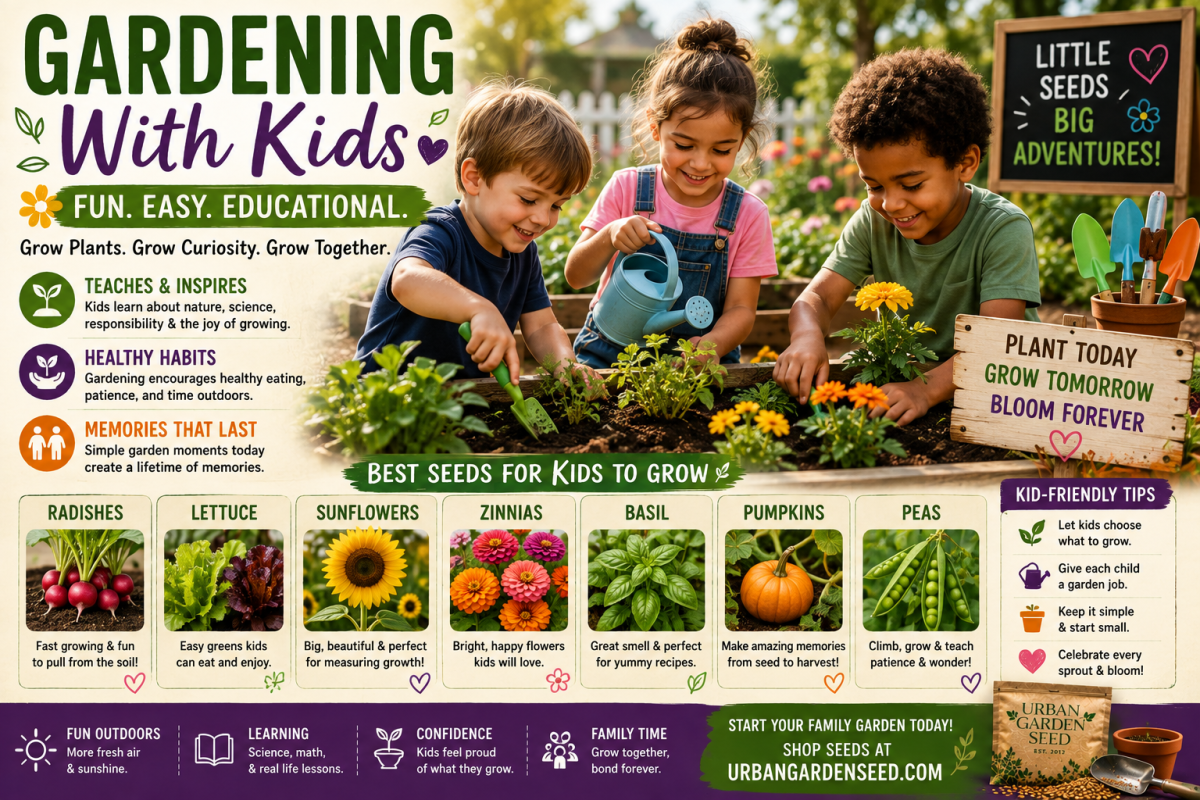
Gardening With Kids: Easy Seeds, Fun Projects & a Complete Family Garden Guide
Aug
A packet of seeds can become much more than a garden.
For a child, it can become a science experiment, a responsibility, an outdoor adventure, a first harvest, and sometimes the beginning of a lifelong interest in growing food and flowers.
Gardening with kids does not require a farm, a greenhouse, expensive equipment, or years of experience.
A family can begin with one container of radishes.
A classroom can grow sunflowers.
A grandparent can plant zinnias with a grandchild.
A homeschool family can turn germination into a science lesson.
A backyard garden can become a place where children see exactly where vegetables come from.
The most important thing is to make the first experience achievable.
Children are much more likely to stay interested when they can see something happening.
That is why choosing the right seeds matters.
Why Gardening Is Such a Good Family Project
Gardening brings together several activities that children naturally enjoy.
There is dirt to dig.
Seeds to count.
Water to pour.
Plants to measure.
Insects to discover.
Flowers to watch.
Vegetables to harvest.
And unlike many activities, the project changes every week.
A seed disappears beneath the soil.
A few days later, something green appears.
Leaves unfold.
Roots grow.
Flowers open.
Eventually, food or seeds may be harvested.
The garden becomes a living lesson that cannot be recreated quite the same way on a screen.
It also allows adults and children to work on something together without needing the child to understand everything first.
They learn by participating.
Start Small Instead of Building the Perfect Garden
One of the easiest ways to make gardening frustrating for children is to make the first garden too complicated.
You do not need fifteen raised beds.
You do not need twenty varieties of tomatoes.
You do not need a professional irrigation system.
Start with a project that can succeed.
A container, one small garden bed, or a sunny section of the backyard is enough.
Choose several reliable plants, give each child something they can call their own, and allow the garden to expand as their confidence grows.
The first objective is not maximum food production.
The first objective is to make growing something feel possible.
Choose Seeds That Give Children Visible Progress
Adults may happily wait months for a rare perennial to germinate.
Most children prefer quicker feedback.
Fast-growing crops are useful because the child can observe changes frequently.
Radishes are an excellent example. Their seedlings emerge relatively quickly, their leaves become easy to recognize, and the final harvest is hidden underground until the root is pulled from the soil.
That moment of discovery is part of the fun.
Leaf lettuce is another practical choice because children can watch leaves grow and eventually harvest food that looks familiar.
Green onions, arugula, kale, and other leafy crops can also work well when grown during the appropriate season.
The lesson is simple: begin with plants that reward attention.
Radishes Make an Excellent First Vegetable
Radishes are particularly well suited to beginner family gardens.
They do not require a huge amount of space, can be grown in beds or suitable containers, and provide an obvious harvest.
Children can help make a shallow planting row, space the seeds, water the soil, and watch the leaves emerge.
When harvest time arrives, let the child pull the radish.
The vegetable appearing from beneath the soil turns an ordinary harvest into an event.
Afterward, cut one open together.
Compare its color, smell, texture, and taste.
The gardening project has now become a food lesson as well.
Lettuce Creates a Garden Children Can Eat From
Lettuce works especially well for families that want a garden connected directly to meals.
Instead of telling children that vegetables come from a supermarket bag, they can walk outside and see the leaves growing.
Leaf lettuce can be particularly rewarding because the garden does not always need to wait for a single mature head.
Appropriate varieties can be harvested progressively.
Let children help wash the leaves and use them in a sandwich, taco, wrap, or salad.
The connection between seed and dinner becomes clear.
Bush Beans Give Kids Something Big to Plant
Tiny seeds can be difficult for young hands.
Beans are different.
Bean seeds are large enough for children to see and handle easily, making planting more straightforward.
Bush beans can also avoid the need for the tall structures required by many climbing varieties.
Children can observe the plant developing true leaves, flowers, and eventually pods.
The progression is easy to follow.
Beans are also useful for simple germination experiments because their size makes the emerging root and shoot easier to observe than many tiny seeds.
Sunflowers Turn the Garden Into a Measuring Project
Few plants communicate growth as dramatically as sunflowers.
What begins as one seed can eventually become a plant taller than the child who planted it.
That makes sunflowers perfect for a garden journal.
Measure the plant once a week.
Record the height.
Count new leaves.
Photograph the changes.
Watch the flower head develop.
Later, observe visiting insects and birds.
A sunflower is not simply a flower project.
It can become a seasonal science project.
Make sure you choose a sunflower variety whose mature height and growing requirements fit the available space.
Not every sunflower is a giant.
That gives families options for both large yards and containers.
Zinnias Bring Fast Color to a Children’s Flower Garden
Children often respond strongly to color.
Zinnias can transform an ordinary garden bed into a bright collection of flowers.
They are available in many colors, shapes, and sizes, allowing children to choose varieties based on appearance.
That choice matters.
When children participate in deciding what to grow, the garden feels more like their project.
Once the plants bloom, children can observe bees, butterflies, and other flower visitors.
Flowers can also be cut for supervised indoor arrangements.
The child gets to experience both the growing process and the reward.
Marigolds Fit Easily Into Vegetable and Flower Beds
Marigolds are useful when you want a child-friendly garden to contain both food and flowers.
Their bright yellow, orange, and red tones create quick visual impact.
They can be planted along vegetable beds, in containers, or in dedicated flower areas.
Let children compare different flower shapes or colors.
Ask them which plants attract the most insects.
Have them count flower buds.
Simple observations turn garden maintenance into exploration.
Basil Connects the Garden to the Kitchen
Basil is a good choice for children because touching the leaves releases a recognizable fragrance.
Smell makes the gardening experience more sensory.
Children can compare basil with other herbs and learn that plants are not identified only by how they look.
Once mature enough to harvest, basil can move directly into the kitchen.
Use it on pizza, pasta, sandwiches, sauces, or other family meals.
A child who helped plant and harvest the basil can see exactly how something from the garden becomes an ingredient.
Pumpkins Turn Gardening Into a Long-Term Adventure
Pumpkins require more time and considerably more growing space than radishes or lettuce, but they can be memorable for children.
A pumpkin project develops over an entire season.
First comes the seed.
Then vines.
Then flowers.
Then tiny fruits.
Finally, the pumpkins enlarge and change color.
Children can measure circumference, compare fruits, photograph development, and eventually harvest them.
If your garden does not have enough room for sprawling vines, choose another crop rather than forcing pumpkins into an unsuitable space.
The best children’s garden is one designed around the property you actually have.
Peas Make Vertical Gardening Interesting
Peas introduce children to climbing plants.
Give them an appropriate trellis and let them observe how the vines use their tendrils to attach to supports.
The growing direction itself becomes a lesson.
Peas also demonstrate an important gardening concept: plants prefer different seasons.
While tomatoes and peppers thrive during warmer periods, peas generally prefer cooler growing conditions.
Children begin learning that a garden changes throughout the year.
Carrots Teach Patience
Carrots are useful for teaching a very different lesson.
Most of the exciting part is happening underground.
Above the soil, children see feathery leaves.
Below it, the root gradually develops.
Harvest day reveals whether the carrot is long, short, straight, forked, tiny, or enormous.
Not every carrot needs to look perfect.
In fact, unusual carrots often make the project more entertaining.
Carrots do best when their soil and container depth are appropriate for the variety.
Nasturtiums Combine Flowers and Edible Gardening
Nasturtiums can help children understand that categories such as “flower” and “food” sometimes overlap.
Their bright flowers add visual interest, and suitable plant parts are edible.
For families growing edible flowers, adults should always positively identify the plant and supervise what children taste.
Never teach children to eat a flower simply because it looks familiar.
Identification comes first.
Give Each Child a Garden Job
Children tend to become more invested when they have a real responsibility.
One child might be responsible for checking moisture.
Another can measure sunflowers.
Another can record the first day each crop germinates.
Another can count flowers or harvested vegetables.
Jobs should match the child’s age and ability.
The objective is not perfect garden management.
It is participation.
Adults should remain responsible for tasks involving fertilizers, garden chemicals, sharp tools, heavy equipment, or anything else requiring mature judgment.
Create a Garden Journal
A garden journal turns one season into a record children can revisit later.
Young children can draw pictures.
Older children can write dates, measurements, weather observations, and harvest totals.
Record when seeds were planted.
Note when the first seedling appeared.
Draw the first true leaves.
Measure a sunflower.
Count tomatoes.
Press a fallen flower.
Write down which vegetable tasted best.
By the end of the season, the journal tells the story of the garden.
The next year, children can compare results.
That introduces them to experimentation.
Turn Germination Into a Science Experiment
A simple germination experiment can show children what happens before a seedling appears from the ground.
Use suitable untreated seeds, a moist medium, and a transparent setup that allows children to observe the early root and shoot.
Beans and other larger seeds are particularly easy to observe.
Compare seeds given different amounts of light or moisture, but avoid deliberately creating unsafe moldy conditions.
Ask children to make predictions first.
Which seed will germinate?
Which one will grow fastest?
Then observe what actually happens.
Science becomes something they can see.
Build a Pollinator Observation Station
A flowering garden can become a wildlife-observation project.
Instead of simply telling children that pollinators visit flowers, let them watch.
Spend ten minutes near the flower bed and count visitors.
Do they see bees?
Butterflies?
Hoverflies?
Beetles?
Hummingbirds in suitable regions?
Compare which flowers receive the most activity.
Teach children to observe insects without grabbing or disturbing them.
The garden becomes a place to learn respect for living things.
Make a Pizza Garden
One way to keep children interested is to organize plants around food they already enjoy.
A “pizza garden” might include tomatoes, basil, peppers, and other suitable ingredients.
The point is not that every ingredient in pizza must be grown at home.
The point is creating a connection between familiar food and living plants.
When harvest arrives, use part of it together.
Children can see their garden move from soil to table.
Try a Rainbow Garden
Color is another easy theme.
Grow vegetables and flowers in different colors.
Red tomatoes.
Orange marigolds.
Yellow sunflowers.
Green lettuce.
Purple beans or flowers.
The exact crops depend on climate and variety, but the concept gives children a goal: produce as many garden colors as possible.
This also encourages families to explore varieties beyond the most familiar supermarket choices.
A Back-to-School Garden Can Start in Late Summer
Gardening with children is not limited to spring.
Late summer and fall can provide excellent opportunities for cool-season crops in many parts of the United States.
Depending on local climate and frost timing, families may consider crops such as radishes, lettuce, kale, peas, spinach, green onions, or other cool-season vegetables.
A school or homeschool project can follow a crop from late-summer sowing through fall harvest.
In warmer parts of the country, fall may be one of the most productive gardening periods of the year.
Always use local planting guidance rather than relying on one national date.
Children Can Garden Without a Backyard
A children’s garden can fit almost anywhere appropriate sunlight and safe access are available.
A few containers can hold lettuce, herbs, radishes, flowers, or other compact crops.
This is useful for families living in apartments, rental properties, townhomes, or homes where permanent beds are not practical.
Containers also make it easy to assign one child their own pot.
Just make sure every container has appropriate drainage and enough root space for the plant being grown.
Safety Matters
Gardening with children should always be supervised appropriately.
Very young children may put seeds, soil, plants, or other materials in their mouths.
Some plants and seeds are toxic.
Some commercial seeds may be treated with chemical coatings.
Some garden products should never be handled by children.
Use clearly identified seeds and plants.
Read labels.
Store fertilizers, pesticides, tools, and other potentially hazardous materials securely.
Teach children that they should never eat any plant, berry, seed, mushroom, or flower unless a responsible adult has specifically identified it as safe and edible.
Gardening should encourage curiosity, but curiosity works best with good boundaries.
Let Children Choose Some of the Seeds
Adults naturally want to design the most efficient garden.
Children often care about entirely different things.
They may want the tallest sunflower.
A purple carrot.
The brightest zinnia.
A pumpkin.
A flower shaped differently from anything they have seen.
Give them some choices.
The garden is more powerful when it reflects their curiosity.
You can still guide the final selection based on climate, season, mature size, and available space.
Why Starting From Seed Works So Well for Children
Buying a mature plant teaches children how to care for a plant.
Starting from seed teaches the entire process.
They see something that looks dry and inactive become a living organism.
They learn that growth takes time.
They learn that water can help—but too much water can hurt.
They discover that different plants germinate at different speeds.
They experience failure and try again.
And when the plant finally flowers or produces food, the result feels earned.
Choosing Seeds for a Family Garden
For a first project, prioritize plants that are appropriate for your climate, manageable in your available space, and rewarding enough to hold a child’s attention.
A good family garden might combine a quick crop, a flower, an herb, and one longer-term vegetable.
For example, radishes provide an early harvest while sunflowers create height and drama, basil brings fragrance and kitchen use, and pumpkins or tomatoes become longer seasonal projects.
That balance means something interesting is happening throughout the season.
Why Families Shop Urban Garden Seed
Urban Garden Seed offers vegetable, flower, herb, fruit, tree, and specialty seeds for gardeners with many different goals.
For family gardening projects, customers can choose among beginner-friendly vegetables, colorful flowers, culinary herbs, and unusual varieties that can make a child’s garden feel more exciting.
Urban Garden Seed currently offers Non-GMO seed choices, untreated seeds, multiple seed categories, and a 30-Day Satisfaction Guarantee.
For gardening with children, untreated seeds can be particularly useful when parents prefer to avoid chemically coated seed products.
Always review the individual product description and growing instructions before planting.
Start With One Seed
A child does not need to understand botany before becoming interested in gardening.
Start with one seed.
Put it into the soil.
Add water.
Watch.
Wait.
Then return tomorrow.
That simple process teaches one of gardening’s most valuable lessons:
Good things can begin very small.
Whether you are a parent, grandparent, teacher, homeschooler, or first-time gardener, creating a garden with a child can turn an ordinary growing season into something they remember for years.
Visit UrbanGardenSeed.com to explore vegetable, herb, flower, fruit, and specialty seeds for your next family gardening project.
Plant together. Learn together. Grow together.
